A Mineral Family in Many Colors
Tourmaline
Borosilicate mineral supergroup / black tourmaline focus
Borosilicate mineral supergroup with multiple species and color varieties
Loading this page…
Return homePlease wait while the next page arrives.


A Mineral Family in Many Colors
Borosilicate mineral supergroup / black tourmaline focus
Borosilicate mineral supergroup with multiple species and color varieties
Tourmaline encompasses a family of boron-bearing silicate minerals rather than a single composition.
Geology · Human history · Spiritual attributes
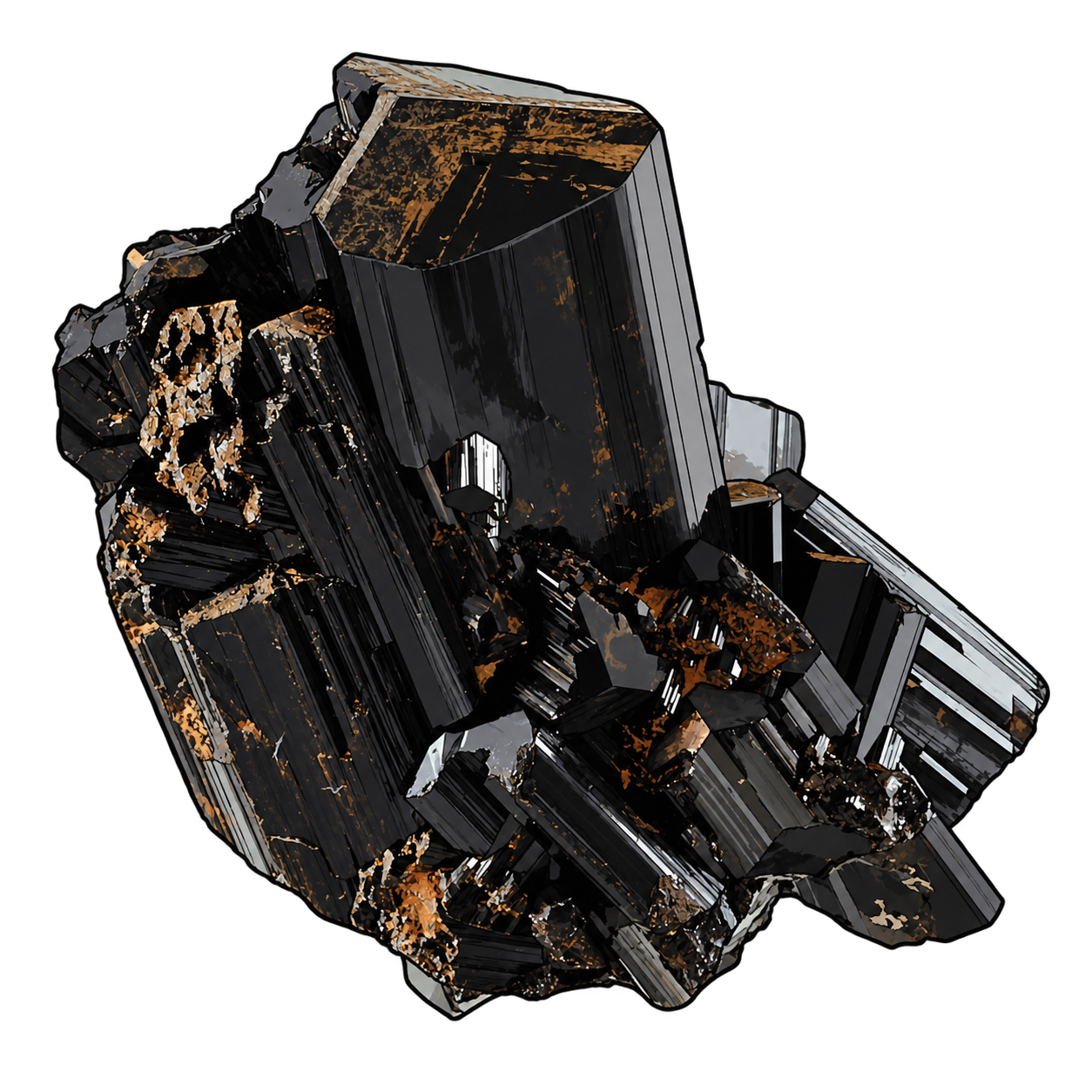
Tourmaline encompasses a family of boron-bearing silicate minerals rather than a single composition. Its members include familiar black crystals, delicate pink gems and transparent green or blue stones. Some crystals preserve contrasting colors within one piece, making their internal growth patterns as compelling as their external shape. [1–4]
Modern crystal meanings vary with color and practice. Black tourmaline is commonly associated with protection and grounding; green tourmaline is more often linked with compassion, growth and heart-centered reflection. The Crystal Council presents these as distinct spiritual correspondences rather than one uniform meaning for every member of the family. [5, 6]
These associations can guide a personal ritual or choice of jewelry. They do not establish that a crystal removes toxins, treats emotional illness or shields its wearer from electronic devices. Tourmaline's measurable electrical properties are a separate subject from spiritual interpretations.
Mineral class: Borosilicates Crystal symmetry: Trigonal; commonly described within the hexagonal crystal family Typical habit: Prismatic, often with lengthwise striations Mohs hardness: About 7–7.5 Cleavage: Very poor in common species Fracture: Uneven to conchoidal Luster: Vitreous, sometimes resinous Composition and density: Species-dependent [2–4, 7]
Schorl is an iron-rich tourmaline, typically black, with idealized formula NaFe²⁺₃Al₆(BO₃)₃Si₆O₁₈(OH)₄. The Handbook of Mineralogy records a measured density of approximately 3.18–3.22 for schorl. Its dark appearance does not make it a separate class of material from brightly colored tourmalines; it shares their structural family. [3]
Elbaite contains lithium and aluminum in positions occupied differently by other tourmalines. Its simplified formula is Na(Al,Li)₃Al₆(BO₃)₃Si₆O₁₈(OH)₄. It supplies a wide range of transparent colored gems and commonly displays zoning. The handbook reports measured densities of approximately 2.90–3.10, illustrating why a single density cannot represent all tourmaline. [2]
Dravite is the magnesium-rich member represented by NaMg₃Al₆(BO₃)₃Si₆O₁₈(OH)₄. It is often brown, but documented colors extend well beyond brown. Its compositions form series with other members, so a visual color name is not a substitute for mineralogical analysis. [4]
Zoning means that different parts of a crystal have different colors. Watermelon tourmaline has a pink center and a green outer zone, often displayed in cross-sectional slices. An elongated bicolored crystal may instead change color along its length. Trade terms include rubellite for red-to-pink material and indicolite for blue material; usage at the boundaries is not completely uniform. [1]
Pleochroism is a change in apparent color with viewing direction caused by direction-dependent absorption. It can occur even within one compositionally uniform zone. In a cut stone, internal reflections complicate the light path, so a facet can show a different balance of colors from its neighbor. A cutter therefore considers both the colored regions in the rough and the optical direction through them. [8]
The handbook records piezoelectric and pyroelectric behavior in common tourmaline species: electrical polarization can change with mechanical stress or temperature. These physical responses do not mean a specimen is a battery, nor do they demonstrate the wellness or protective effects sometimes attached to crystal marketing. Heating or striking a valuable crystal is not an appropriate way to explore the phenomenon. [2–4]
Elbaite is characteristic of granite pegmatites, where it can occur with quartz, albite, mica, beryl and other minerals. Documented localities include Elba, Brazil, Afghanistan, Pakistan, Madagascar and parts of the United States. Individual cavities within the same deposit can produce markedly different specimens. [1, 2]
Schorl has a wider geological range, occurring in granitic rocks and pegmatites, high-temperature veins and some metamorphic rocks. Resistant grains can also survive into sediments. Dravite commonly occurs in metamorphosed limestones or mafic rocks affected by boron-bearing fluids; it is less characteristically a pegmatite mineral. These settings help explain why not every tourmaline specimen resembles a transparent pink pegmatite crystal. [3, 4]
PARAÍBA: COLOR AND ORIGIN
Paraíba tourmaline owes its distinctive saturated blue-to-green appearance principally to copper, with manganese also relevant to the accepted trade definition. The name originated with Brazilian discoveries in the late 1980s, but qualifying material also comes from Nigeria and Mozambique. It is not a guarantee of Brazilian origin. [9]
GIA's geographic-origin research uses quantitative trace-element measurements compared with known-source samples. Ordinary appearance and standard gemological properties cannot reliably establish which of those countries supplied a stone. For an expensive purchase, distinguish three questions: is it tourmaline, does it meet the Paraíba definition, and what evidence supports its stated origin? A vivid photograph cannot answer all three.
Tourmaline's color range contributed to historical confusion with other gems. GIA traces its name to a Sinhalese term associated with mixed gems and describes Dutch merchants using it for material from Sri Lankan gravels. Color alone was an unreliable guide to identity before modern mineralogical methods. [10]
In the late nineteenth and early twentieth centuries, pink and red tourmaline connected California mines with Chinese workshops. GIA records demand associated with Empress Dowager Cixi and the use of the material for carvings and jewelry. The disruption of that market after the fall of the Qing government affected California production. This is a specific commercial history, not evidence that every modern spiritual meaning is ancient. [10]
View a zoned or strongly directional stone from several angles. Decide whether you prefer an even face-up color, visible transitions or an intact natural prism. For specimens, check terminations and joins for repairs; for jewelry, inspect surface-reaching fractures and exposed edges. Species, variety, treatment and locality are different parts of a good description.
Heating and irradiation are established color treatments. GIA notes that irradiated colors can be vulnerable to strong light or heat, while excessive heat and thermal shock can damage tourmaline generally. Ask for known treatments to be disclosed rather than assuming that a natural mineral must retain an untreated color. [7]
Clean with lukewarm soapy water and a soft brush, then rinse and dry. Avoid steam and ultrasonic cleaners. Although relatively resistant to scratches, tourmaline has only fair toughness: protect long prisms, thin slices and ring stones from knocks, and store them separately from other jewelry. [7]
gia.edu · Reference for the accompanying text · Reference recorded October 15, 2026
handbookofmineralogy.org · Reference for the accompanying text · Reference recorded October 15, 2026
handbookofmineralogy.org · Reference for the accompanying text · Reference recorded October 15, 2026
handbookofmineralogy.org · Reference for the accompanying text · Reference recorded October 15, 2026
thecrystalcouncil.com · Reference for the accompanying text · Reference recorded October 15, 2026
thecrystalcouncil.com · Reference for the accompanying text · Reference recorded October 15, 2026
gia.edu · Reference for the accompanying text · Reference recorded October 15, 2026
gia.edu · Reference for the accompanying text · Reference recorded October 15, 2026
gia.edu · Reference for the accompanying text · Reference recorded October 15, 2026
gia.edu · Reference for the accompanying text · Reference recorded October 15, 2026