A Coarse-Grained Igneous Rock
Gabbro / Indigo Gabbro
Gabbro is a coarse-grained mafic igneous rock; indigo gabbro is a trade label.
Coarse-grained mafic intrusive igneous rock
Loading this page…
Return homePlease wait while the next page arrives.


A Coarse-Grained Igneous Rock
Gabbro is a coarse-grained mafic igneous rock; indigo gabbro is a trade label.
Coarse-grained mafic intrusive igneous rock
Gabbro is a dark, coarse-grained rock formed as mafic magma crystallizes below the surface.
Geology · Human history · Spiritual attributes
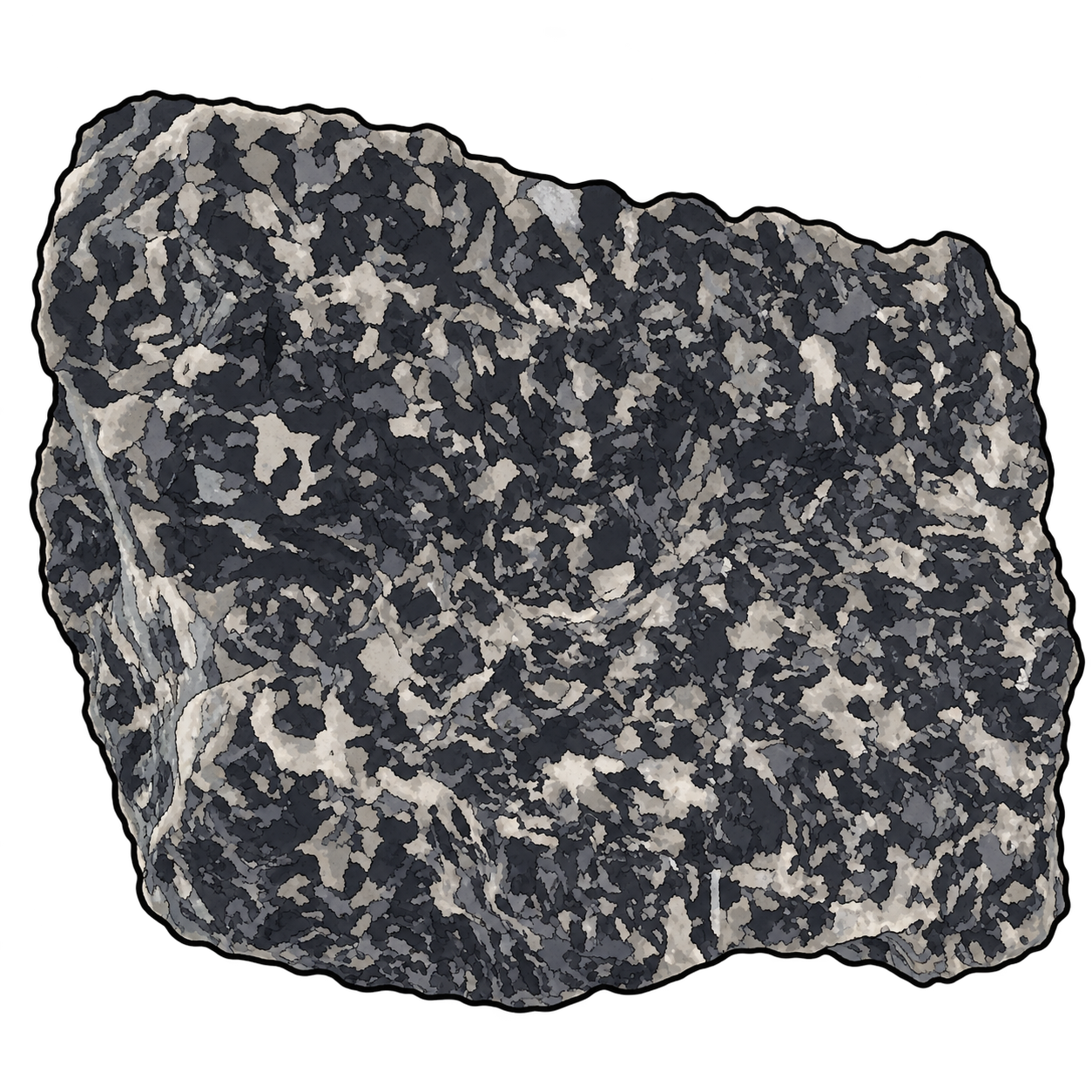
Plagioclase-rich mafic igneous rock, commonly with pyroxene and sometimes olivine [1][2][3][4][5][6]
Dark, coarse-grained and mottled; pale grains contrast with darker constituents [1][2][3][4][5][6]
Introspection · Inner vision · Self-discovery · Renewed perspective [3]
Gabbro is a dark, coarse-grained rock formed as mafic magma crystallizes below the surface. Its pale feldspar and darker minerals form a visible mosaic: a polished sphere contains many interlocking crystals, not one crystal enlarged to ornamental size. Collectors may encounter both geological specimens and material marketed as indigo gabbro or Mystic Merlinite. The trade name should accompany, rather than substitute for, an identification of the actual rock. [1, 2, 3]
The spiritual associations commonly offered for ornamental gabbro concern the material sold as indigo gabbro or Mystic Merlinite. Contemporary practitioners regard it as a meditation stone for exploring inner experience and reconsidering habitual priorities. These are modern interpretations, not evidence that all gabbro shares an ancient ceremonial tradition. [3]
Classification: Coarse-grained, mafic intrusive rock Typical constituents: Calcium-rich plagioclase and pyroxene; olivine and accessory minerals vary Crystal system: No single system applies to the aggregate Texture: Interlocking crystals visible without high magnification Color: Commonly dark gray, black or dark green with lighter grains Hardness and density: Variable with the mineral assemblage and alteration Transparency: The whole rock is normally opaque, although some individual grains transmit light in thin section [1, 2]
“Mafic” describes a composition relatively enriched in magnesium and iron compared with felsic rocks such as granite. “Coarse-grained” describes texture. Both are needed: dark color alone cannot distinguish gabbro from every other igneous rock. Basalt can have broadly similar chemistry but a much finer texture because its cooling history differs. [1, 2]
Plagioclase is a feldspar series rather than one fixed chemical composition. The calcium-rich members characteristic of many gabbros contrast with darker pyroxenes. Augite, a common pyroxene, has Mohs hardness approximately 5.5–6 and good cleavage. Anorthite, the calcium-rich feldspar end-member, has hardness about 6–6.5 and its own cleavage directions. These constituent properties explain why a polished rock can reflect and wear differently from grain to grain; they are not a measured hardness for every gabbro carving. [4, 5]
Under a hand lens, follow the boundaries between adjacent grains. Their shapes, relative sizes and intergrowths provide information that a simple color description misses. A uniformly smooth polished face can disguise those boundaries; angled illumination often makes them easier to see. Rust-colored alteration, fractures and filled cavities should be described separately from the original mineral mosaic.
Gabbro crystallizes below ground, in both continental intrusions and deeper oceanic crust. [2]
Minnesota's Duluth Complex formed during the Midcontinent Rift about 1.1 billion years ago. Plagioclase, pyroxene and olivine vary between its rocks, which also host copper, nickel and platinum-group mineralization. [1]
Ocean drilling reveals additional complexity. During IODP Expedition 345 at Hess Deep, researchers described several related gabbroic rock types, including olivine gabbro and gabbronorite. Some contained large pyroxene crystals enclosing smaller grains, while other sections showed layering and later alteration. These observations show that a magma body is not necessarily a uniform tank that solidifies into identical rock from top to bottom. [6]
Anorthosite, also present in the Duluth Complex, differs by its overwhelming proportion of plagioclase. [1]
Gabbro is used far beyond small decorative objects. The Geological Society lists flooring, worktops, facing stone, monuments and sea defenses among its applications. Different uses demand different tests: an ornamental palm stone is selected chiefly for appearance and finish, whereas a large exterior block must satisfy engineering and weathering requirements. [7]
For geologists, the sequence of minerals and their relationships can record crystallization, deformation and fluid alteration. The Hess Deep drilling reports distinguish original magmatic textures from subsequent changes rather than treating every visible feature as part of the initial cooling event. A collection specimen with a trustworthy locality record can therefore be a small sample of a much larger geological investigation. [6]
Look at the entire object in ordinary light. If a seller emphasizes a blue or violet flash, request a short rotation video to establish how strongly the appearance depends on angle. Evaluate the polish, cracks, pits and boundaries between contrasting grains. A photographed highlight should not be mistaken for a continuous body color.
For a scientific collection, prioritize a precise locality and material identification. For a carving, prioritize structural soundness and workmanship as well as pattern. Ask about coatings, stabilization and repaired joins. Do not use a pocket scratch test to authenticate a valuable finished piece: one mark may sample only one mineral and damage the polish without identifying the rock.
cse.umn.edu · Reference for the accompanying text · Reference recorded October 15, 2026
geology.com · Reference for the accompanying text · Reference recorded October 15, 2026
thecrystalcouncil.com · Reference for the accompanying text · Reference recorded October 15, 2026
handbookofmineralogy.org · Reference for the accompanying text · Reference recorded October 15, 2026
handbookofmineralogy.org · Reference for the accompanying text · Reference recorded October 15, 2026
iodp.tamu.edu · Reference for the accompanying text · Reference recorded October 15, 2026
geolsoc.org.uk · Reference for the accompanying text · Reference recorded October 15, 2026