Green from the Earth's Interior
Peridot
Gem-quality olivine, usually magnesium-rich.
Gem-quality olivine variety, commonly magnesium-rich
Loading this page…
Return homePlease wait while the next page arrives.


Green from the Earth's Interior
Gem-quality olivine, usually magnesium-rich.
Gem-quality olivine variety, commonly magnesium-rich
Peridot is the transparent, gem-quality form of olivine, a magnesium–iron silicate.
Geology · Human history · Spiritual attributes
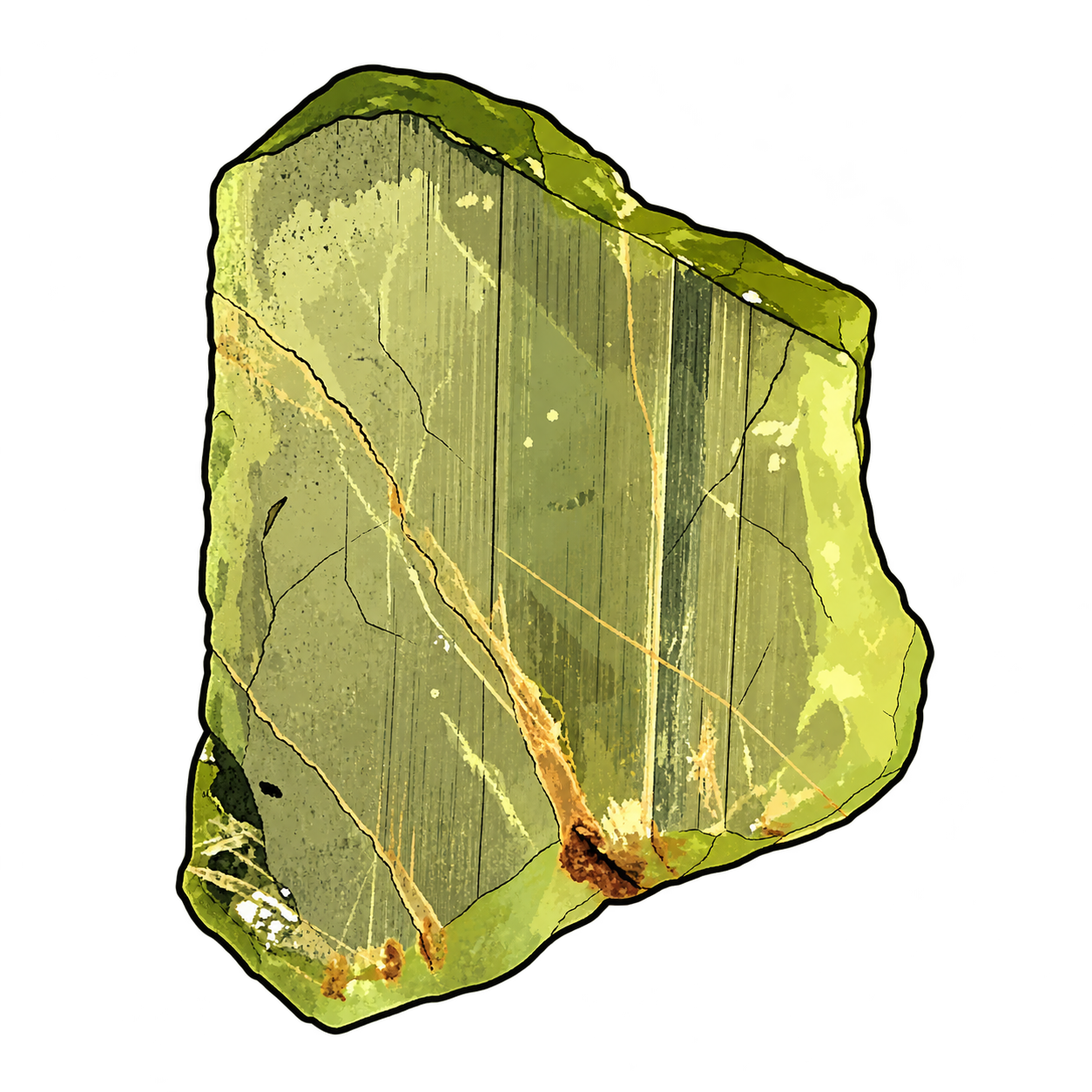
Peridot is the transparent, gem-quality form of olivine, a magnesium–iron silicate. Its characteristic green belongs to the mineral's own iron-bearing composition rather than to a coating or an unusually rare impurity. Most jewelry material is terrestrial, although olivine also occurs in meteorites. These are related mineralogical stories, not interchangeable statements of provenance. [1]
In contemporary crystal practice, peridot is associated with renewed confidence, openness to change and the willingness to release an unhelpful emotional pattern. The Crystal Council connects it with personal direction, generosity and prosperity. These are spiritual interpretations of the stone, not measured effects of its chemistry. [2]
A simple contemplative use is to place a stone beside a journal and identify one change that is within reach. The significance comes from the practice and the person undertaking it. Claims that peridot removes illness, regulates organs or physically realigns the body are not established mineral properties.
Composition: Magnesium–iron silicate, commonly written (Mg,Fe)₂SiO₄ Crystal system: Orthorhombic Mohs hardness: Approximately 6.5–7 Luster: Vitreous Cleavage: Imperfect; broken surfaces may be conchoidal Tenacity: Brittle Color: Green to yellow-green, with variations in tone and brownish influence [1, 3, 4]
Olivine compositions range between magnesium-rich forsterite and iron-rich fayalite. The forsterite end-member has the formula Mg₂SiO₄; natural gem material contains iron as well. A formula written with both Mg and Fe describes substitution within that structure, not a mixture of separate green and colorless grains. Gem peridot is generally on the magnesium-rich side of the series. [1, 3]
The Handbook of Mineralogy describes forsterite as an orthorhombic mineral occurring in short prisms, grains and masses. Its listed end-member density, about 3.28, is a useful reference rather than a universal measurement for every peridot. Composition influences optical and physical constants, so identification should use a combination of observations rather than one number. [3]
Peridot withstands ordinary light exposure well, but scratch resistance does not make it resistant to every kind of wear. GIA rates its toughness as fair to good. A hard impact can chip an edge, and rapid temperature changes can fracture a stone. A protective setting is therefore more appropriate for frequently worn jewelry than an exposed corner or thin, unsupported rim. [4]
Peridot's palette is narrower than that of tourmaline or garnet, yet individual stones vary considerably. Some are lemon-green; others are a richer grass green or a subdued olive. Strong green with little brown is especially valued, but the best choice also depends on brightness, cut and the light in which the stone will usually be seen. [5]
Characteristic inclusions include dark mineral crystals and round, reflective fracture features often called lily pads. These can be instructive under magnification without being desirable in every finished gem. Their visibility, position and effect on durability matter more than the mere fact that inclusions are present. Many good-quality peridots are clean to the unaided eye. [5]
Cutters use brilliant, step and mixed designs as well as cabochons and beads. A close-up image can make a small stone appear deeply saturated or emphasize inclusions that are inconspicuous in normal wear. Compare the actual dimensions and ordinary face-up appearance, not just the enlarged photograph. [5]
Olivine is a major constituent of many ultramafic rocks. Forsterite also occurs in magnesium-rich carbonate rocks altered by metamorphism. These settings explain why the same mineral can appear in very different associations: volcanic material is not its only geological context. [3]
GIA distinguishes peridot carried within volcanic rocks from crystals recovered in veins and pockets. Gem sources include Arizona, China, Pakistan, Myanmar and the Egyptian island of Zabargad. Locality can describe a stone's history, but it is not a quality grade: color, clarity, size and cutting vary within a source. [1]
The Natural History Museum's Imilac specimen is a pallasite: olivine crystals set among iron–nickel metal. Its material records events in the early solar system roughly 4.5 billion years ago. Explanations of pallasite formation involve differentiated small bodies and may include impacts that mixed metal and silicate material. The familiar image of a simple, undisturbed core–mantle boundary is not the only interpretation. [6]
This makes pallasites scientifically important, but it does not make a green peridot gemstone extraterrestrial by appearance. Meteorite attribution requires a documented specimen history. Removing a crystal from its metal matrix can also remove much of the context that makes the specimen informative.
GIA identifies Zabargad, formerly called Topazios, as an important ancient source and records an Egyptian association between peridot and the sun. The island's old name also illustrates a difficulty in reading historical gem descriptions: an ancient use of “topaz” need not refer to the mineral now given that name. [7]
Green stones were not always distinguished correctly. The large gems decorating the Shrine of the Three Holy Kings in Cologne Cathedral were long described as emeralds but are peridots. Such reidentifications show why a historical object's documented material matters more than a repeated popular label. [7]
Solar imagery and protective lore are part of peridot's cultural reception. Modern interpretations of renewal and confidence continue that bright visual language, but they should not be presented as one uninterrupted, universally shared belief system.
For jewelry, examine chips at facet junctions, surface-reaching fractures and the security of the setting. For a natural specimen, retain its locality record and matrix information. Ask for evidence behind any meteorite claim; ordinary gem identification and an extraterrestrial origin claim are different questions.
Clean suitable jewelry gently with lukewarm soapy water and a soft brush, then rinse and dry. Avoid steam and ultrasonic cleaners, strong acids and sudden heat. GIA also notes that prolonged exposure to acidic perspiration can affect the surface, so wipe jewelry after wear. Store it separately from harder gemstones. [4]
A matrix specimen may need a different approach if its associated minerals or old repairs are water-sensitive. Begin with dry, gentle cleaning and seek specimen-specific advice before soaking it. Brightness should come from the stone and its preparation, not an abrasive attempt to remove every natural surface feature.
gia.edu · Reference for the accompanying text · Reference recorded October 15, 2026
thecrystalcouncil.com · Reference for the accompanying text · Reference recorded October 15, 2026
handbookofmineralogy.org · Reference for the accompanying text · Reference recorded October 15, 2026
gia.edu · Reference for the accompanying text · Reference recorded October 15, 2026
gia.edu · Reference for the accompanying text · Reference recorded October 15, 2026
nhm.ac.uk · Reference for the accompanying text · Reference recorded October 15, 2026
gia.edu · Reference for the accompanying text · Reference recorded October 15, 2026