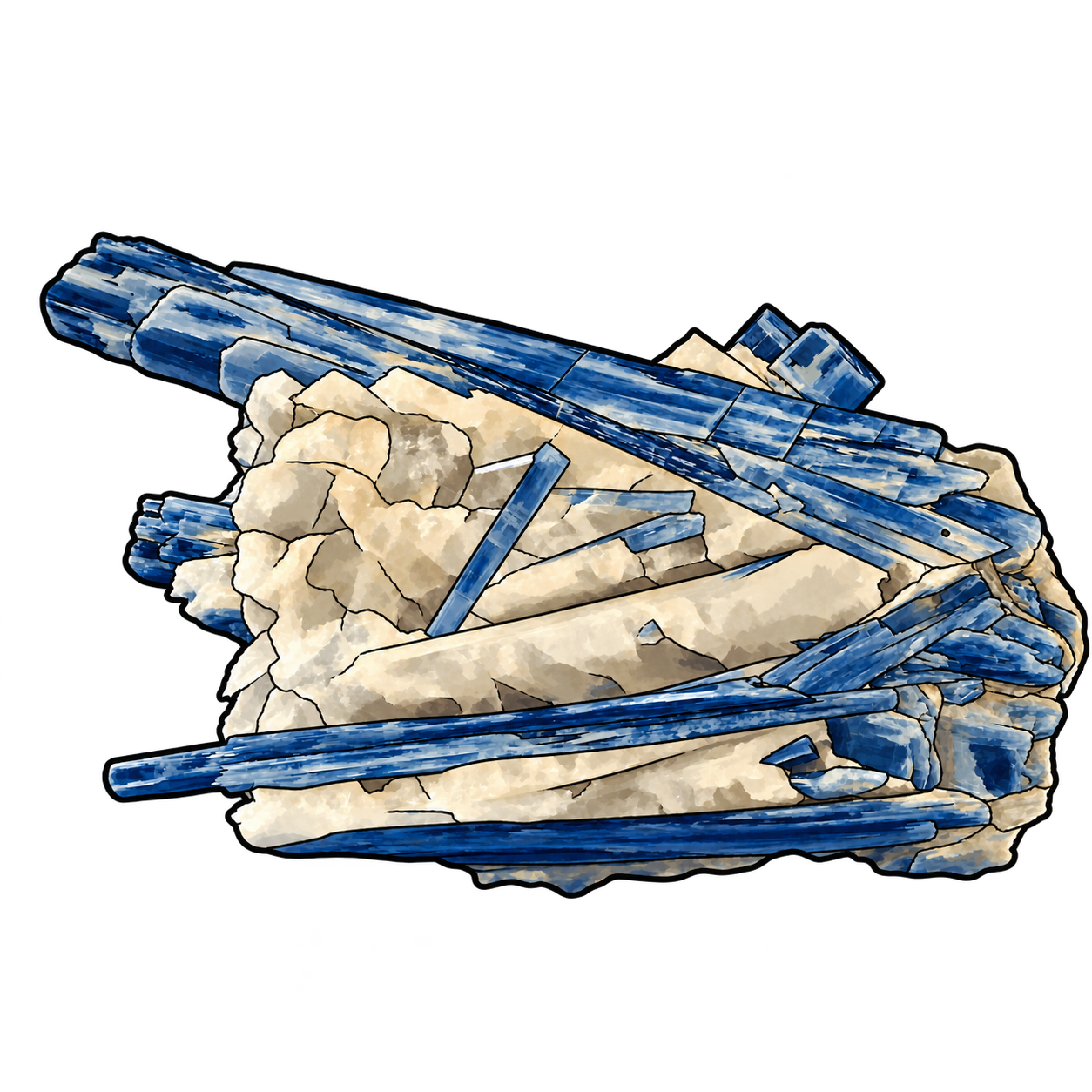
Blue blades that reveal the importance of direction
Kyanite
Aluminium silicate mineral, polymorphous with andalusite and sillimanite.
Aluminum silicate mineral species and associated appearance varieties
Loading this page…
Return homePlease wait while the next page arrives.


Blue blades that reveal the importance of direction
Aluminium silicate mineral, polymorphous with andalusite and sillimanite.
Aluminum silicate mineral species and associated appearance varieties
Kyanite is triclinic and frequently grows as flattened blades, sometimes bent or intergrown.
Geology · Human history · Spiritual attributes
Kyanite's modern spiritual associations differ with its presentation. The Crystal Council connects blue kyanite with communication, intuition and dreams; Michelle Welch gives black kyanite a protective and clearing role. These accounts describe practitioner beliefs rather than scientifically demonstrated forces. [1,2]
A blue blade beside a journal offers a quiet visual focus; a spreading black fan lends itself to Welch's imagery of sweeping away unwanted energy. Their shared mineral identity allows several distinct symbolic readings, shaped by colour, form and the practitioner's intention.
Kyanite is triclinic and frequently grows as flattened blades, sometimes bent or intergrown. Its luster ranges from glassy to pearly. The Handbook of Mineralogy records approximately Mohs 5.5 along the long direction and 7 across it. This pronounced difference is a property of its structure, not an inconsistency to be averaged into one misleading number. Cleavage and splintery fracture create additional weaknesses distinct from scratch resistance. [3]
A long blade thus has several kinds of surface to read: original growth faces, cleavage planes and irregular breaks. Parallel-looking features do not all have the same origin. Neither a smooth polish nor a high hardness value in one direction makes a thin projection resistant to impact. For identification, these observations are useful in combination, but an unnecessary scratch test can permanently damage the very feature that makes a specimen worth keeping.
Kyanite is usually recognized by blue crystals, but blue is not a requirement. The mineral's name refers to its familiar color, not the full range of its chemistry. Green and orange gem material has been investigated alongside blue specimens. GIA examined saturated yellowish-green kyanite reported from Tanzania and linked its color to substantial iron content through spectroscopy and chemical analysis. Some crystals in that parcel also contained narrow blue zones. [4]
A faceted blue kyanite may resemble another blue gem at a glance. Laboratory measurements make the comparison more precise. One GIA Gübelin collection specimen, recorded as originating in Myanmar, has refractive indices of 1.714 and 1.728, specific gravity 3.69 and bluish-green/blue pleochroism. These are measurements of that specimen, not a guarantee that every kyanite will reproduce them exactly. Its internal parallel color banding illustrates why a photograph may show an uneven color field. [5]
Research on chromium-rich material reported from Odisha, India, found greenish-blue to bluish-green colors and inclusions identified as ilmenite, quartz, feldspar and zircon. Iron-titanium charge transfer and chromium-related absorption contributed to the optical character. This makes “green” or “blue” a description to investigate, not a complete explanation of color. The examined Indian samples were biaxial positive, whereas some reference specimens are negative; identification should accommodate documented variation rather than reject a stone on one generalized table entry. [6]
Kyanite, andalusite and sillimanite share the same chemical formula but arrange their atoms differently. They are polymorphs. Their stability depends on pressure and temperature, so the presence of one rather than another can help interpret a rock's metamorphic history. Kyanite is associated with relatively high-pressure conditions; sufficient heating at an appropriate pressure favors sillimanite instead. [7]
Real rocks complicate this simple picture. Their bulk chemistry, fluids and coexisting minerals influence what can grow, and geological history is not recovered from a single loose blue blade alone. A specimen still in its host rock preserves relationships that a cut stone cannot: neighboring minerals, growth orientation and the contact between crystals and matrix. Those features give a mineral specimen value as evidence as well as an object of beauty. [7]
Kyanite also has an industrial role very different from jewelry. USGS describes how kyanite, andalusite and sillimanite are heated to produce mullite and silica, materials useful in refractory products. Refractories line equipment such as furnaces and kilns that must withstand high temperatures. This use depends on controlled transformation of the mineral; it does not mean that a display crystal can be placed in a fire and emerge unchanged. The gemstone and the industrial feedstock share a chemical starting point, but their intended treatment is entirely different. [8]
Lift a cluster by a stable base and keep projecting blades away from hard surfaces. Avoid pressing a cloth between closely packed crystals or forcing a stiff brush across thin edges. A gentle dry brush is a sensible first approach to dust; more involved cleaning should account for the matrix and any existing fractures rather than assume that every mineral in the piece behaves like kyanite.
Under indirect light, compare the color along a blade, then turn the specimen to observe changes in reflection and transmitted color. Preserve those differences in a collection description. “Blue kyanite” supplies an identity, but the arrangement of blades, pale and dark bands, intact ends and accompanying rock describes the individual object.
thecrystalcouncil.com · Reference for the accompanying text · Reference recorded October 15, 2026
survey.llewellyn.com · Reference for the accompanying text · Reference recorded October 15, 2026
handbookofmineralogy.org · Reference for the accompanying text · Reference recorded October 15, 2026
gia.edu · Reference for the accompanying text · Reference recorded October 15, 2026
gia.edu · Reference for the accompanying text · Reference recorded October 15, 2026
gia.edu · Reference for the accompanying text · Reference recorded October 15, 2026
my.gia.edu · Reference for the accompanying text · Reference recorded October 15, 2026
usgs.gov · Reference for the accompanying text · Reference recorded October 15, 2026