Color in three directions; a cross within the crystal
Andalusite and Chiastolite
Andalusite; chiastolite is the cross-patterned inclusion variety.
Aluminum silicate mineral species and associated appearance varieties
Loading this page…
Return homePlease wait while the next page arrives.


Color in three directions; a cross within the crystal
Andalusite; chiastolite is the cross-patterned inclusion variety.
Aluminum silicate mineral species and associated appearance varieties
Andalusite shares the composition Al2SiO5 with kyanite and sillimanite, but their atoms occupy different structures.
Geology · Human history · Spiritual attributes
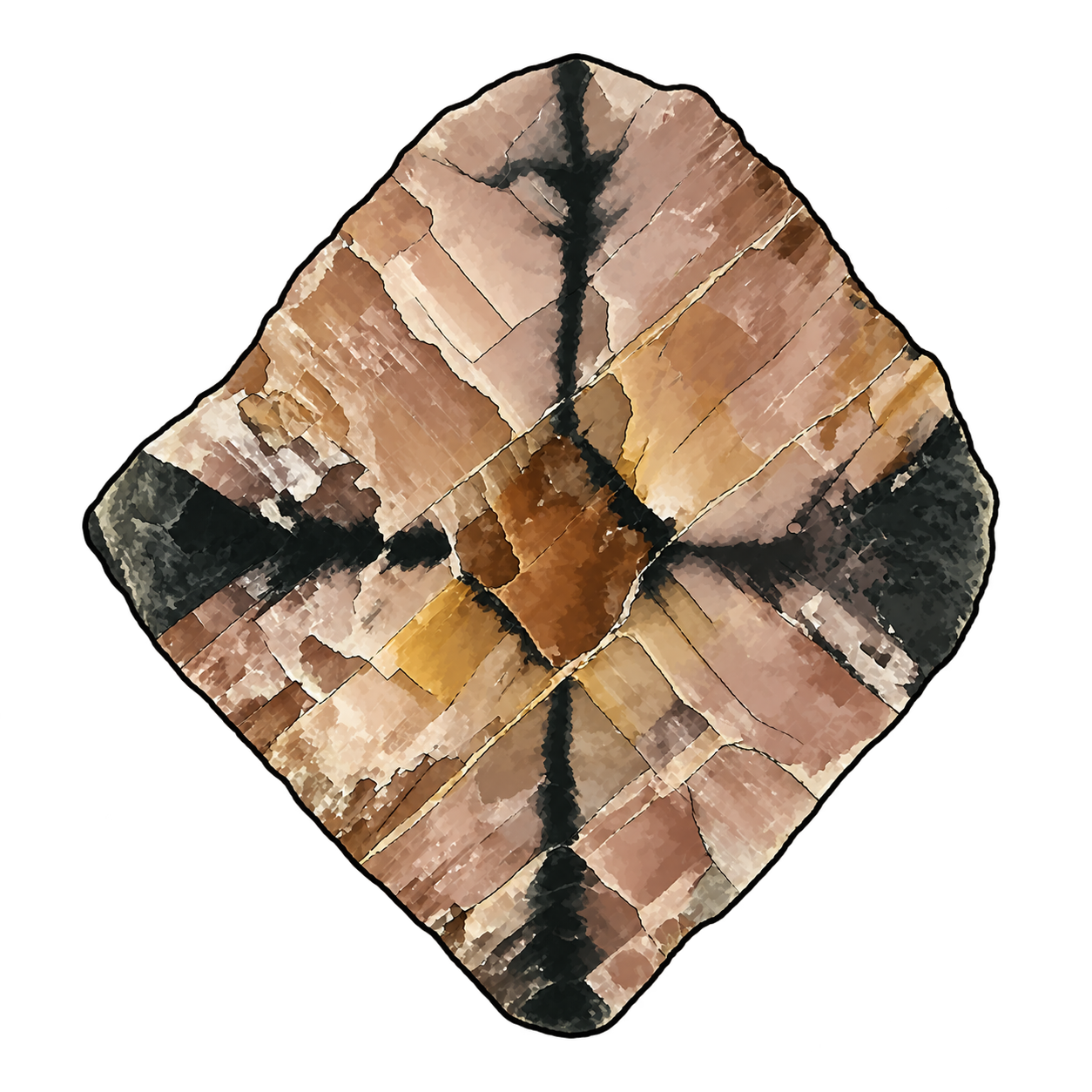
Pink-brown, greenish or tan prisms; transparent gems can combine contrasting directional colors. Chiastolite typically has dark carbonaceous inclusions arranged across a pale section. [2][3]
Grounding • Protection • Composure • Perspective • Steadiness through change. [1]
Contemporary crystal practice associates chiastolite with grounding, protection and steadiness through change. The Crystal Council emphasizes composure and confidence; these are spiritual interpretations rather than demonstrated mineral effects. [1]
The cross can serve as a focus while reflecting on competing commitments. Its historical Christian significance belongs to a distinct devotional tradition, discussed below.
Andalusite shares the composition Al2SiO5 with kyanite and sillimanite, but their atoms occupy different structures. These polymorphs are distinct minerals, not interchangeable names or stages of gem quality. Andalusite commonly forms prismatic crystals with nearly square sections. Chiastolite belongs to the same species: its defining feature is the arrangement of inclusions, not a different chemical formula. [2,3]
The Handbook of Mineralogy gives a Mohs hardness of 6½–7½ and a measured specific gravity of approximately 3.13–3.16. Its glassy surface can take an attractive polish, but good cleavage and brittle behavior mean that a hard edge can still chip. Hardness describes resistance to scratching; it does not make a thin slice resistant to impacts. [2]
Andalusite occurs particularly in aluminum-rich rocks altered by heat, including contact-metamorphosed sediments, and also in regional metamorphic settings. The surrounding mineral assemblage helps a geologist interpret the conditions of formation. A loose cross-cut slice, however striking, cannot by itself establish the exact temperature, pressure or geographical origin of its parent rock. [2]
Chiastolite's dark design lies inside the crystal. Carbonaceous material becomes arranged along growth-related regions, so a cut across the prism reveals a cross or related geometric pattern. It is not usually a carving, and it is not evidence that two separate crystals have intersected. The width, symmetry and continuity of the arms vary; some sections have broad dark wedges, while others show narrow lines or an incomplete cross. [3]
A slice also conceals the third dimension. Sections cut at different positions along a prism need not have identical patterns. This makes the edge and reverse useful parts of a specimen's appearance rather than merely the backing of its most attractive face. A convincing identification should consider the material, not only whether its pattern resembles a familiar symbol.
The Spanish geological historian Miguel Calvo Rebollar describes the cross-bearing material as graphite-rich growth features accompanied by small quartz grains. Historical names such as “cross stone” are less precise than modern mineral names: early descriptions can refer to different stones with superficially similar markings. His review therefore distinguishes recognizable chiastolite descriptions from older ambiguous reports. [4]
Transparent andalusite is notable for pleochroism: light is absorbed differently along different directions through the crystal. A faceted gem may show olive, yellowish and reddish-brown areas at the same time. This is not the same as a color-change gemstone that changes appearance when the light source changes, nor is it surface iridescence. [5]
Facets redirect light through the interior, so a cutter must consider the whole face-up pattern rather than looking only through one flat crystal face. Richard Hughes's discussion of pleochroism explains why contrasting directional colors can remain visible in a faceted stone even in orientations that a simple textbook diagram might suggest would suppress them. The result can be a deliberately balanced mixture rather than one uniform hue. [5]
A 2009 study of Brazilian material documented green, brownish-pink and bicolored specimens, including unusually transparent chiastolite. It also separated genuine color zoning from directional color. The distinction matters: a region that is chemically or structurally different is not the same phenomenon as the same region viewed along a different direction. [6]
Chiastolite was carried through European networks of pilgrimage, exchange and collecting. Calvo Rebollar's archival study places its likely circulation among pilgrims returning from Santiago de Compostela in the second half of the sixteenth century. By the seventeenth and eighteenth centuries it appeared in cabinets of curiosities as both a religiously suggestive object and a natural puzzle. Association with Compostela did not establish that every specimen was mined there. [4]
The study identifies Anselmus de Boodt's 1609 description as an early unambiguous account and Johannes de Laet's 1647 work as an early printed illustration. Such records are more useful than assigning a single modern “meaning” to every historical owner. A pilgrim's devotional souvenir, a collector's curiosity and a mineralogist's specimen could be the same material understood in different ways. [4]
The Brazilian study found that experimental heating produced little color improvement, whereas resin fracture filling could make included material appear clearer. This does not establish that all andalusite is filled. It does mean that an unusually clear example should not be described as untreated solely on visual inspection. [6]
For a chiastolite slice, an intact cross and a well-finished edge often matter more than transparency. For a faceted stone, the arrangement of color, visible fractures and condition of facet junctions are more informative than judging it against the uniform color of an unrelated gem. Neither form is an inferior version of the other.
Support thin sections across their face rather than pinching a projecting corner. Use a soft cloth or gentle brush; do not test a collectible by scratching it. When treatment and mounting are known to permit cleaning, use brief mild washing rather than steam, aggressive chemicals or prolonged soaking. An uncertain resin-filled or fractured piece is better cleaned conservatively by a jeweler.
thecrystalcouncil.com · Reference for the accompanying text · Reference recorded October 15, 2026
handbookofmineralogy.org · Reference for the accompanying text · Reference recorded October 15, 2026
mindat.org · Reference for the accompanying text · Reference recorded October 15, 2026
dialnet.unirioja.es · Reference for the accompanying text · Reference recorded October 15, 2026
gia.edu · Reference for the accompanying text · Reference recorded October 15, 2026
gia.edu · Reference for the accompanying text · Reference recorded October 15, 2026