Natural Crosses in Metamorphic Rock
Staurolite / Fairy Crosses
Iron-rich aluminium silicate, sometimes naturally twinned into cross-like forms.
Mineral species; ornamental specimens may include other minerals
Loading this page…
Return homePlease wait while the next page arrives.


Natural Crosses in Metamorphic Rock
Iron-rich aluminium silicate, sometimes naturally twinned into cross-like forms.
Mineral species; ornamental specimens may include other minerals
Staurolite's crossed crystals are among the most recognizable shapes in a mineral collection.
Geology · Human history · Spiritual attributes
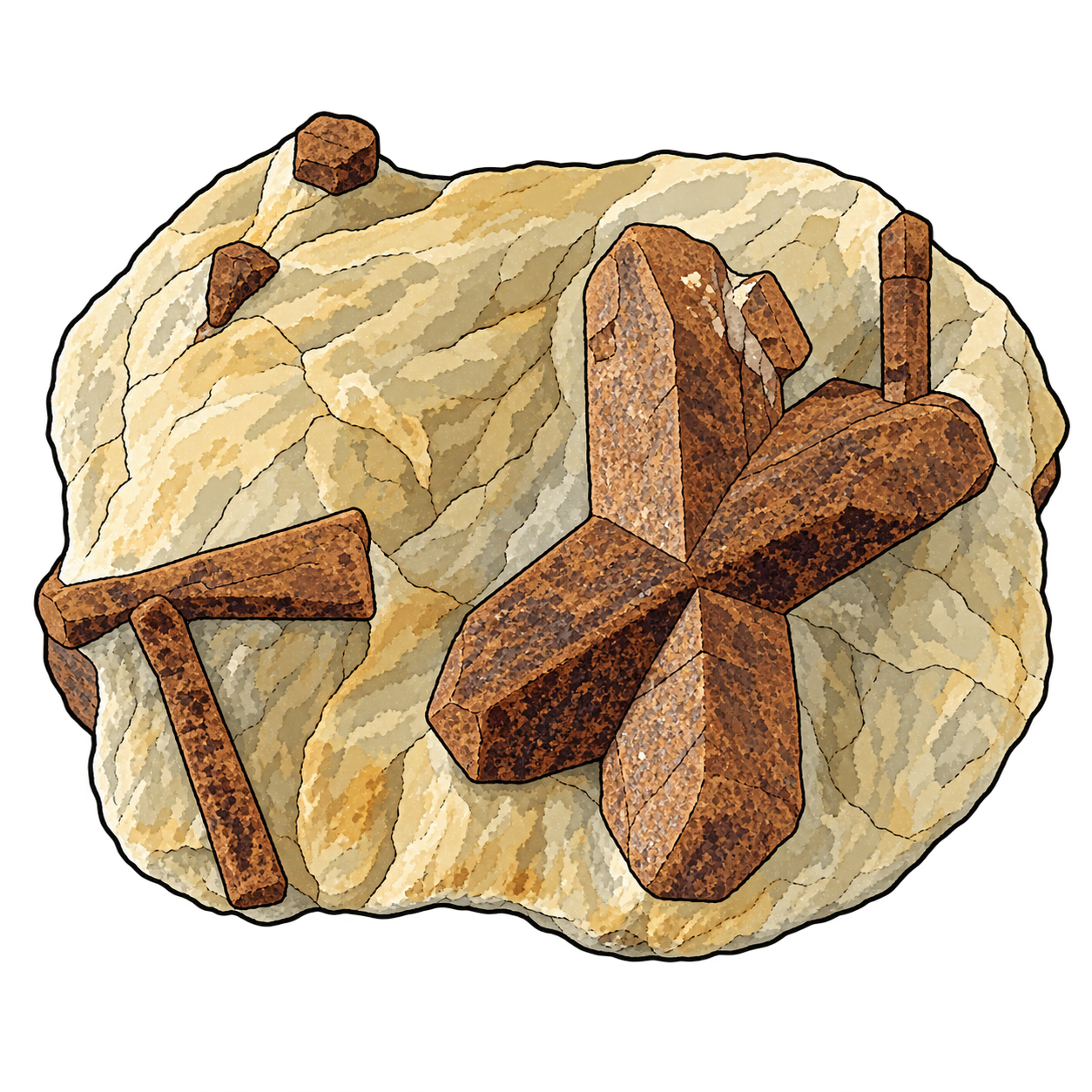
Staurolite's crossed crystals are among the most recognizable shapes in a mineral collection. Their meeting arms are not necessarily the work of a carver: twinning can produce an oblique or nearly right-angled intersection as crystals grow. Many staurolites, however, are single prisms rather than crosses. The mineral is more varied than the familiar charm suggests. [1]
Staurolite carries both regional fairy-stone folklore and modern crystal associations. In Virginia's fairy-stone tradition, crossed specimens are regarded as fortunate keepsakes. Contemporary practitioners also connect the mineral with grounding, emotional protection and inward guidance. These meanings come from different interpretive settings and need not be combined into a single supposedly ancient system. [2, 4]
A specimen may also hold a memory of a place, a gift or a shared collecting experience. That personal significance needs no claim that a cross-shaped crystal prevents illness or changes the outcome of events. Its geological origin and its cultural meanings can be appreciated together without confusing their kinds of evidence.
Staurolite is an aluminum-rich silicate commonly containing substantial iron, with magnesium and other elements participating in its variable chemistry. It is monoclinic but often appears nearly orthorhombic. Brown to reddish-brown crystals are typical; hardness is about 7–7½ and density approximately 3.74–3.83. Despite that hardness, the mineral is brittle and has distinct cleavage. [1]
The well-known twins commonly intersect at about 60 degrees; approximately 90-degree cruciform twins are less frequent. These orientations arise from crystallographic relationships. They are not separate species, and a single untwinned prism is no less genuine. The name itself refers to a cross. [1]
Shape and material should therefore be described separately. A polished cross may be made from staurolite without preserving a completely natural outline; an unmodified natural twin may be uneven, worn or partially embedded. An appealing object does not need perfect symmetry to be a useful mineral specimen.
Staurolite is characteristic of suitable metamorphosed, clay-rich rocks. Smith College's petrology reference describes its use as an index mineral in medium-grade pelitic metamorphic rocks. In that context, it contributes evidence about a rock's transformation under heat and pressure. [5]
An index mineral is not a thermometer that can be read in isolation. A geologist considers the mineral assemblage, textures and composition of the host. A loose crystal may establish that staurolite is present, but it lacks many relationships preserved in a piece of schist. A matrix specimen can show crystals growing within the fabric of the rock and is worth preserving intact rather than automatically extracting the most conspicuous cross.
The Handbook records associations including garnet, kyanite, sillimanite, muscovite and quartz. Occurrences extend well beyond Virginia, including European and Brazilian localities. The fairy-stone story is regional; the mineral is not confined to the landscape in which that story became famous. [1]
Virginia State Parks recounts a tale in which fairies heard news of Christ's crucifixion and wept; their tears became small stone crosses. The narrative joins fairy imagery with Christian remembrance. It is presented as legend, not as a geological explanation or a securely dated account of the first human use of staurolite. [2]
The story helps explain why a modest brown mineral could become a treasured keepsake. The recognizable shape allows viewers to attach memory, grief or hope to a small physical object. The tale's emotional power does not require replacing crystallography with folklore, nor does its presence establish that all communities interpreted the stone in the same way.
Fairy Stone State Park's name brought that association into a public landscape. Virginia's historic-register account records development between 1933 and 1940 by about 600 Civilian Conservation Corps workers, with the historic district entering the National Register in 2007. The mineral's cultural story therefore includes identifiable modern public works as well as the more elusive history of its legend. [3]
NATURAL CRYSTAL OR FINISHED CHARM?
Virginia State Parks distinguishes natural from filed specimens and describes darkening with linseed-based oil. Such alterations should be disclosed. [2]
Look for a clear description of alterations, not a promise that every attractive cross is untouched. Surface texture, the meeting of the arms and any remaining matrix can be informative, but photographs alone may not settle the question. A repeated shape is a reason to ask about manufacture, not by itself a laboratory diagnosis.
Staurolite is not solely a decorative curiosity. U.S. Geological Survey mineral-industry reporting lists it among materials used in abrasive applications, including competition with garnet for sandblasting. Industrial grains and collector-quality crossed crystals are different products from the same wider mineral resource. [6]
That practical use should not encourage improvised grinding of a specimen. Dust control and industrial material specifications are separate concerns from keeping a natural crystal on a shelf.
Protect projecting arms and thin intersections from impacts. Move a matrix specimen by the supporting rock, not by a convenient crystal, and avoid forcing a twin into a tight holder. Scratch hardness does not prevent a narrow arm from snapping.
Before cleaning, determine whether the surface is natural, oiled, colored or part of a mixed-mineral specimen. Gentle handling preserves information that filing or aggressive cleaning can remove. Keep locality and modification notes with the piece: a documented ordinary crystal often tells more than a visually perfect but unexplained charm.
handbookofmineralogy.org · Reference for the accompanying text · Reference recorded October 15, 2026
dcr.virginia.gov · Reference for the accompanying text · Reference recorded October 15, 2026
dhr.virginia.gov · Reference for the accompanying text · Reference recorded October 15, 2026
thecrystalcouncil.com · Reference for the accompanying text · Reference recorded October 15, 2026
science.smith.edu · Reference for the accompanying text · Reference recorded October 15, 2026
apps.usgs.gov · Reference for the accompanying text · Reference recorded October 15, 2026