Green Silica Marked by Iron-Red Inclusions
Bloodstone
Green chalcedony/jasper material with red markings.
Patterned or colored microcrystalline silica aggregate
Loading this page…
Return homePlease wait while the next page arrives.


Green Silica Marked by Iron-Red Inclusions
Green chalcedony/jasper material with red markings.
Patterned or colored microcrystalline silica aggregate
Bloodstone, or heliotrope, is green chalcedony marked by red iron-oxide inclusions, commonly hematite.
Geology · Human history · Spiritual attributes
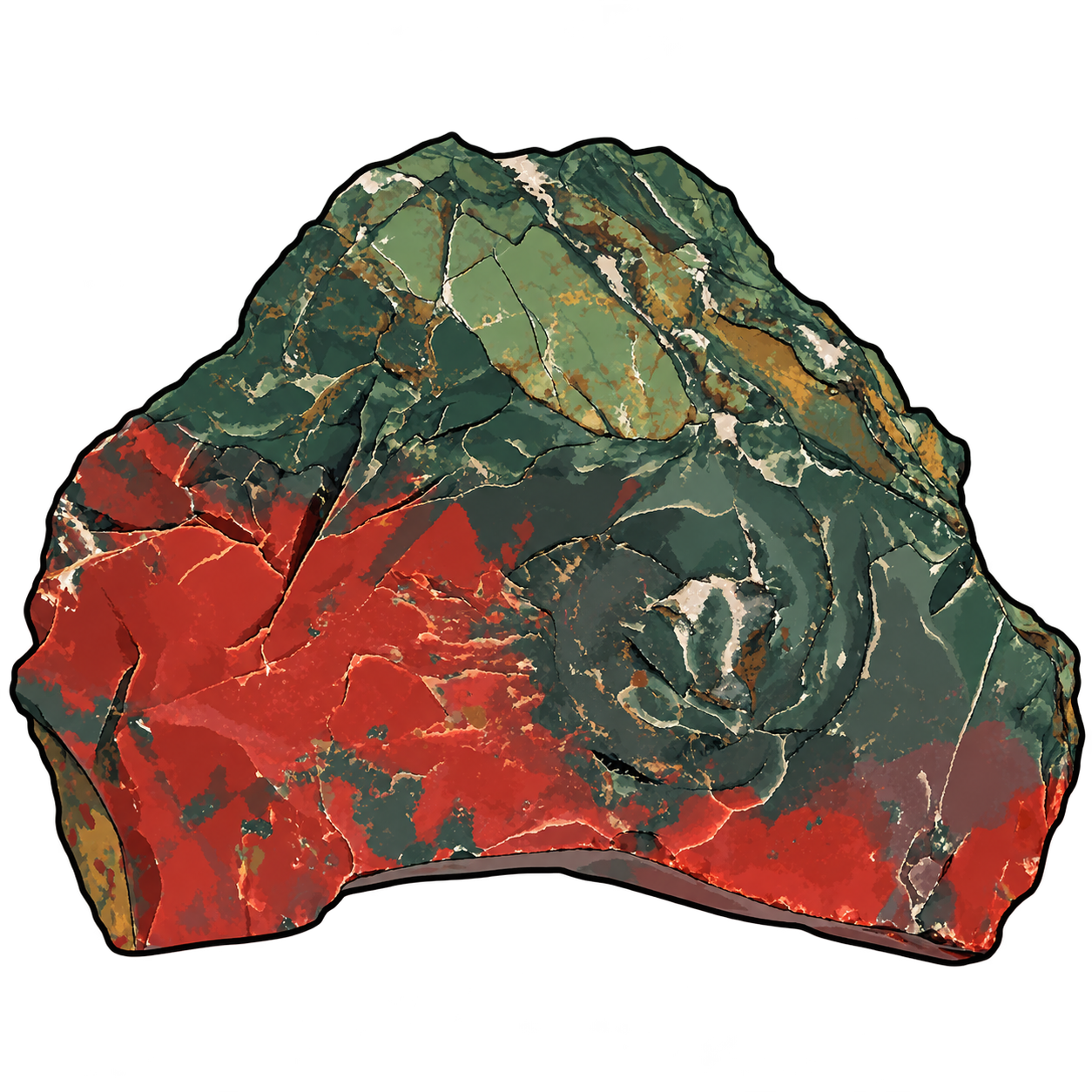
Bloodstone, or heliotrope, is green chalcedony marked by red iron-oxide inclusions, commonly hematite. [1]
Modern bloodstone practice emphasizes courage and the ability to follow a chosen direction. The Crystal Council associates it with willpower, confidence and protection, using root-chakra and earth symbolism. These are spiritual meanings, not evidence that the stone changes blood, circulation or physical strength. [2]
The red-green contrast makes these meanings visually memorable. A person may choose the stone as a reminder of commitment without assuming that its mineral composition produces the quality it represents.
Principal host chemistry: Silicon dioxide, SiO₂ Texture: Fine crystalline aggregate Mohs hardness: Approximately 6½–7 Reported specific gravity: About 2.55–2.70 Refractive index: Approximately 1.530–1.543 Cleavage: None apparent Fracture: Shell-like Transparency: Usually opaque, sometimes translucent at thin edges Color: Green to greenish blue with red inclusions [3, 4]
These are aggregate properties. Bloodstone is not a single transparent crystal with one uniformly colored interior. Its host and inclusions contribute to the appearance and can produce variation among specimens. Gemdat identifies chlorite or hornblende inclusions among the possible sources of green coloration; the red areas are associated with iron oxides. A precise identification of every colored constituent requires analysis. [3]
Commercial sources include India, Australia, Brazil, China and the United States. [1] A documented locality cannot be inferred from color.
The finished pattern depends on which part of the rough is selected. One section may show mostly green, another red patches, and another pale or yellow-brown material. Hobart King notes that commercial descriptions can overlap with “fancy jasper” where additional colors become dominant. Such labels reflect visual emphasis rather than a sharp boundary between separate mineral species. [4]
For a cutter, the problem is composition: how to place the markings within a cabochon, bead or carving. A small red spot may disappear when an edge is rounded. A larger carving can preserve several colors that a smaller gem would exclude. The amount of red alone therefore does not measure the quality of the workmanship or the interest of the object.
The Getty preserves a Roman bloodstone engraved gem dated to the second through fourth centuries CE. Only 1.4 by 1.1 centimeters, it demonstrates the use of the material at an intimate scale. The catalogue establishes its material, period and cultural attribution; it does not establish a particular healing purpose. [5]
At a larger scale, a tazza in the Metropolitan Museum combines bloodstone with gold and enamel. The museum dates it to approximately 1575–1625, probably Milanese, with nineteenth-century additions. Its present form therefore records more than one period of workmanship. The vessel is 9.2 centimeters high and 15.4 centimeters long—small enough for close inspection of the stone within its elaborate setting. [6]
GIA records Christian blood symbolism and an older belief that heliotrope reddened the sun when placed in water. These are traditions, not physical effects. Bloodstone remains a March birthstone. [1]
Evaluate the whole pattern in ordinary light. A dark field, a few isolated red points and broad red patches offer different visual effects. Look at the back and edges as well as the face, especially where a setting could conceal a fracture or a thin section.
A signet, an old carving and an unmounted cabochon need different handling. Preserve engraved details and historic surfaces; do not polish away evidence of use merely to increase gloss. Keep a record of any repairs, treatment information and documented origin.
GIA recommends warm soapy water and gentle brushing for sound bloodstone; avoid harsh chemicals and excessive heat. [1]
Bloodstone is an ornamental material, not a substance to ingest or use to treat bleeding. Its lasting interest lies in the combination of mineral pattern, skilled carving and the meanings people have attached to it.
gia.edu · Reference for the accompanying text · Reference recorded October 15, 2026
thecrystalcouncil.com · Reference for the accompanying text · Reference recorded October 15, 2026
gemdat.org · Reference for the accompanying text · Reference recorded October 15, 2026
geology.com · Reference for the accompanying text · Reference recorded October 15, 2026
getty.edu · Reference for the accompanying text · Reference recorded October 15, 2026
metmuseum.org · Reference for the accompanying text · Reference recorded October 15, 2026