White borate, branching veining, and a modern association with patience
Howlite
Calcium borosilicate hydroxide, commonly white with dark veining.
Mineral species; ornamental specimens may include other minerals
Loading this page…
Return homePlease wait while the next page arrives.


White borate, branching veining, and a modern association with patience
Calcium borosilicate hydroxide, commonly white with dark veining.
Mineral species; ornamental specimens may include other minerals
Howlite is a white calcium borosilicate hydroxide, often crossed by gray markings.
Geology · Human history · Spiritual attributes
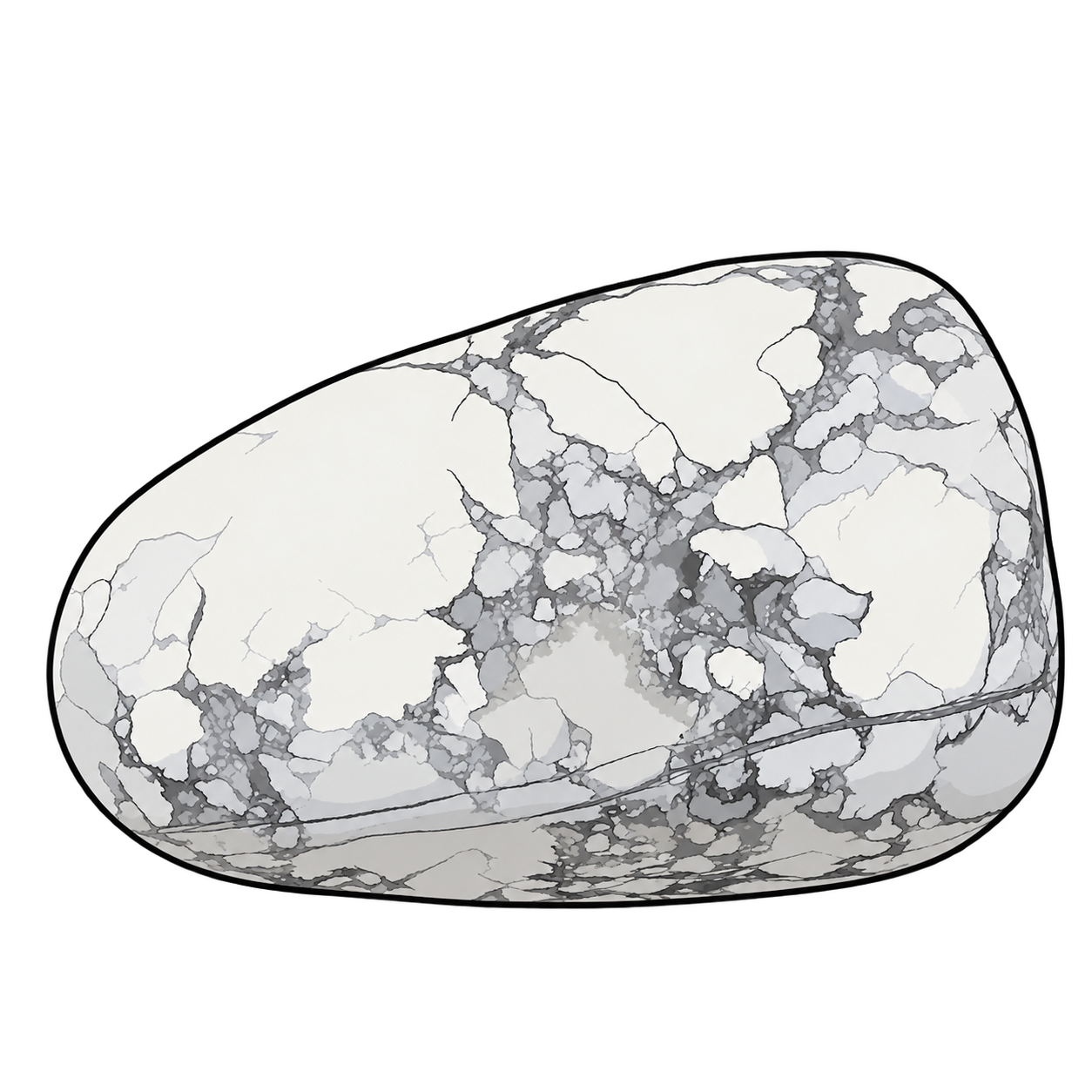
Patience, calm reflection, inner strength, and renewal in contemporary crystal practice. [3]
The Crystal Council associates howlite with patience, calming attention, inner strength, and a fresh emotional beginning. In this modern framework it is chosen less as a symbol of action than as a reminder to pause before responding. These are practitioner interpretations, not demonstrated mineral effects. [3]
A simple use is to place a polished piece beside a journal and associate it with one practical intention: listening fully, making time to reflect, or allowing a decision to wait. The value of that ritual belongs to the person's attention and chosen meaning; it does not require claims that the stone treats illness or changes the nervous system. [3]
Howlite has a Mohs hardness of about 3.5 and a measured density around 2.53–2.59 g/cm³. It has no distinct cleavage; breaks are uneven to curved. Most familiar material is opaque-looking, though thin fragments can transmit light. Small, well-formed crystals are uncommon and tabular rather than quartz-like points. [1]
These properties explain why a polished howlite object needs different expectations from a quartz carving. A glossy finish is a surface condition, not evidence of hardness. The finish can be scratched even when the stone looks dense and substantial. Nor does the lack of cleavage make an object unbreakable: a drilled bead, thin carving, or pre-existing crack can still be vulnerable to impact.
Howlite belongs to borate-bearing deposits and is associated with minerals such as colemanite and ulexite. The Handbook of Mineralogy records nodular masses as the usual habit, alongside uncommon individual crystals. Its locality record includes Nova Scotia, California, Sonora, and Turkey. These are documented occurrences, not a way to assign a polished stone's origin from its pattern. [1]
For a collection, there are two different questions worth asking: what mineral is this, and where was this particular piece collected? A correctly identified tumble can answer the first while leaving the second unresolved. A field-collected specimen accompanied by a reliable locality label carries information that an attractive but undocumented polished piece does not. Neither the gray webbing nor a seller's photograph can supply that missing chain of provenance.
The National Museum of Natural History, Sofia's gemmology reference identifies the original description as Henry How's 1868 paper on borates and other minerals in Nova Scotian anhydrite and gypsum. Its title used the name “Silicoborocalcite.” The mineral now called howlite commemorates How, and its type locality is near Windsor, Nova Scotia. [2]
That record gives the stone a concrete historical setting: mineral analysis and the study of regional deposits. It is more informative than presenting the name as a mystical epithet. The description date marks scientific recognition; it does not, by itself, tell us when people first encountered the material.
Howlite can be dyed and sold as a turquoise look-alike. GIA's treatment reference distinguishes dyeing—adding color to porous or fractured material—from the formation of a naturally colored mineral. Blue dye does not convert howlite into turquoise, and “natural stone” does not necessarily mean untreated color. [4]
A historical GIA laboratory report illustrates why appearance alone is unreliable. A bead resembling turquoise had a pale interior visible at its drill hole; its measured properties supported dyed howlite. This was an examination of a particular specimen, not a rule that every dyed bead has an obvious white core. [5]
For buying purposes, an accurate description such as “dyed blue howlite” is preferable to an ambiguous turquoise name. Ask whether the color is natural or added, whether a coating is present, and how the seller established the mineral identity. Do not reproduce destructive laboratory tests on a finished object: a stain, scratch, or damaged drill hole is not a useful substitute for a clear seller disclosure.
For an uncolored piece, assess the pattern, finish, and integrity rather than expecting uniformity. Look closely at narrow edges and drilled holes, and distinguish an intentional dark marking from an open fissure. If the object is dyed, treatment disclosure matters as much as the underlying mineral name.
Use a soft cloth for routine dust removal. For a finished piece of uncertain treatment, obtain cleaning guidance from the maker before using liquids or solvents. Avoid abrasive polishing and keep howlite separately wrapped from harder stones. These conservative measures protect both its relatively soft surface and any undisclosed finish. A display specimen does not need to be scrubbed to look like a tumble; preserving its original surface may be the better choice.
handbookofmineralogy.org · Reference for the accompanying text · Reference recorded October 15, 2026
nmnhs.com · Reference for the accompanying text · Reference recorded October 15, 2026
thecrystalcouncil.com · Reference for the accompanying text · Reference recorded October 15, 2026
my.gia.edu · Reference for the accompanying text · Reference recorded October 15, 2026
gia.edu · Reference for the accompanying text · Reference recorded October 15, 2026