Blue-Green Copper–Aluminum Phosphate
Turquoise
Hydrated copper aluminium phosphate.
Mineral species; ornamental specimens may include other minerals
Loading this page…
Return homePlease wait while the next page arrives.


Blue-Green Copper–Aluminum Phosphate
Hydrated copper aluminium phosphate.
Mineral species; ornamental specimens may include other minerals
Turquoise is an opaque to semitranslucent gem whose appeal lies in color, texture and the pattern of its surrounding rock.
Geology · Human history · Spiritual attributes
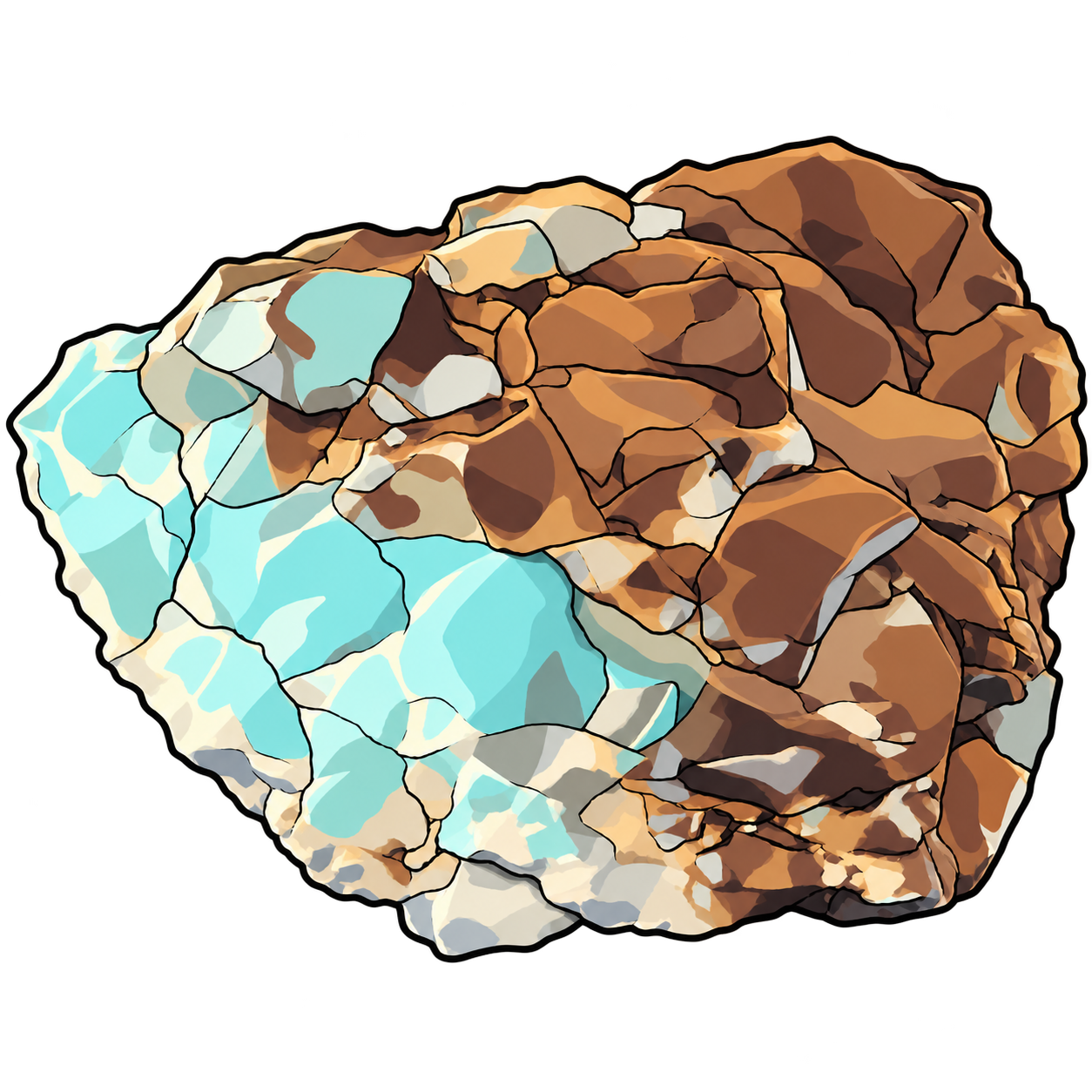
Turquoise is an opaque to semitranslucent gem whose appeal lies in color, texture and the pattern of its surrounding rock. A smooth sky-blue cabochon and a green stone crossed by dark matrix can both be turquoise. Neither color nor pattern, however, establishes a mine of origin or an absence of treatment. [1, 2]
Modern crystal practice and older cultural traditions offer several distinct ways of understanding turquoise. They should be named rather than merged into a single universal account.
These associations belong to their respective communities and practices. A modern throat-chakra interpretation should not be presented as the explanation for every Indigenous or Egyptian use, and spiritual meaning is not evidence of medical efficacy.
Composition: CuAl₆(PO₄)₄(OH)₈·4H₂O Crystal system: Triclinic Mohs hardness: 5–6 Typical form: Fine-grained masses, veinlets, crusts and nodules Specific gravity: About 2.86 in crystalline material; lower in porous masses Luster: Waxy to dull in masses; glassy in rare crystals Fracture: Small shell-like to smooth surfaces [1]
Tiny crystals form turquoise's body. Their packing affects porosity, polish and coherence; compact material can have a soft, waxy sheen. [2]
Dark lines and patches are remnants of surrounding material. The trade term “spiderweb” describes a fine network of matrix; it is a pattern description, not a separate mineral species. A well-balanced web can be part of a stone's appeal, while a matrix-free stone emphasizes uninterrupted color. [6]
Turquoise forms as a secondary mineral where copper-bearing water interacts with suitable aluminum- and phosphorus-bearing material. The familiar deposits are associated with arid landscapes, altered rocks and veins. Its geological story concerns water moving through rock, even where today's surface appears exceptionally dry. [1, 2]
The Handbook records occurrences in Iran, the southwestern United States, China and elsewhere. The traditional association of fine blue material with the Nishapur district of Iran helped establish “Persian blue” as a color description in the trade. GIA cautions that this phrase is used even when the stone was mined elsewhere. [1, 6]
Deborah Schorsch's Metropolitan Museum study identifies Wadi Maghara and Serabit el-Khadim as important sources for ancient Egypt. At Serabit el-Khadim, a temple was dedicated to Hathor, whose epithets included mistress of turquoise. Mining inscriptions, tools and surviving objects give the association a particular place and history. [7]
Turquoise appears with carnelian and lapis lazuli in the pectoral of Sithathoryunet, dated approximately 1887–1878 BCE. The three materials contribute contrasting colors within intricate goldwork. Schorsch also emphasizes that turquoise was relatively rare in Egypt and that other blue-green materials were historically misidentified. Scientific examination has corrected several museum identifications; color alone did not settle the question. [7]
The Museum of Indian Arts and Culture's exhibition account discusses turquoise in contemporary work as well as historical practice. Its examples include Santo Domingo artist Angie Reano Owen and Pascua Yaqui artist Na Na Ping, whose inlay work brings inherited skills into individual designs. Such work should not be confined to an anonymous category of “tribal jewelry”: the maker, community, date and design are meaningful parts of the object. [4]
Stabilization and dyeing answer different needs. Impregnation introduces material such as polymer or wax into a porous stone to improve its behavior and appearance. Dye changes color. A seller should identify the process instead of using “enhanced” as the only description. Heat and chemicals can damage some impregnations even when ordinary wear is well tolerated. [8]
An imitation need not contain turquoise. GIA describes manufactured turquoise substitutes, including ceramic products, among gem simulants. A natural turquoise, a treated natural turquoise and an imitation can all be attractive, but they are not the same product. [9]
Ask for a written identification and treatment statement when buying an important piece. A mine name deserves provenance; an artist's name deserves documentation; and a premium for untreated material deserves supporting evidence. These are separate questions, not conclusions that follow automatically from a famous color or recognizable matrix.
GIA evaluates turquoise through color, texture and matrix. An even medium blue traditionally commands strong demand, but green shades and intricate web patterns can be deliberate design choices. Judge a piece on its own terms rather than treating every departure from plain blue as a flaw. [6]
Inspect the polish, edges, back and setting. Ask whether any backing, filling or joined construction is present, and obtain dimensions as well as carat weight. In finished jewelry, workmanship and the security of the setting matter alongside the stone. For an heirloom or artist-made object, retain invoices and maker information with any gem report.
GIA recommends warm soapy water for turquoise jewelry and rules out steam and ultrasonic cleaning. High heat can damage the surface or color; chemicals, cosmetics, perspiration and skin oils can also affect its appearance. Treated pieces may have additional sensitivities to solvents. [5]
Clean gently rather than soaking indiscriminately, especially when the item includes adhesives, backing or other materials. Dry it carefully and store it separately from harder gems. Tell a jeweler that turquoise is present before sizing or repair, and provide the known treatment history. The goal is to preserve the particular material and workmanship, not to restore an imagined universal shade of blue.
handbookofmineralogy.org · Reference for the accompanying text · Reference recorded October 15, 2026
gia.edu · Reference for the accompanying text · Reference recorded October 15, 2026
thecrystalcouncil.com · Reference for the accompanying text · Reference recorded October 15, 2026
media.newmexicoculture.org · Reference for the accompanying text · Reference recorded October 15, 2026
gia.edu · Reference for the accompanying text · Reference recorded October 15, 2026
gia.edu · Reference for the accompanying text · Reference recorded October 15, 2026
metmuseum.org · Reference for the accompanying text · Reference recorded October 15, 2026
gia.edu · Reference for the accompanying text · Reference recorded October 15, 2026
gia.edu · Reference for the accompanying text · Reference recorded October 15, 2026