Quartz with Reflective Mineral Inclusions
Aventurine
Aventurescent quartz-rich material with reflective inclusions.
Aventurescent quartz-rich aggregate
Loading this page…
Return homePlease wait while the next page arrives.


Quartz with Reflective Mineral Inclusions
Aventurescent quartz-rich material with reflective inclusions.
Aventurescent quartz-rich aggregate
Aventurine is a quartz-rich material distinguished by small flashes from enclosed mineral flakes.
Geology · Human history · Spiritual attributes
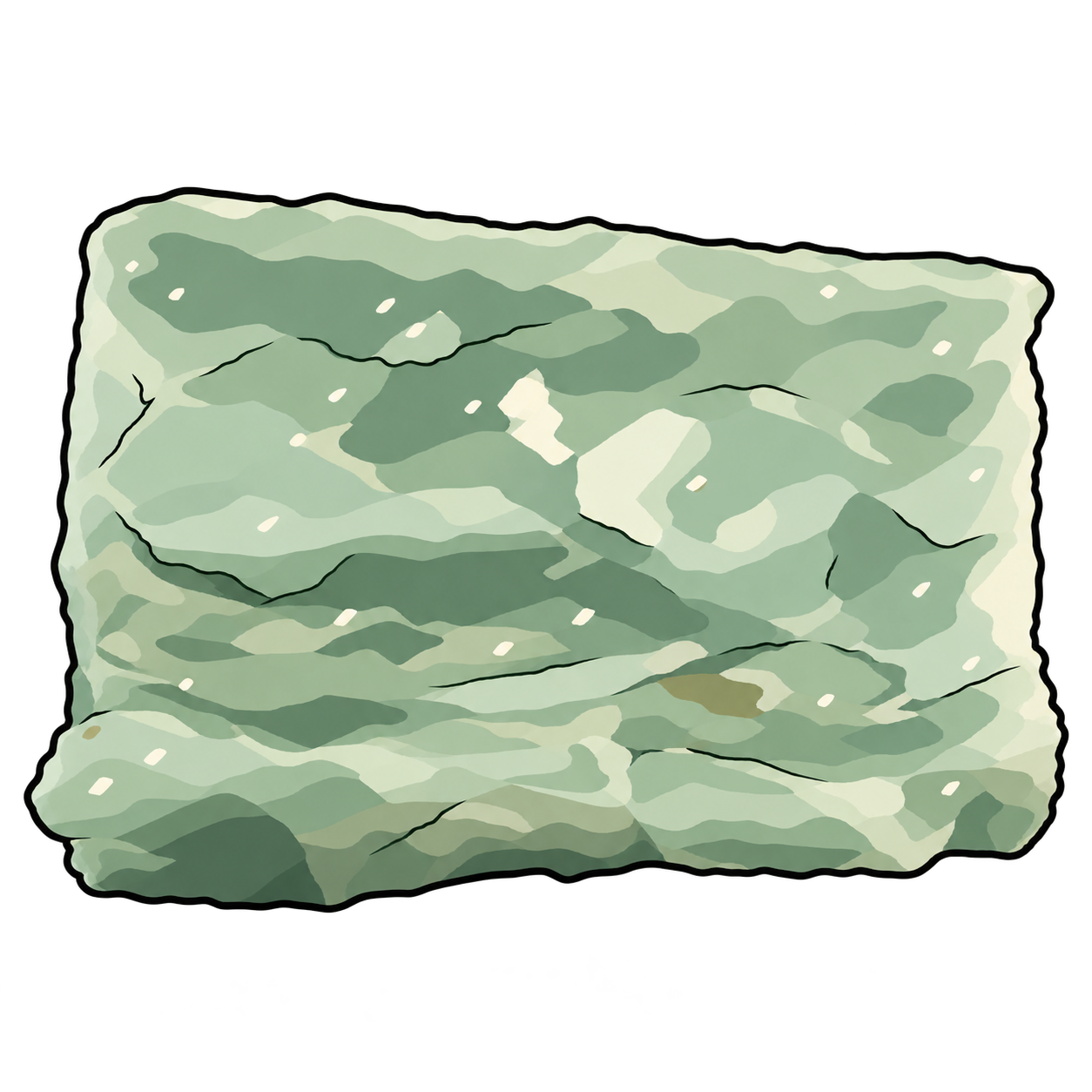
Aventurine is a quartz-rich material distinguished by small flashes from enclosed mineral flakes. Green is its best-known color, but orange, reddish and pink examples reveal a wider range of inclusions. Its appeal lies in the combination of body color, texture and shifting points of reflection rather than the transparency prized in rock crystal. In crystal practice, green aventurine is associated with optimism, opportunity and good fortune. [2, 3, 6, 11]
Green aventurine is treated in contemporary crystal practice as a stone of possibility: a companion for approaching unfamiliar situations with confidence and remaining receptive to change. These associations concern personal symbolism and ritual, not measured effects of its mineral composition. [3]
Green aventurine is a quartz-rich rock containing fuchsite, a green variety of muscovite. It combines distinct minerals rather than constituting a single green quartz crystal. [1]
Aventurine's glitter comes from light reflected by small, flat inclusions. Individual flakes brighten as their orientation catches the light, producing scattered flashes rather than the continuous moving band characteristic of a well-cut cat's-eye stone. [11]
The figures above describe quartz, the principal component, not a guaranteed laboratory reading for every aventurine carving. A published examination of one pink aventurine bangle recorded a refractive index of 1.54 and specific gravity of 2.60. That example illustrates why aggregate texture and included minerals deserve attention alongside a simplified sales label. [6]
Green aventurine commonly contains fuchsite. Hematite and goethite can contribute reddish or orange coloration; the material's appearance depends on the minerals present and their distribution. Vapriikki Mineral Museum records aventurine from India, Russia, the United States, Japan and Finnish Lapland. A color name alone does not establish where an individual piece originated. [2]
Pink material deserves particular care in labeling. A brownish-pink bangle examined by the Taiwan Union Lab of Gem Research had been submitted as “strawberry quartz.” Microscopy and spectroscopy identified a quartz aggregate containing reddish mica, termed alurgite, rather than the hematite inclusions associated with some other material sold under that name. The study demonstrates that a familiar retail name can cover more than one inclusion assemblage. It does not make every pink aventurine identical to that specimen. [6]
Quartz occurs in veins, metamorphic rocks and numerous other geological settings. It can form masses of interlocking grains rather than isolated crystals. Examining grain boundaries and included minerals helps distinguish the texture of a quartz-rich rock from that of a single crystal. [12]
Oxford's Corsi Collection provides a useful example outside the familiar green material. Specimen 722 is described as quartzite colored by hematite and goethite, with coatings on grains producing sparkle in places. Its catalog considers Siberia likely but notes that similar Egyptian material makes the origin uncertain. The uncertainty is part of the record, not a reason to assign a more confident locality. [7]
That catalog also notes that a large object may not glitter as consistently as a selected small piece. A particularly reflective patch can look impressive in a pendant while quieter areas dominate a vase cut from related material. For collectors, distribution matters as much as the simple presence of sparkle. [7]
These names overlap in descriptions of glittering materials but do not identify the same substance. Aventurine quartz is quartz-rich; sunstone is feldspar. Goldstone is manufactured glass containing small copper crystals. A sparkling appearance establishes an optical resemblance, not a common mineral identity. [8, 11]
“Aventurine” also appears in the vocabulary of glassmaking. The Corning Museum of Glass uses the term for translucent glass containing reflective inclusions. Consequently, an antique or decorative-art label mentioning aventurine may refer to glass rather than natural stone. Checking whether the catalog says quartz, feldspar or glass is more useful than relying on the shared name. [9]
Compare the material under both broad room lighting and a small directional light. Look first at the body color, then turn the piece slowly to examine the reflective flecks. A photograph selected for maximum glitter may not show its quieter appearance in ordinary use. Ask for more than one view when sparkle is important to the purchase.
Consider polish, shape and structural condition separately. Check a bangle's inner edge, bead holes and the narrow sections of a carving for chips or open cracks. A pleasing color does not compensate for a weak section in an object that will be handled frequently. These are practical inspection priorities, not a universal grading scale.
Protect thin carvings and bangle edges from impact; inspect existing fractures before mounting.
nmnhs.com · Reference for the accompanying text · Reference recorded October 15, 2026
vapriikki.fi · Reference for the accompanying text · Reference recorded October 15, 2026
thecrystalcouncil.com · Reference for the accompanying text · Reference recorded October 15, 2026
webmineral.com · Reference for the accompanying text · Reference recorded October 15, 2026
australian.museum · Reference for the accompanying text · Reference recorded October 15, 2026
gia.edu · Reference for the accompanying text · Reference recorded October 15, 2026
oum.ox.ac.uk · Reference for the accompanying text · Reference recorded October 15, 2026
gia.edu · Reference for the accompanying text · Reference recorded October 15, 2026
allaboutglass.cmog.org · Reference for the accompanying text · Reference recorded October 15, 2026
4cs.gia.edu · Reference for the accompanying text · Reference recorded October 15, 2026
mints.uwc.ac.za · Reference for the accompanying text · Reference recorded October 15, 2026