Color with an architectural edge
Fluorite
Calcium fluoride (CaF2).
Calcium fluoride mineral species and color varieties
Loading this page…
Return homePlease wait while the next page arrives.


Color with an architectural edge
Calcium fluoride (CaF2).
Calcium fluoride mineral species and color varieties
Fluorite is calcium fluoride, a halide rather than a silicate.
Geology · Human history · Spiritual attributes
Fluorite's modern spiritual associations centre on the ordering of thought. The Crystal Council presents its colours as variations on a shared theme of clarity and deliberate choice. These correspondences belong to contemporary spiritual practice, rather than to demonstrated effects on cognition. [1]
A multicoloured piece can hold several of these meanings together. Its visible zones offer a natural image for different concerns finding a place within an ordered whole. The individual interpretation remains a matter of practice and preference; the colours themselves do not establish different capacities to influence the mind.
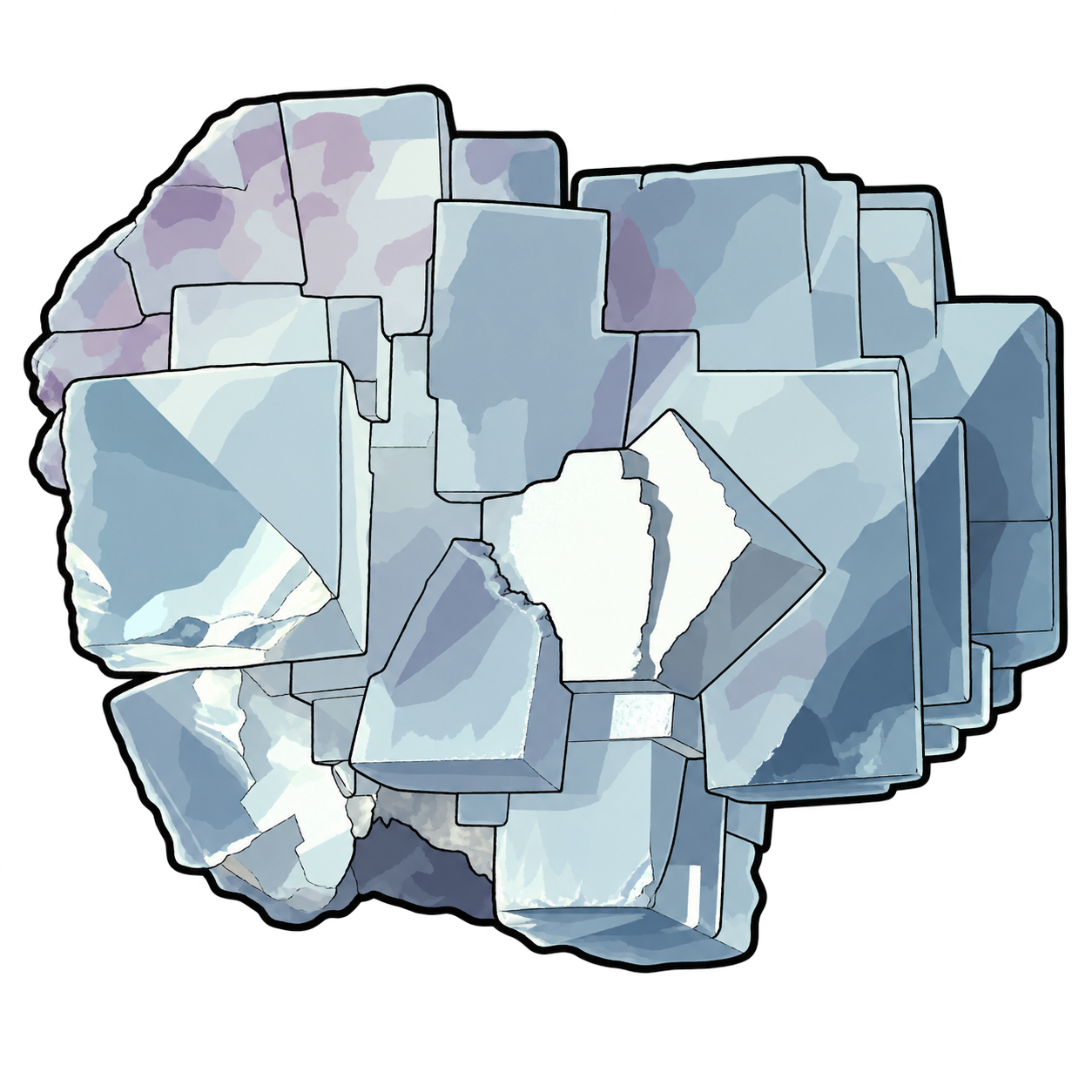
Fluorite is calcium fluoride, a halide rather than a silicate. Its cubic crystal structure can produce cubes, octahedra and combinations of faces, including stepped or rounded forms. Interpenetrating twins can appear as cubes passing through one another. Massive, granular and rounded aggregates occur as well. [2]
It has Mohs hardness 4 and a density commonly close to 3.18 g/cm³. Transparent to translucent pieces have a glassy lustre, while massive material may look dull. Perfect octahedral cleavage means that breakage follows four sets of planes, creating eight-faced fragments. A loose octahedron may therefore be a natural growth form or a cleavage fragment. The shape alone does not distinguish the two. [2,3]
Fluorite occurs in hydrothermal veins and deposits associated with layered rocks, and as an accessory mineral in several igneous environments. Quartz, calcite, barite and sulfide minerals are frequent companions. Cavities give crystals room to develop faces; tightly packed material records the same mineral in a less visibly geometric form. [2]
Colour zoning can preserve successive stages of growth. The Natural History Museum of Utah describes an Illinois specimen in which yellow fluorite formed first, small chalcopyrite crystals accumulated on its surface, and a later pale-blue generation enclosed both. The outline of the earlier crystal remains visible as a phantom. Inclusions and coloured boundaries can thus reveal a sequence that the outer face alone conceals. [3]
Fluorescence is a separate optical behaviour: some fluorite emits visible light under ultraviolet excitation. A green daylight specimen may glow bluish-white, as demonstrated by Weardale material in the Utah museum's display. Other specimens respond differently or weakly. Daylight colour and fluorescence are consequently separate observations, and neither should be inferred from the other. [2,3]
“Rainbow fluorite” describes a multicoloured appearance, not a separate mineral species. Cutting or polishing can expose zones that were difficult to see on the original surface. A polished banded piece and a sharply formed cube may look unrelated, yet both can be calcium fluoride with different growth histories and presentations.
Blue John is the banded purple-blue and pale fluorite associated with Castleton in Derbyshire, England. Oxford's Corsi Collection documents its ornamental extraction from around the middle of the eighteenth century and its use in Matthew Boulton's decorative work. The material's alternating bands lent themselves to vessels and objects whose curved surfaces made the colour patterns especially prominent. [4]
The collection's specimen 543 also preserves a specific social history. The sixth Duke of Devonshire gave it to Faustino Corsi after visiting his collection in 1824. Its documented origin and gift distinguish it from a merely similar-looking piece of purple fluorite. Oxford notes that decorative banded fluorite also comes from China; the appearance is not exclusive to one mining district. [4]
Fluorite became Illinois's official state mineral in 1965. The Rosiclare and Cave-in-Rock districts are important parts of its mining and collecting history. The Illinois State Museum describes deposits formed when mineral-bearing hot water moved through fractured limestone and left fluorite behind. This geological connection explains why mineral veins follow weaknesses in the rock rather than appearing at random. [5]
Industrial fluorite is often called fluorspar. Its use as a flux connects it with metal processing; it is also a source material for fluorine chemistry. The industrial mineral and the collector's crystal are the same species, selected for different qualities. A processing plant values composition and recoverability, whereas a cabinet specimen may be prized for undamaged faces, unusual zoning or a well-recorded locality. [3,5]
Fluorite combines moderate scratch resistance with easy cleavage and sensitivity to sudden temperature changes. The Australian Museum consequently describes faceted fluorite mainly as a collector's gemstone rather than a routine jewellery material. Its collection includes a 437.40-carat pink example cut from New South Wales material, demonstrating that impressive size does not imply everyday durability. [6]
Support a cluster from beneath, keep projecting cubes away from harder objects, and avoid tight mounts that concentrate pressure on an edge. A soft brush is preferable to forceful cleaning of a fragile aggregate. Do not attempt acid cleaning: associated minerals and existing fractures complicate the treatment, and the hazardous methods used by specialists are unsuitable for household care. A stable display preserves the small steps, edges and growth boundaries that make fluorite rewarding to examine.
thecrystalcouncil.com · Reference for the accompanying text · Reference recorded October 15, 2026
handbookofmineralogy.org · Reference for the accompanying text · Reference recorded October 15, 2026
nhmu.utah.edu · Reference for the accompanying text · Reference recorded October 15, 2026
oum.ox.ac.uk · Reference for the accompanying text · Reference recorded October 15, 2026
museum.state.il.us · Reference for the accompanying text · Reference recorded October 15, 2026
australian.museum · Reference for the accompanying text · Reference recorded October 15, 2026