A familiar name for a varied mineral family
Apatite
A mineral-group name; much gem material is fluorapatite.
Mineral group; species determination may be more precise
Loading this page…
Return homePlease wait while the next page arrives.


A familiar name for a varied mineral family
A mineral-group name; much gem material is fluorapatite.
Mineral group; species determination may be more precise
Apatite is a group name rather than one colour or one fixed composition.
Geology · Human history · Spiritual attributes
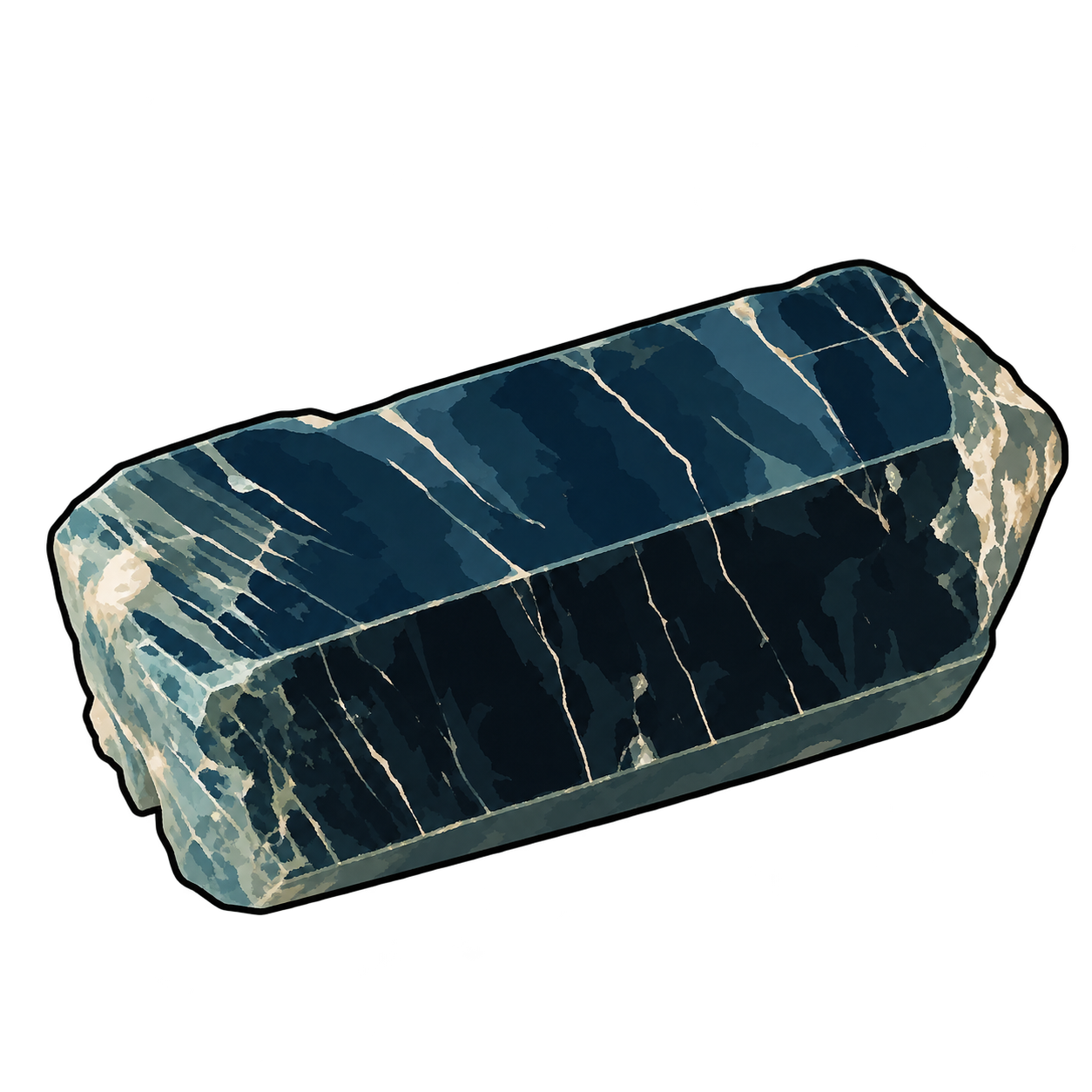
A group of calcium-phosphate minerals; fluorapatite is the common fluorine-rich member. [2][3][4]
Blue, green, yellow and other colours; prisms, granular masses, faceted gems and occasional cat's-eyes. [2][3][4]
Insight, knowledge, inspiration, purpose, manifestation and dream awareness, especially for blue apatite in contemporary practice. [1]
Blue apatite's contemporary symbolism connects inward understanding with forward movement. The Crystal Council associates it with the third eye, describing a stone for reflection, intuitive awareness and giving an imagined possibility clearer form. These are spiritual interpretations, not established effects of the mineral on cognition or health. [1]
The emphasis is less on a fixed outcome than on the relationship between an idea and a direction. A specimen beside a notebook can mark a space for recording impressions and returning to them thoughtfully. Its vivid colour supplies a visual point of attention; the work of interpretation and action remains personal.
Apatite is a group name rather than one colour or one fixed composition. Fluorapatite, chlorapatite and hydroxylapatite are closely related calcium phosphates distinguished by fluorine, chlorine or hydroxyl in an important structural position. Fluorapatite has the formula Ca₅(PO₄)₃F. [2,3]
Fluorapatite forms prisms, flattened crystals, nodules and granular masses. Its Mohs hardness is 5, density approximately 3.1–3.25 g/cm³, and lustre glassy to resinous. It is brittle despite poor cleavage; coloured crystals can show directional colour differences. [2]
The name derives from a Greek root associated with deception, reflecting confusion with other minerals. Colour alone is insufficient identification. [2]
Transparent apatite can be faceted; material displaying a cat's-eye is shaped to reveal a concentrated moving band of light. GIA's 2013 report describes a 12.50-carat blue cabochon exhibited at Tucson, with Brazilian origin reported by the exhibitor. A small, concentrated light source revealed a particularly sharp eye. [3]
The article distinguishes that optical effect from the cause of the blue colour. Earlier research had proposed a manganese-bearing substitution as an explanation for blue apatite, but the author left the origin of this particular stone's colour open to further investigation. The eye was directly observable; its vivid body colour required a separate explanation. This distinction is useful whenever a gem combines several striking features. [3]
Fluorapatite occurs in igneous rocks, including pegmatites and carbonatites, and in marbles and skarns. It is also an important component of sedimentary phosphorites. [2]
USGS defines phosphate rock as ore and concentrates containing apatite minerals. These materials are the principal source of phosphorus for phosphate fertilizers. The commercial importance lies in the phosphate chemistry rather than gem colour or transparency: material with little appeal as a display crystal may be valuable as an agricultural raw material. [4]
This connection places apatite within a broader movement of phosphorus through rocks, soils and living systems. A cabinet specimen invites attention to an individual crystal; a mineral-resource perspective asks how much phosphate a deposit contains and how it can be recovered. Both begin with composition, but they ask different questions of the material.
Hydroxyapatite provides the structural model for the principal mineral component of teeth and bone. NIST emphasizes that biological mineral is more complex and variable than a well-defined synthetic material. Proteins and other molecules interact with calcium-phosphate surfaces and help govern mineral growth in living tissues. [5]
In developing tooth enamel, for example, proteins influence the formation of elongated apatite crystallites and are subsequently removed as the enamel matures. This is organized biomineralization, not simply a body depositing a miniature version of a gem-shop crystal. The relationship is chemical and structural; it does not make a natural apatite specimen a treatment for teeth, bones or nutritional deficiency. [5]
Apatite's moderate hardness and brittleness call for protection from rubbing and impacts. Store a loose gem separately from harder stones, and support a natural prism so its ends do not bear unnecessary pressure. GIA also identifies apatite as vulnerable to thermal shock, so avoid sudden temperature changes and high-heat cleaning. [2,6]
An uncut prism can reveal details that disappear during cutting: changes in colour along its length, cloudy zones, irregular ends or networks of pale fractures. In a polished gem, the cutter instead organizes colour and reflected light into a deliberate viewing face. Both forms can be rewarding, with the natural crystal preserving growth texture and the finished stone emphasizing its optical character.
thecrystalcouncil.com · Reference for the accompanying text · Reference recorded October 15, 2026
handbookofmineralogy.org · Reference for the accompanying text · Reference recorded October 15, 2026
gia.edu · Reference for the accompanying text · Reference recorded October 15, 2026
usgs.gov · Reference for the accompanying text · Reference recorded October 15, 2026
nist.gov · Reference for the accompanying text · Reference recorded October 15, 2026
4cs.gia.edu · Reference for the accompanying text · Reference recorded October 15, 2026