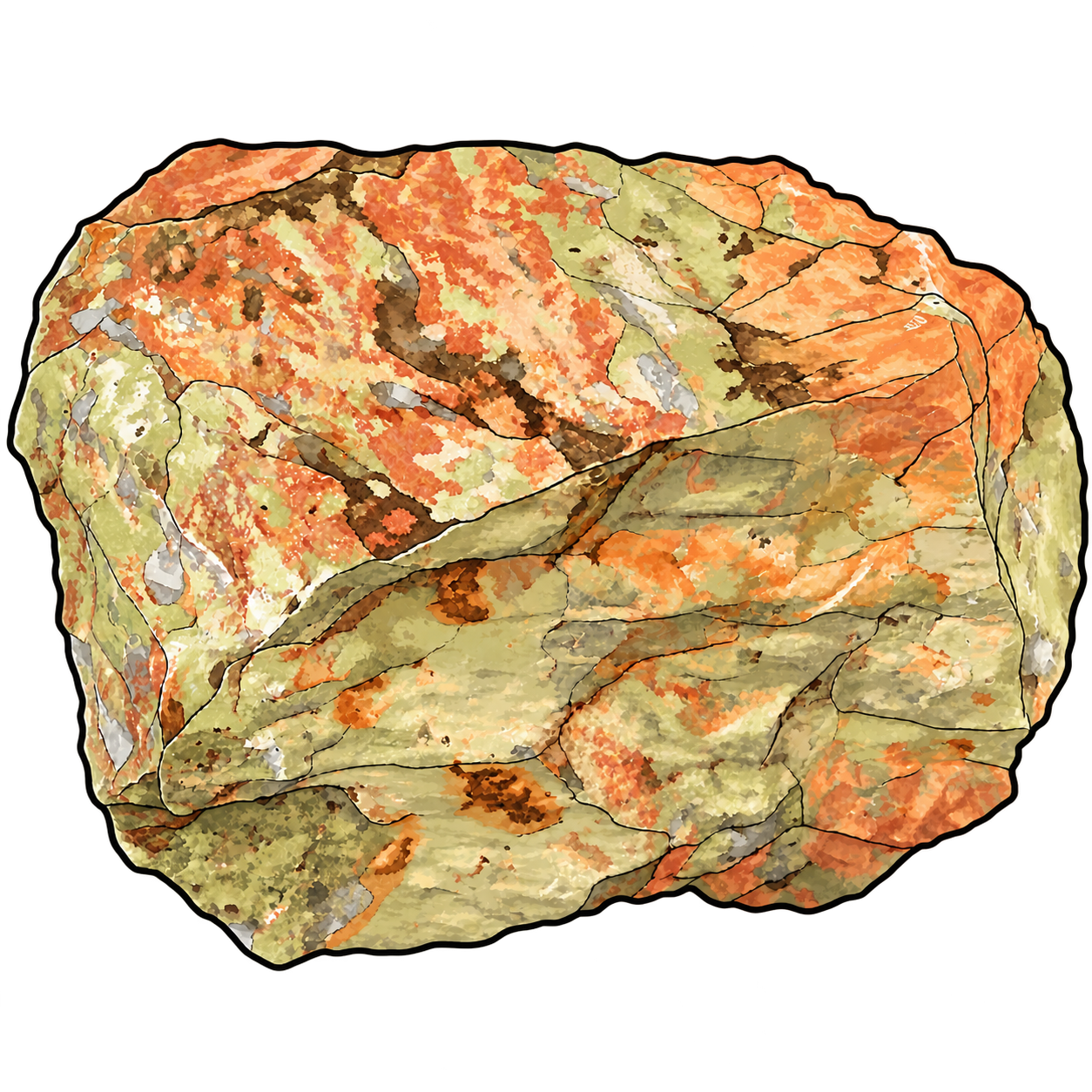
Pink feldspar and green epidote in an altered granitic rock
Unakite
Altered rock combining feldspar, epidote and commonly quartz.
Altered natural rock assemblage
Loading this page…
Return homePlease wait while the next page arrives.


Pink feldspar and green epidote in an altered granitic rock
Altered rock combining feldspar, epidote and commonly quartz.
Altered natural rock assemblage
Unakite's pink-and-green pattern belongs to a rock assembled from contrasting minerals.
Geology · Human history · Spiritual attributes
Compassion, self-acceptance, emotional balance and patient change in contemporary crystal practice. [5]
Unakite's pink-and-green pattern belongs to a rock assembled from contrasting minerals. Green epidote lies among pink feldspar and lighter quartz, producing a mottled mosaic rather than the banding of an agate or the uniform structure of a single crystal. The proportions vary: some pieces are predominantly green, while others retain broad pink areas interrupted by smaller green patches.
The Crystal Council presents unakite as a heart-centered stone associated with self-love, empathy, compassion and working through change. Its chakra interpretation is a contemporary spiritual framework, not a mineralogical classification or evidence of medical benefit.[5]
The pink and green areas offer a visual focus for the idea of holding different experiences together. A person may use unakite during reflection on a difficult transition, treating its joined colors as a reminder that change need not erase what came before. Compassion can be directed outward toward another person or inward toward an imperfect decision. These are chosen meanings, not physical effects of epidote on emotion.
Unakite has no single formula or crystal system. Its components retain their own properties even when they are polished into one object. Epidote is a calcium-aluminum-iron silicate, commonly green, with Mohs hardness 6–7 and pronounced cleavage. Orthoclase, a potassium feldspar with formula KAlSi3O8, has hardness about 6–6.5 and its own cleavage. Those mineral properties help explain why an apparently solid polished surface can still chip along internal planes.[3,4]
The overall pattern depends on the sizes and distribution of the ingredients, not simply their names. A large pink feldspar patch can dominate one face while the reverse is largely green. Fine mixtures give a more even color at a distance; coarser areas remain visibly separate. A description should therefore distinguish the rock's identity from the particular visual balance of an individual piece.
U.S. Geological Survey work in the Virginia Blue Ridge describes unakite as a local product of secondary alteration in granodioritic rock. In the studied material, epidote replaced much of the earlier mineral assemblage while some original feldspar remained; secondary quartz was also present, and elements of the earlier texture survived.[2]
This is not the same process as loose pink and green fragments being cemented into a sediment. It is alteration within an existing rock. The distinction matters because unakite preserves both continuity and replacement: parts of the earlier rock remain recognizable, while other constituents have changed. The precise alteration history must come from geological evidence at a locality, not from color alone.
An early U.S. Geological Survey account connects the name with the Unaka Mountains and cites Bradley's 1874 description. It also records material from Milams Gap near Luray, Virginia, and from the vicinity of Troutdale in Grayson County, describing irregular red feldspar, quartz and green epidote.[1]
The name therefore has a documented geological history independent of later crystal-shop symbolism. Those occurrences are examples, not a provenance certificate for every carved heart or bead. An object without a locality can still be described accurately as unakite; assigning it to the Unaka Mountains solely because of the name would add information that has not been established.
The common trade phrase “unakite jasper” is less precise than unakite: the rock is not defined as a fine-grained quartz variety. Its visibly mixed minerals are part of its character. Conversely, not every green-and-pink stone is unakite; a decorative resemblance is a starting observation, not a complete identification.
For a polished piece, examine whether the finish is even across the different patches and whether any pits or fractures interrupt the surface. For rough material, a fresh-looking edge may reveal texture more clearly than a weathered exterior, but an intact specimen need not be broken to satisfy curiosity. A close photograph under neutral light is more informative than saturation that exaggerates pink and green into neon colors.
Use gentle cleaning and avoid impacts, especially at thin carved edges and drill holes. Cleavage in a constituent mineral can make a local area vulnerable even when the whole rock feels substantial. A soft damp cloth is generally a conservative choice for an untreated polished object; dry it afterward and account separately for metal settings, adhesives or stringing. Keep rough pieces apart from softer polished materials that they could abrade.
pubs.usgs.gov · Reference for the accompanying text · Reference recorded October 15, 2026
pubs.usgs.gov · Reference for the accompanying text · Reference recorded October 15, 2026
handbookofmineralogy.org · Reference for the accompanying text · Reference recorded October 15, 2026
handbookofmineralogy.org · Reference for the accompanying text · Reference recorded October 15, 2026
thecrystalcouncil.com · Reference for the accompanying text · Reference recorded October 15, 2026