Blue mineral fibers, quartz landscapes, and a history beyond ornamental stone
Dumortierite
Aluminium borosilicate, commonly encountered in quartz-rich material.
Mineral species; ornamental specimens may include other minerals
Loading this page…
Return homePlease wait while the next page arrives.


Blue mineral fibers, quartz landscapes, and a history beyond ornamental stone
Aluminium borosilicate, commonly encountered in quartz-rich material.
Mineral species; ornamental specimens may include other minerals
Dumortierite is an aluminum borosilicate occurring in fibrous masses and as needles within quartz.
Geology · Human history · Spiritual attributes
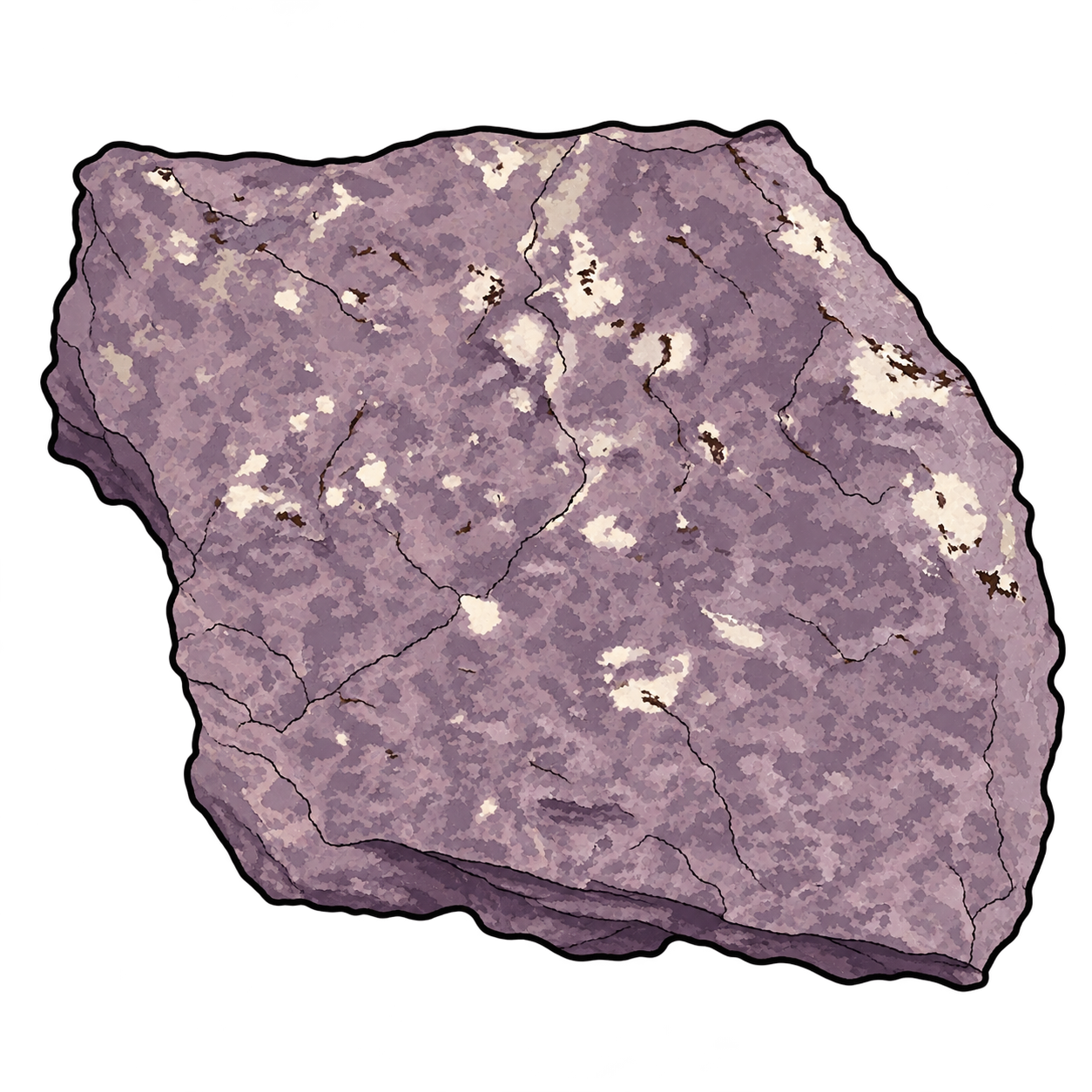
The Crystal Council associates dumortierite with learning, concentration, intention, and third-eye practice. Its account places the stone beside study and intuitive exploration, including dream-centered reflection. These are practitioner beliefs rather than evidence that the mineral changes memory, intelligence, or perception. [3]
A quiet study space or meditation setting is a coherent place for this symbolism, without requiring claims about hidden physical powers. A stone can mark the beginning of a period of concentration just as a notebook or candle can mark an intentional activity. Its significance belongs to the practice and the person, not to a scientifically established enhancement of mental performance.
Dumortierite is commonly represented by Al7(BO3)(SiO4)3O3. It crystallizes in the orthorhombic system and frequently develops slender prisms, needles, or fibrous aggregates rather than large, sharply terminated crystals. The Handbook of Mineralogy reports hardness of approximately 7–8.5 and specific gravity around 3.21–3.41. Distinct cleavage in one direction and less developed cleavage in another mean hardness should not be confused with immunity to breakage. [1]
Dumortierite can be strongly pleochroic: color depends on the direction of polarized light through a crystal. Opaque aggregates may conceal this optical behavior. [1,2]
Color alone is not a sufficient test. Blue needles in quartz may suggest dumortierite, but a reliable identification considers crystal habit, optical behavior, and, where needed, analytical results. Equally, a purple rough specimen is not excluded merely because popular illustrations emphasize blue examples.
Dumortierite occurs in aluminum-rich metamorphic rocks and some pegmatitic or vein environments, associated with quartz, kyanite, andalusite, sillimanite, cordierite or muscovite. [1]
USGS work in Nevada's Rochester district documented dumortierite both in quartz veins and in a sericite–dumortierite–quartz–andalusite schist formed by chemical replacement of rhyolitic rock. That example is more specific than the simplified description that all dumortierite forms in pegmatites. The surrounding rocks, fluids, and replacement history matter. [5]
Such geological context should stay attached to a documented specimen. A blue or violet stone bought without provenance cannot be assigned to a Nevada mine or Brazilian locality from its color and texture alone.
In a 2015 GIA examination, Brazilian rock crystal contained vivid blue dumortierite needles arranged in clusters and along internal growth planes. Raman analysis established their identity. The researchers also identified pale to colorless needles as the same mineral, an important caution against using blue color as a defining requirement. [2]
Chemical analysis found substantially more magnesium in the colorless inclusions than in the blue ones. The authors proposed that relationships among magnesium, titanium, and iron could help explain the difference, while explicitly calling for further investigation. The result is a scientific explanation in development, not permission to claim that every pale dumortierite has one proven color mechanism. [2]
For collectors, the attraction of included quartz is partly spatial: a clear host preserves the orientation and distribution of tiny crystals. A dense blue ornamental rock offers a different experience. Both can legitimately involve dumortierite, but a description should say whether the material is an aggregate, a quartz-rich rock, or visible inclusions in transparent quartz.
The mineral honors French paleontologist Eugène Dumortier; early occurrences include the Beaunant–Chaponost area near Lyon. [1]
Its history also extends into manufacturing. A mid-twentieth-century USGS account describes about two decades of mining at the Nevada deposit in Humboldt Queen Canyon and the use of the material in spark-plug insulators. It reports only a small production in 1949 after earlier operations ceased. Those are historical observations, not a statement about present mine availability or a claim that every ornamental dumortierite was mined for ceramics. [4]
Industrial value and decorative value reflect different priorities. An industrial user evaluates composition and behavior in processing; a collector may value a well-documented occurrence, crystal habit, or attractive inclusion scene. Neither standard is captured by judging how saturated the blue appears in a photograph.
Ask what the finished item actually contains. A commercial name may describe the mineral responsible for its color rather than the majority of the object. Keep any laboratory report and locality information with the piece, especially where a clear quartz host or a mixed rock is involved.
Do not equate a relatively high hardness with complete toughness. Fibrous margins, fractures, and interfaces between minerals remain vulnerable. Avoid dropping specimens or storing polished surfaces loose beside other stones. For a stable, untreated polished piece, use a soft cloth and mild cleaning rather than aggressive abrasion. Avoid ultrasonic or steam cleaning where inclusions, cracks, unknown fillers, or a delicate matrix are present. Rough fibrous specimens should be handled gently, without grinding or brushing material into airborne dust.
handbookofmineralogy.org · Reference for the accompanying text · Reference recorded October 15, 2026
gia.edu · Reference for the accompanying text · Reference recorded October 15, 2026
thecrystalcouncil.com · Reference for the accompanying text · Reference recorded October 15, 2026
pubs.usgs.gov · Reference for the accompanying text · Reference recorded October 15, 2026
pubs.usgs.gov · Reference for the accompanying text · Reference recorded October 15, 2026