Green Minerals Formed Through Transformation
Serpentine
Serpentine-group minerals and serpentine-rich rock
Hydrous magnesium silicate mineral group and related serpentinite rocks
Loading this page…
Return homePlease wait while the next page arrives.


Green Minerals Formed Through Transformation
Serpentine-group minerals and serpentine-rich rock
Hydrous magnesium silicate mineral group and related serpentinite rocks
Serpentine is a group of hydrous magnesium silicate minerals; serpentinite is a rock composed largely of them.
Geology · Human history · Spiritual attributes
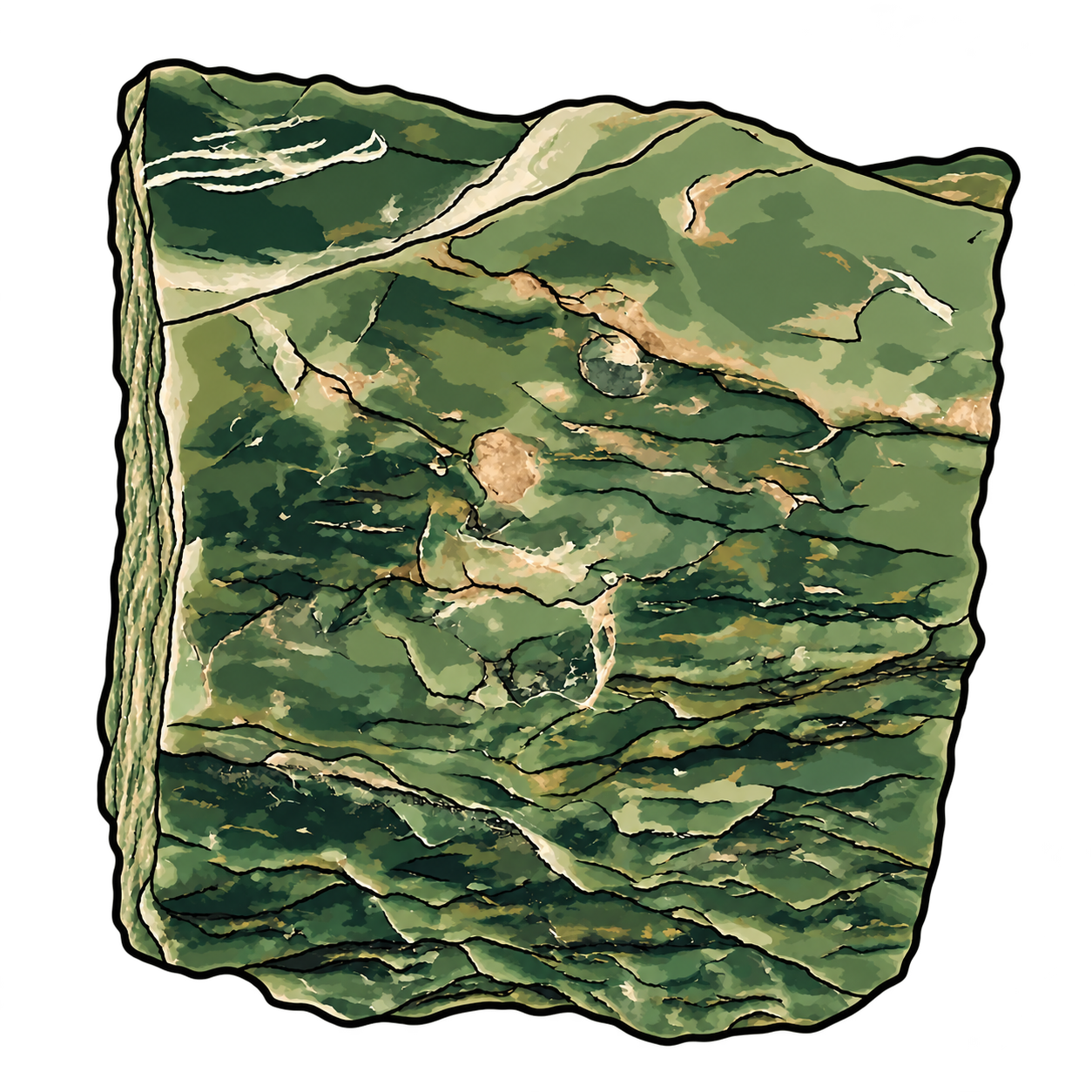
Serpentine is a group of hydrous magnesium silicate minerals; serpentinite is a rock composed largely of them. The familiar polished green material may contain several minerals, pale veins and dark inclusions. Its pattern records alteration and mineral growth rather than the interior of one large green crystal. [1, 2]
Contemporary crystal practice associates serpentine with transformation and a sense of connection to the natural world. The Crystal Council links it with compassionate reflection and uses kundalini imagery to describe spiritual awakening. These are practitioner interpretations, not properties established by mineral analysis. [3]
This last association draws on kundalini language; it does not establish that historical tantric traditions prescribed a serpentine stone. A meaningful meditation object need not be credited with changing anatomy, treating illness or producing a guaranteed spiritual experience.
Common members: Antigorite, lizardite and chrysotile Simplified magnesium-rich composition: Mg₃Si₂O₅(OH)₄ Material type: Sheet silicates with differing structural arrangements Antigorite hardness: Approximately 2.5–3.5 in the Handbook of Mineralogy Lizardite hardness: Approximately 2.5 in the Handbook of Mineralogy Typical luster: Waxy, greasy or resinous; some fibrous surfaces appear silky Whole-rock properties: Variable with mineral mixture and texture [1, 2, 4]
The principal serpentine minerals have closely related compositions but different arrangements of their layers. Lizardite generally forms very fine platy material; antigorite commonly has a bladed or platy habit; chrysotile has the characteristic fibrous form associated with asbestos. An attractive polished object and a loose fibrous specimen should not be treated as equivalent simply because both carry a serpentine label. [1, 2, 4]
The handbook lists antigorite as monoclinic and records perfect cleavage along its layers. Lizardite has different structural variants and a similarly strong layer-related cleavage. Such crystal-scale properties do not imply that a mixed ornamental rock will split neatly along one visible plane. Its veins, grain arrangement and fractures also influence how it behaves. [1, 2]
A polished rock may contain minerals harder or softer than its dominant serpentine. Thin veins can wear differently, and a coating can alter the feel of the surface. It is more useful to identify the material and its condition than to repeat a broad trade range as if it described every part of every carving. Do not scratch a finished object to test a label.
Serpentinization involves water-bearing reactions with magnesium-rich rocks. Lizardite commonly replaces olivine and pyroxene in ultramafic rocks; antigorite can occur in extensive replacements and crosscutting veins. The resulting rock may retain chromite, magnetite or remnants of earlier minerals. Some serpentine also forms through reactions involving magnesium-rich carbonate rocks. [1, 2]
This process has significance far beyond ornamental stones. Where mantle rocks are exposed to seawater, reactions can contribute to hydrothermal activity. NOAA's account of a 2023 Mid-Atlantic Ridge expedition describes a search for alkaline systems resembling Lost City. The team discovered three high-temperature black-smoker vent fields, but not another example of the particular serpentinization-driven alkaline venting it sought. Those are distinct findings, not interchangeable types of vent. [5]
Serpentine is therefore a useful bridge between a familiar green carving and active research into water–rock interactions. A specimen's appearance cannot reveal its complete geological history, but an accurate locality and mineral identification give that history a starting point.
Some serpentine can resemble jadeite or nephrite closely. A 2015 laboratory report examined an unusually clean olive-green cabochon initially resembling fine jadeite. Measurements and infrared spectroscopy identified it as antigorite. The report's proposed precise origin remained a suggestion, illustrating that mineral identification can be firmer than a locality inference. [6]
For buyers, the useful question is what the object actually contains. A vague jade-like trade name should be accompanied by the mineral or rock identity. Serpentine can be attractive and worthwhile under its own name; it does not need to be presented as a more expensive material.
Bowenite is a compact ornamental serpentine material. In the Māori classification recorded by Te Papa, tangiwai is bowenite pounamu rather than nephrite. Its cultural name and geological description can coexist without making bowenite a new mineral species. [7]
The British Museum's black-brown serpentine amulet EA56465, dated to the fourth–fifth centuries CE, is a particularly specific example of ritual use. Its engraved imagery includes an ibis, serpents and an ouroboros enclosing a womb-shaped device and key. At approximately five centimeters long, the object concentrates figures and inscriptions on a small worked surface. [8]
That documented object should not become a claim that all serpentine was historically used for the same purpose. The imagery, period and cultural setting supply the meaning; the rock alone does not.
Tangiwai has a different account. Te Papa connects the name with tears and deep sorrow and records a story in which Waitaiki's tears become stone at Piopiotahi. The museum also makes clear that more than one origin story exists. This is a named Māori narrative attached to a particular material and place, not a universal crystal-shop correspondence. [7]
Chrysotile is an asbestos mineral. The USGS distinguishes it from the amphibole asbestos minerals, while ATSDR emphasizes that hazardous exposure concerns fibers released into the air when deposits or materials are disturbed. A photograph or a general “serpentine” label cannot establish the composition or exposure conditions of an unknown piece. [4, 9]
Do not cut, drill, grind, brush aggressively or otherwise create dust from unidentified or visibly fibrous rough. Seek qualified identification before lapidary work. A polished appearance alone is not a certificate that all constituents are known. If loose fibers or dust are present, stop handling rather than attempting a home cleaning experiment. [9]
For a confirmed compact finished object in sound condition, favor gentle handling and a soft, lightly damp cloth. Avoid abrasives, impacts, prolonged soaking and aggressive chemical cleaning; repairs, coatings and softer mineral veins may need different care. Keep its identification and any treatment history with the piece. Architectural stone, antique carvings and fibrous specimens warrant advice specific to the object rather than one universal cleaning recipe.
handbookofmineralogy.org · Reference for the accompanying text · Reference recorded October 15, 2026
handbookofmineralogy.org · Reference for the accompanying text · Reference recorded October 15, 2026
thecrystalcouncil.com · Reference for the accompanying text · Reference recorded October 15, 2026
usgs.gov · Reference for the accompanying text · Reference recorded October 15, 2026
oceanexplorer.noaa.gov · Reference for the accompanying text · Reference recorded October 15, 2026
gia.edu · Reference for the accompanying text · Reference recorded October 15, 2026
collections.tepapa.govt.nz · Reference for the accompanying text · Reference recorded October 15, 2026
britishmuseum.org · Reference for the accompanying text · Reference recorded October 15, 2026
atsdr.cdc.gov · Reference for the accompanying text · Reference recorded October 15, 2026