A chamber of pale blue light
Celestine
Strontium sulfate (SrSO4).
Strontium sulfate mineral species
Loading this page…
Return homePlease wait while the next page arrives.


A chamber of pale blue light
Strontium sulfate (SrSO4).
Strontium sulfate mineral species
Celestine is orthorhombic strontium sulfate, SrSO₄, in the barite group.
Geology · Human history · Spiritual attributes
Strontium sulfate, SrSO₄. [2]
Orthorhombic sulfate mineral in the barite group. [2]
Glassy plates or prisms, often pale blue or colourless; also granular and fibrous forms. [2]
Peace, clarity, angelic connection, dream awareness and intuitive insight in contemporary practice. [1]
Celestine, often called celestite in crystal shops, is associated with receptive attention and a sense of spiritual spaciousness. The Crystal Council places third-eye and crown-chakra symbolism at the centre of its interpretation, connecting the stone with meditation and inward vision. These associations describe contemporary beliefs rather than measurable mineral properties. [1]
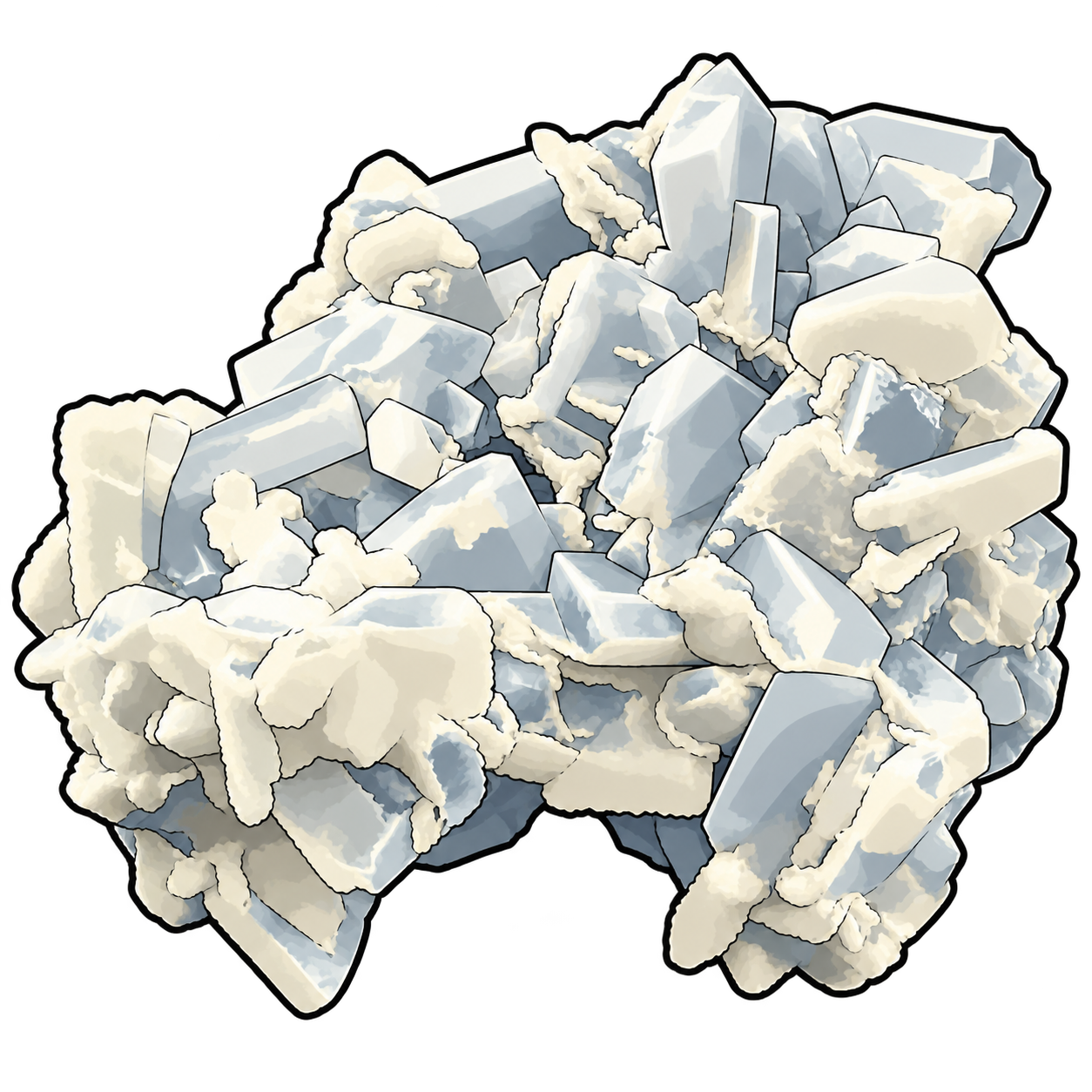
A cluster can provide a particularly engaging visual focus: light gathers along a face, passes into a transparent edge and disappears into a shadowed cavity. That changing pattern rewards still observation. A stable bedside or desk display gives the specimen a place in a personal ritual while protecting its projecting crystals.
Celestine is orthorhombic strontium sulfate, SrSO₄, in the barite group. Its celestial name reflects the familiar pale blue, although other colours occur. Growth forms include plates, prisms and granular or fibrous masses. [2]
Its hardness is about 3–3.5 on the Mohs scale, with a density close to 3.97 g/cm³. Celestine is therefore comparatively heavy yet easily scratched and brittle. Perfect cleavage in one direction and good cleavage in another make exposed crystal edges vulnerable. Glassy faces can contrast with a pearly appearance along cleavage surfaces. [2]
Celestine and barite form a strontium–barium compositional series. Their similar structures explain their resemblance, but identification requires more than blue colour. [2]
Strontium-bearing waters or brines can deposit celestine in fissures and cavities. It also occurs in sedimentary deposits, hydrothermal veins and some volcanic rocks. [2]
Ohio's Findlay Arch provides a well-documented regional example. Fractures allowed mineral-bearing fluids to circulate through carbonate rocks, leaving celestine in small cavities and along breaks. Quarrying sometimes exposed larger mineral-lined openings. The rock surrounding a specimen is therefore part of its geological setting, not merely a background for the crystals. [3]
Crystal Cave on South Bass Island entered its modern history through well drilling. In 1880, a drill became stuck while Herman Herbster was improving his vineyard property. Attempts to recover the equipment exposed celestine. Failed mining ventures and financial difficulties preceded a sheriff's sale in 1894; the property eventually passed to the Heineman family, and the cave opened to visitors in 1898. [3]
The Ohio Geological Survey records crystals reaching about 45 centimetres in length. It also qualifies the popular description of the cave as the world's largest geode, noting that it lacks several usual geode features. Its significance does not depend on the superlative: it is an unusually large, accessible example of crystal-lined space. [3]
Celestine is an important source of strontium. USGS distinguishes it from strontianite, a strontium carbonate: both can supply the element, but celestine more often occurs in sedimentary deposits large enough for economic extraction. Strontium is frequently used in carbonate form, so extracting a useful element and obtaining the desired industrial compound are separate operations. [4]
Strontium compounds produce the strong reds of many fireworks and signal flares. This colour is not the blue of a celestine specimen transferred into a flame. The appearance of a solid mineral and the light produced by excited chemical species are different phenomena. The connection is the element strontium, carried from a natural raw material into a manufactured application. [5]
Support the sound base, protect projecting crystals from contact, and dust gently. A secure mount accommodates the specimen's weight without stressing its delicate edges. [2]
Look across a cluster from several angles. Some faces may be transparent while others appear milky or crusted; broad plates can alternate with narrower prisms. The relationships between clear crystal, pale coating and darker matrix often give a specimen more visual depth than colour alone.
thecrystalcouncil.com · Reference for the accompanying text · Reference recorded October 15, 2026
handbookofmineralogy.org · Reference for the accompanying text · Reference recorded October 15, 2026
dam.assets.ohio.gov · Reference for the accompanying text · Reference recorded October 15, 2026
usgs.gov · Reference for the accompanying text · Reference recorded October 15, 2026
pubs.usgs.gov · Reference for the accompanying text · Reference recorded October 15, 2026