Delicate forms with unexpected weight
Barite / Baryte
Barium sulfate (BaSO4).
Barium sulfate mineral species and aggregate forms
Loading this page…
Return homePlease wait while the next page arrives.


Delicate forms with unexpected weight
Barium sulfate (BaSO4).
Barium sulfate mineral species and aggregate forms
Barite is barium sulfate, BaSO₄.
Geology · Human history · Spiritual attributes
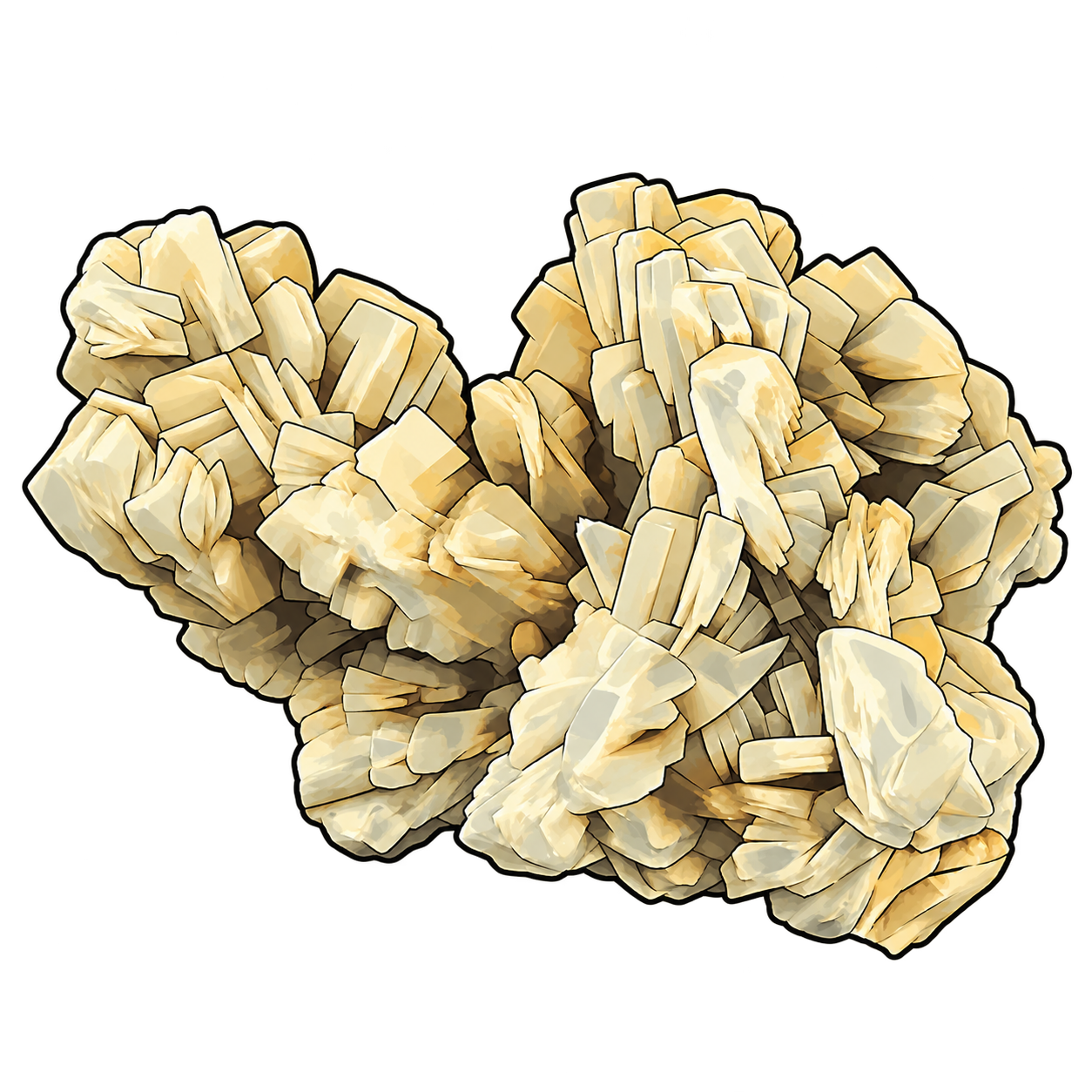
Barium sulfate, BaSO₄; also spelled baryte. [2]
Orthorhombic sulfate mineral in the barite group. [2]
Plates, blades, crests and rosettes; colourless, cream, yellow, brown, blue and other pale shades. [2]
Inner vision, dream awareness, spiritual guidance and alignment with the higher self in contemporary practice. [1]
Barite's contemporary spiritual associations emphasize inward attention. The Crystal Council links it with the third-eye and crown chakras, describing meditation as a way to explore intuition and a spiritually meaningful direction. These meanings belong to practitioner tradition rather than the mineral's demonstrated physical effects. [1]
Its physical presence offers a distinctive contrast to this inward symbolism. Broad pale plates may look almost weightless, yet a supported specimen feels substantial. For contemplative use, a stable display keeps delicate blades visible without placing pressure on them.
Barite is barium sulfate, BaSO₄. Its orthorhombic crystals commonly form plates or blades; aggregates may be crested, fibrous, nodular or rose-like. The lustre ranges from glassy to resinous or pearly, and colour can vary within a single crystal. Barite forms a compositional series with celestine, its strontium-bearing relative. [2]
At about 4.5 g/cm³, its density is high for a familiar pale nonmetallic mineral. Hardness is only 3–3.5, however, and the mineral is brittle with prominent cleavage. Weight and resistance to damage are separate properties: a heavy cluster can still lose a thin plate through careless handling. [2]
Some specimens fluoresce or phosphoresce, and some change colour on exposure to light. These behaviours vary by specimen. Keep a valued coloured piece away from prolonged intense illumination and support it beneath its body rather than lifting by a blade. [2]
Barite's name comes from a Greek word meaning heavy, a property central to its industrial uses. USGS describes its preparation as a weighting agent for petroleum-well drilling fluids, as well as its use in fillers and heavy aggregates. Processing can include washing and separation to improve purity or density, followed by crushing or grinding to the required particle size. [3]
This industrial route differs sharply from specimen collecting. A collector protects the architecture of intact crystals; a processor seeks a predictable material that can be distributed through another product. The same density remains useful in either setting, but the desired physical form changes completely. A finely ground weighting material and a fan of translucent blades are two presentations of the same mineral. [3]
Oklahoma's barite roses contain quartz sand grains enclosed within radiating barite crystals. Small amounts of hematite contribute their reddish colour. The Oklahoma Geological Survey describes the roses as growths within the Garber Sandstone, formed after the sandstone had become rock; their exact age is not established. [4]
Their rounded, petal-like crystals are unusual. The Survey discusses organic compounds inhibiting growth at crystal corners as an explanation for the disc-like shapes. Groundwater supplied the ingredients, but details of the formation mechanism and distribution remain research questions. These mineral roses became Oklahoma's official state rock in 1968. [4]
The phrase desert rose describes an aggregate shape rather than a unique chemical identity. Barite roses and gypsum roses can resemble flowers while belonging to different minerals. The mineral name alongside the descriptive name keeps the form and substance clear.
At seafloor hydrothermal vents, hot barium-bearing fluid encounters cold sulfate-bearing seawater. Their mixing can precipitate barite. A study of 22 barite-rich samples from the Endeavour Segment of the Juan de Fuca Ridge found branching and needle-like forms near vent exteriors, with larger blades and tablets inside chimney structures. [5]
The researchers combined texture, chemistry and fluid-inclusion evidence to investigate the conditions of growth. Variations in strontium within individual crystals recorded changes in the system, while the different crystal shapes related to fluid mixing and saturation. Barite thus preserves more than an attractive outline: it can retain information about water movement and chemical conditions in a difficult-to-observe environment. [5]
Follow the edge of a single plate before looking at the cluster as a whole. A thin crystal may be nearly transparent at its margin while appearing darker where several plates overlap. Honey-coloured zones, white coatings and associated minerals can interrupt that pattern, revealing successive surfaces and growth relationships.
Support the main body, leave space around projecting blades, and dust gently. Separate pieces during storage to prevent rubbing and impacts. [2]
thecrystalcouncil.com · Reference for the accompanying text · Reference recorded October 15, 2026
handbookofmineralogy.org · Reference for the accompanying text · Reference recorded October 15, 2026
usgs.gov · Reference for the accompanying text · Reference recorded October 15, 2026
ou.edu · Reference for the accompanying text · Reference recorded October 15, 2026
repository.library.noaa.gov · Reference for the accompanying text · Reference recorded October 15, 2026