A blue stone with two histories
Angelite
Trade name for blue-grey massive anhydrite.
Blue-gray massive anhydrite traded under a variety name
Loading this page…
Return homePlease wait while the next page arrives.


A blue stone with two histories
Trade name for blue-grey massive anhydrite.
Blue-gray massive anhydrite traded under a variety name
Angelite is blue anhydrite rather than a separate mineral species.
Geology · Human history · Spiritual attributes
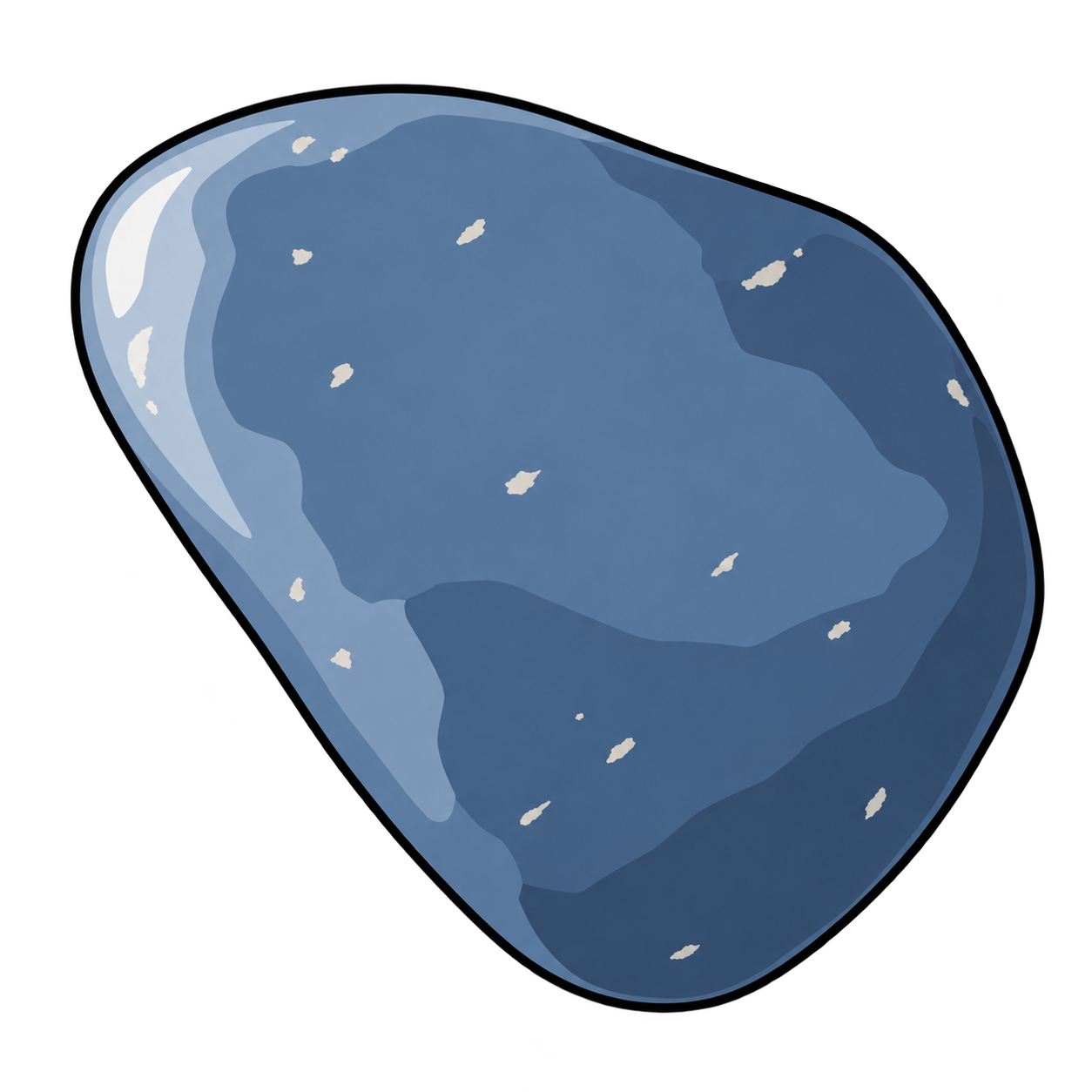
Gentle expression, inner peace, angelic connection, intuition and dream awareness in contemporary crystal practice. [1]
Angelite's modern spiritual identity centres on communication: expressing an inward impression, listening closely and seeking a sense of connection beyond ordinary experience. The Crystal Council associates it with the throat, third-eye and crown chakras. These are practitioner beliefs rather than demonstrated effects of calcium sulfate. [1]
Its soft blue appearance suits this language of receptivity. A supported stone beside a journal can serve as a personal reminder to listen before responding or to record an impression after meditation. Such use gives the object a role in a chosen practice without making its colour or mineral structure a promise of supernatural communication.
Angelite is blue anhydrite rather than a separate mineral species. The trade name is especially associated with fine-grained material fashioned into carvings and polished stones. Mineralogical naming and a lapidary name operate at different scales: anhydrite identifies the substance, while angelite describes a familiar commercial presentation. [2]
Anhydrite has the formula CaSO₄ and an orthorhombic crystal structure. Its Mohs hardness is about 3–3.5 and its measured density is close to 2.98 g/cm³. Three prominent cleavage directions can produce block-like fragments. Fine-grained masses conceal much of that geometry, although their smooth exterior does not remove the underlying susceptibility to damage. [3]
The name reflects the absence of structural water. Gypsum contains calcium sulfate plus water within its structure; anhydrite does not. Anhydrite occurs in evaporite deposits, salt-dome cap rocks and some hydrothermal settings. Blue is one possible appearance within a mineral species that can also be colourless, white, grey or other shades. [3]
The rounded, opaque forms sold as angelite represent only one part of anhydrite's visual range. GIA described a transparent purple faceted anhydrite in 2023. The 2.13-carat stone showed conspicuous doubling when viewed through it, and laboratory Raman spectroscopy confirmed its identity. Internal features included fractures, twins and fingerprint-like inclusions. [4]
That example illustrates why appearance alone is an incomplete guide to a mineral. A soft blue carving and a transparent purple gem can share a chemical identity while differing strongly in texture, clarity and presentation. Faceting emphasizes transmission and reflection of light; carving fine-grained material emphasizes a continuous surface and colour. Neither form changes the stone into a more durable substance. [4]
The relationship between anhydrite and gypsum has geological consequences. Research at Dingwall, Nova Scotia, examined the expansion and deformation associated with anhydrite hydration. Water moving through fractures and porous zones participates in the formation of gypsum, and the resulting growth can change the shape and integrity of exposed rock. [5]
This is a process governed by access to water, temperature, rock texture and reaction conditions, not an instantaneous transformation of every specimen that receives a drop of water. Nevertheless, sustained wetting is unnecessary for a polished angelite display piece. Dry storage and gentle cleaning respect both its softness and its calcium-sulfate chemistry. [3,5]
Blue anhydrite was worked long before the modern angelite trade name. The Metropolitan Museum of Art holds a small bowl dated to about 1878–1749 BCE, from late Dynasty 12 to early Dynasty 13. Excavated at Abydos in 1904, it came from a tomb containing two burials, including that of a woman. The bowl is only 9.7 centimetres across. [6]
The museum places this material within the Egyptian use of stone vessels for perfumed oils, ointments and cosmetics. These valued possessions belonged to both everyday life and funerary provision for those able to obtain them. The bowl offers a concrete history of blue anhydrite as a worked and cherished material; modern angelic associations belong to a later interpretive tradition. [6]
Protect angelite from abrasion and knocks, especially at narrow carved features and drilled holes. Use a soft dry cloth for ordinary dust. Avoid soaking, chemical cleaners and improvised scratch tests; a decorative specimen need not be damaged to demonstrate its softness. Support carvings across their base and keep them separate from harder stones during storage. [3,5]
The most revealing details may be understated: the distribution of pale flecks, a change in blue-grey tone or the transition from a polished face to an unworked edge. These features give an individual piece its character without requiring a bright sparkle or a sharply terminated crystal.
thecrystalcouncil.com · Reference for the accompanying text · Reference recorded October 15, 2026
mindat.org · Reference for the accompanying text · Reference recorded October 15, 2026
handbookofmineralogy.org · Reference for the accompanying text · Reference recorded October 15, 2026
gia.edu · Reference for the accompanying text · Reference recorded October 15, 2026
doi.org · Reference for the accompanying text · Reference recorded October 15, 2026
metmuseum.org · Reference for the accompanying text · Reference recorded October 15, 2026