Pale Banded Chalcedony from a Complex Vein System
Blue Lace Agate
Pale blue-and-white banded chalcedony.
Patterned or colored microcrystalline silica aggregate
Loading this page…
Return homePlease wait while the next page arrives.


Pale Banded Chalcedony from a Complex Vein System
Pale blue-and-white banded chalcedony.
Patterned or colored microcrystalline silica aggregate
Blue lace agate is recognized by pale blue and white bands that curve, branch and fold across a cut surface.
Geology · Human history · Spiritual attributes
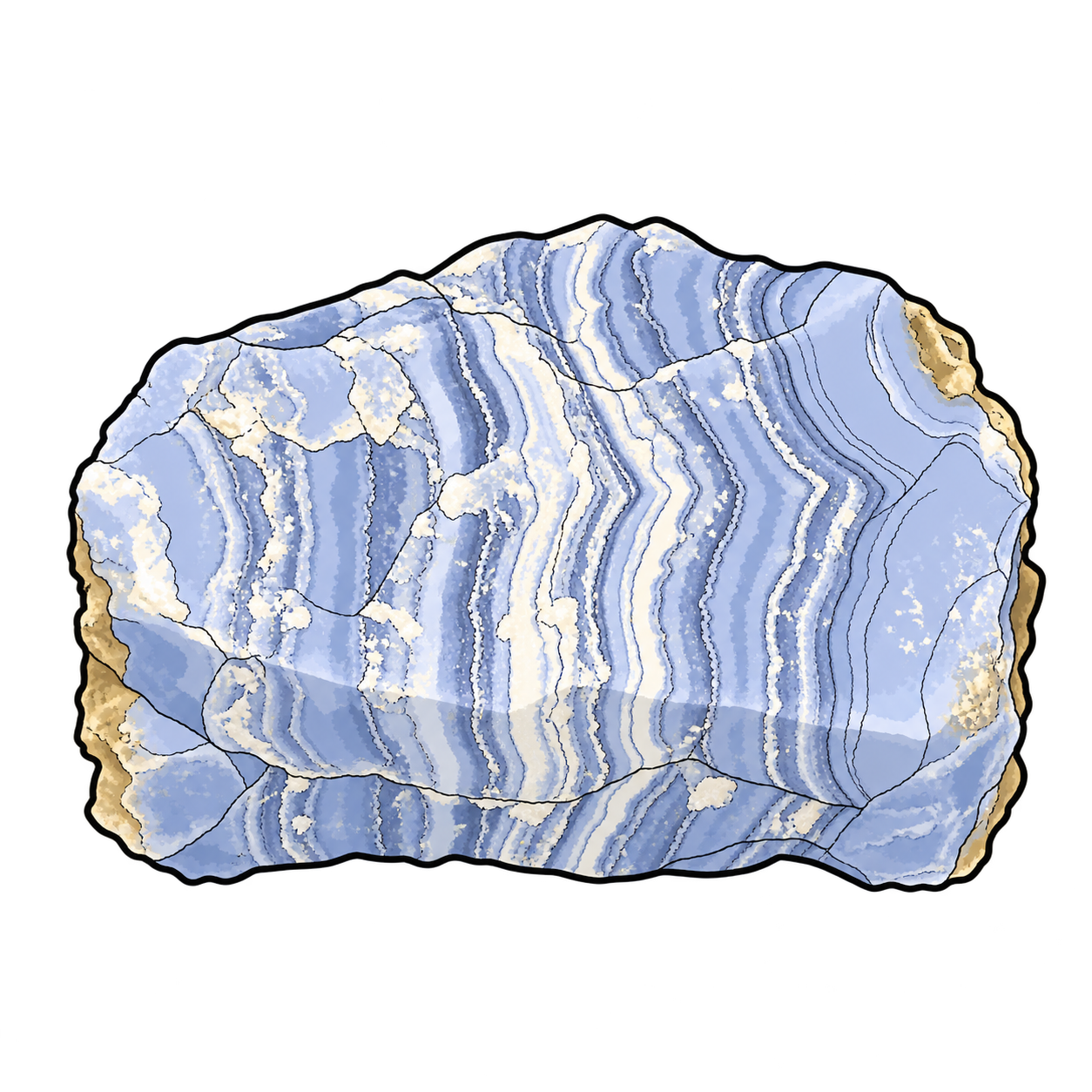
Blue lace agate is recognized by pale blue and white bands that curve, branch and fold across a cut surface. It belongs to chalcedony, the fine-grained silica family, rather than constituting a separate mineral species. The familiar Namibian material is particularly interesting because its decorative bands accompany a complex mineral history: fractures, carbonate minerals, silica deposition and replacement all contributed to the deposit. [1, 2]
Blue lace agate has a clear place in contemporary crystal symbolism: speaking honestly without losing gentleness. The Crystal Council associates it with the throat chakra, confidence and calm expression. These are spiritual correspondences, not evidence that carrying a mineral changes vocal ability or guarantees another person's response. [3]
One simple way to work with that symbolism is to place the stone beside a notebook while preparing for a conversation. Write down the essential point, the question you hope to ask and the room you want to leave for an answer. This is a reflective exercise inspired by the association, not a historical ritual or a treatment.
Principal composition: Silicon dioxide, SiO₂ Material type: Microcrystalline aggregate Main constituent: Quartz; the studied Namibian material contains abundant length-slow quartzine Hardness: Approximately 6½–7 Typical chalcedony refractive index: About 1.53–1.54 Typical specific gravity: Around 2.6 Luster: Waxy to glassy, depending on surface and polish Transparency: Translucent to locally opaque [1, 2, 4]
The word quartzine describes an optical and textural form of fibrous silica, not another blue mineral with a different chemical formula. “Length-slow” refers to its behavior under polarized light; it does not mean the bands necessarily grew slowly. In the Ysterputs research, this feature helped interpret the mineral-forming environment. [2]
These values describe the chalcedony, not every component of a rough specimen. A piece retaining carbonate minerals, clay or an open cavity cannot be treated as a uniform block of silica. The same distinction matters in care: a hard band does not make a fragile adjoining crystal equally resistant.
The visible form of an ornament must also be separated from crystal habit. A polished tower, heart or sphere is a lapidary shape. It is not evidence that blue lace agate grew naturally in that outline. On rough material, retain the distinction between a broken surface, a cut face and an undisturbed growth surface.
The 2024 study places the Namibian deposit in a fractured Jurassic dolerite sill that intruded older marine sediments. Dolomite lined early fissures and broken rock; the assemblage also includes later quartz, carbonate minerals and gypsum. The researchers interpreted the quartzine as evidence of saline fluids, probably connected with the sedimentary setting. This is a vein deposit, not simply a collection of silica-filled volcanic bubbles. [2]
Field descriptions record seams of variable thickness and occasional cavities lined with small crystals. Some nearby material has darker blue color and less obvious layering. Such variation helps explain why a rough lot can contain both strongly patterned cutting material and less regular collector specimens. It does not establish the origin of an unlabelled piece by appearance alone. [4]
An especially unusual feature is chalcedony with cubic outlines. The 2024 authors favored replacement of melanophlogite over the older suggestion of fluorite. A pseudomorph preserves an earlier material's external shape after replacement; a cube of chalcedony therefore does not mean quartz has acquired cubic symmetry. [2]
The blue is commonly discussed in terms of light scattering by very small internal features. Local descriptions relate it to Rayleigh scattering, but a precise identification of the scattering features should not be invented for an individual stone. Its appearance also depends on thickness, illumination and the background against which it is viewed. [4]
The most useful visual comparison is often between a diffuse-light photograph and a view with light passing through a thin edge. Compare the white bands as well as the blue. A camera's color balance can alter both, while a strongly colored background can make subtle blue look more saturated than it will in ordinary use.
Cutting selects a section through the layers. A broad ribbon on one face may become a thin line on another. Cabochons can emphasize a small sequence of waves; a larger slab can preserve the relationship between several bands and a cavity. Evaluate that composition on its own terms rather than assuming more stripes automatically make a better piece.
The University of Nebraska–Lincoln's agate collection records changing geographic descriptions in the twentieth-century trade. Material advertised as South African was later identified more specifically with Namibia, and the name Blue Lace Chalcedony also appeared in early references. The record is useful because commercial names and locality descriptions did not become consistent at the same moment. [5]
A provenance label should consequently be more specific than an attractive variety name when a documented origin is being claimed. Preserve the supplier's locality record, but do not silently upgrade “African blue agate” to a named mine. The familiar trade identity is not proof of a particular excavation site or collecting date.
Pale blue banding is a visual guide, not a complete test. Other blue chalcedonies exist, and chalcedony can also be dyed. Material identity, locality and color treatment are separate questions. A piece can be genuine chalcedony while its color has been enhanced. Ask for an explicit disclosure rather than treating “real stone” as an answer to all three. [1, 6]
Avoid harsh household tests. Solvents may affect dyes, adhesives or finishes without providing a reliable identification, and scratching damages the object. If a significant purchase depends on untreated color or origin, use appropriate documentation and qualified assessment.
A smooth cabochon is easier to clean than rough with exposed drusy crystals. GIA notes that tiny crystal coatings can be damaged by impact even when their constituent mineral is relatively hard. Protect such surfaces from rubbing against other stones and from cleaning tools that can catch projecting points. [7]
For an uncomplicated, sound polished piece, begin with gentle cleaning and a soft cloth. Ask before soaking a repaired specimen or one with uncertain associated minerals. Dyed or coated pieces need treatment-specific care; harsh solvents and heat should not be used merely because the main material is silica. [6]
Choose a setting that protects vulnerable edges, and store a pendant or loose stone where it cannot knock against harder gems. For a mineral specimen, support the base rather than gripping a thin band or crystal-lined opening. Keeping the original label with the piece preserves the geological context that its finished appearance cannot supply.
australian.museum · Reference for the accompanying text · Reference recorded October 15, 2026
doi.org · Reference for the accompanying text · Reference recorded October 15, 2026
thecrystalcouncil.com · Reference for the accompanying text · Reference recorded October 15, 2026
namibianbluelace.co.za · Reference for the accompanying text · Reference recorded October 15, 2026
csd.unl.edu · Reference for the accompanying text · Reference recorded October 15, 2026
gia.edu · Reference for the accompanying text · Reference recorded October 15, 2026
gia.edu · Reference for the accompanying text · Reference recorded October 15, 2026