Blue Pectolite from the Dominican Republic
Larimar
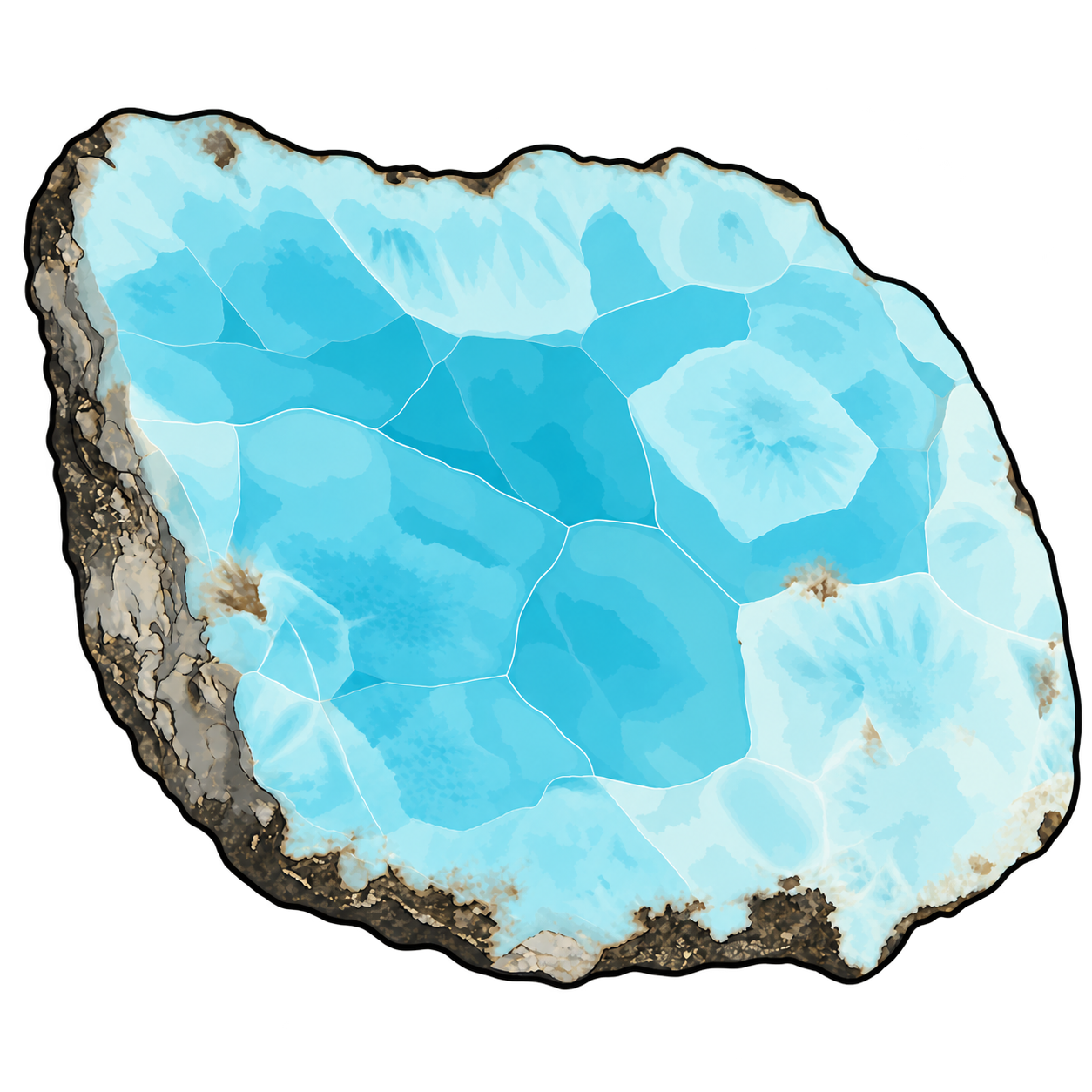
Blue pectolite trade material from the Dominican Republic.
Gem variety of pectolite; source designation requires provenance
Loading this page…
Return homePlease wait while the next page arrives.


Blue Pectolite from the Dominican Republic
Blue pectolite trade material from the Dominican Republic.
Gem variety of pectolite; source designation requires provenance
Larimar's blue-and-white pattern can resemble light moving over shallow water.
Geology · Human history · Spiritual attributes
Calm communication · Compassion · Emotional honesty · Self-understanding [5]
Larimar's blue-and-white pattern can resemble light moving over shallow water. Its origin is nevertheless volcanic and mineralogical rather than marine: this ornamental material developed within altered basalt in the Dominican Republic. Cutting exposes its internal pattern, turning a small part of a mineralized vein or cavity into a surface that invites close observation. [1, 2]
In contemporary crystal practice, larimar is associated with gentle expression and the courage to communicate difficult feelings. Throat-chakra symbolism connects its blue color with the voice, while its oceanlike appearance contributes to interpretations of calm and emotional openness. These are modern spiritual associations, not an account of how pectolite affects the body. [5]
A pendant, a palm-sized stone or a specimen on a desk may serve the same personal intention. Such use does not require a claim that the material treats trauma or replaces professional support. The meaning belongs to the practice and the person, not to a medical property established for the mineral.
Pectolite has the composition NaCa₂Si₃O₈(OH) and a triclinic structure. It can form needles, radiating aggregates and compact masses. The mineral's hardness is approximately 4½–5, with perfect cleavage in two directions and a measured density commonly around 2.84–2.90. Individual crystals are brittle, while compact aggregates can be comparatively tough. This distinction helps explain why a polished piece may endure handling better than a delicate fibrous specimen. [3]
Larimar is a gem-trade name, not a separate mineral species. Its identity combines pectolite with a distinctive Dominican occurrence and appearance. White or gray pectolite from elsewhere remains pectolite; it should not acquire a Dominican provenance merely because it has been cut into a similar shape. Nor should every component of a mixed larimar specimen be presumed to have identical properties. [1–3]
A polished dome can make a compact aggregate look visually continuous, but its texture deserves attention. The boundaries between pale and blue areas, darker inclusions and any fractures are part of the individual stone. A useful description records those features rather than reducing the object to an idealized color name.
A 2024 mineralogical and geochemical study links larimar to altered Cretaceous basalt of the Dumisseau Formation. Its interpretation involves relatively low-temperature, alkali-rich fluids followed by mixing with meteoric water. Alteration of the original volcanic minerals supplied ingredients for later mineral growth; pectolite occurs with minerals including natrolite, prehnite, calcite and chlorite. [2]
The important sequence is volcanic rock first, subsequent chemical alteration and cavity or vein mineralization afterward. Larimar was not simply assembled when colored ingredients fell into moving lava. Blue, green and white zones may record successive conditions within a mineralized body. The study's detailed account is a model supported by its examined material, not a guarantee that a polished cabochon reveals every stage unaided. [2]
The 1989 gemological study proposed copper-related coloration. Later research discusses competing explanations, including vanadium and lead-related color centers; the cause of the blue is not uniformly settled. [1, 6]
Likewise, resemblance to the sea is an aesthetic association, not evidence of an oceanic origin. The distinction enriches rather than diminishes the material: a pattern reminiscent of water formed through a very different geological history.
Woodruff and Fritsch described mining from approximately 1974 and wider market recognition during the 1980s. Their account traced waterworn fragments in the Río Baoruco drainage back to a bedrock source. This is a documented modern collecting and commercial history, distinct from stories that attach an ancient civilization or lost spiritual tradition to the stone. [1]
A 2013 laboratory report examined a ceramic larimar imitation that had been sold as an imitation, not as natural pectolite. Under magnification it showed gas bubbles and localized blue color; its refractive index and density differed markedly from larimar. The report demonstrates that a convincing pattern need not establish mineral identity. [4]
An imitation can be attractive when honestly described. The problem is the substitution of one material's identity and price story for another's. For an important purchase, seek material disclosure and competent testing rather than relying on color, a photograph or a destructive home test. A report about one ceramic product does not imply that every imitation uses that same recipe.
With moderate hardness, larimar deserves protection from abrasion and harder jewelry. Keep polished pieces separate, and avoid knocking thin edges or existing fractures. A setting should support the stone rather than expose its most vulnerable corners. [3]
The 1989 research found color stable under its light testing but responsive to irradiation and a jeweler's torch. Avoid strong heat; a blanket claim that ordinary daylight instantly destroys larimar's color is not supported by that study. Tell a jeweler the material's identity before repair. [1]
Where the condition or treatment history is uncertain, ask for cleaning advice appropriate to that piece. A decorative aggregate may include more than pectolite, and preserving the whole object is more important than applying a generic ritual or a cleaning method intended for a different gemstone.
gia.edu · Reference for the accompanying text · Reference recorded October 15, 2026
badap.agh.edu.pl · Reference for the accompanying text · Reference recorded October 15, 2026
handbookofmineralogy.org · Reference for the accompanying text · Reference recorded October 15, 2026
gia.edu · Reference for the accompanying text · Reference recorded October 15, 2026
thecrystalcouncil.com · Reference for the accompanying text · Reference recorded October 15, 2026
sciencedirect.com · Reference for the accompanying text · Reference recorded October 15, 2026