Fossil resin and a record of ancient forests
Amber
Fossilized resin, an organic gem rather than a crystalline mineral.
Organic gem material: fossil resin
Loading this page…
Return homePlease wait while the next page arrives.


Fossil resin and a record of ancient forests
Fossilized resin, an organic gem rather than a crystalline mineral.
Organic gem material: fossil resin
Amber is fossilized tree resin, valued for its warm color, light weight and ability to preserve traces of ancient life.
Geology · Human history · Spiritual attributes
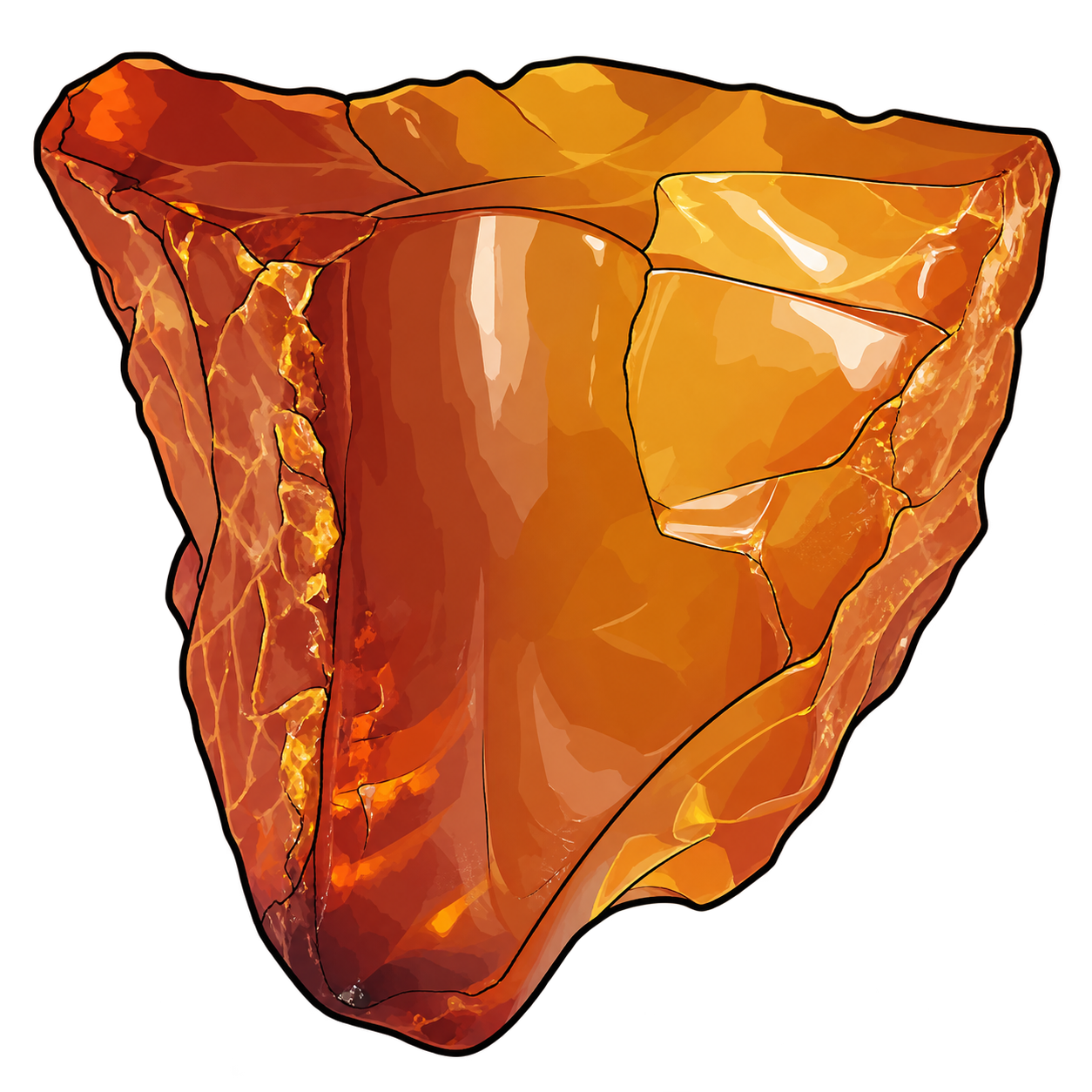
Amber is fossilized tree resin, valued for its warm color, light weight and ability to preserve traces of ancient life. It belongs among organic gem materials rather than crystalline minerals. A polished piece may be clear enough to reveal an insect, clouded with minute bubbles or patterned by successive resin flows. Its golden appearance has also made it a symbol of sunlight, protection and renewal. [1, 2, 8]
Amber's spiritual associations draw on both its luminous color and its preservation of the past. Contemporary practitioners use it as a symbol of positive energy, personal renewal and protection. These beliefs belong to spiritual practice; they are distinct from the physical processes that preserve resin and its inclusions. [8, 9]
In her writing on contemporary rootwork, Stephanie Rose Bird links amber's golden appearance with solar symbolism and describes its protective use. Other modern practitioners emphasize the preservation of memory and spiritual balance. These are identifiable interpretations, not a single doctrine shared by every culture that has valued amber. [8, 9]
Composition: A complex mixture of organic compounds altered during geological maturation Structure: Noncrystalline; no mineral crystal system Mohs hardness: About 2–2.5 Specific gravity: Commonly near 1.08 Refractive index: Commonly near 1.54 Transparency: Transparent, translucent or opaque Durability: Soft and readily scratched; vulnerable to heat and unsuitable cleaning chemicals [1, 3, 4]
Amber does not have the repeating atomic structure of quartz or feldspar. Its properties reflect the original resin and the changes that occurred after burial. A single tidy chemical formula cannot adequately describe every amber deposit. The material is better understood as a matured organic substance whose chemistry can help researchers distinguish sources and identify substitutes. [3, 7]
Amber's low density makes a relatively large bead or pendant lighter than a similarly sized piece of many familiar gemstones. Its surface can take a bright polish, but that polish is easily scratched. Density and refractive index are useful measurements, not sufficient proof of identity by themselves: imitations and composites require closer examination. [1, 7]
Trees produce resin as part of their response to damage and other stresses. Sticky flows can trap debris or small organisms before hardening. Burial protects some resin from destruction; over time, the loss of volatile components and linking of organic molecules change its structure. Geological conditions affect that maturation, so age alone is not a universal dividing line between amber and less mature resin often called copal. [3]
Amber deposits need not mark the exact position of the original forest. Resin-bearing material can be transported and redeposited. Baltic amber also reaches beaches after erosion releases it from older deposits, explaining why a material that began in trees became associated with the sea. [2, 3]
Different deposits preserve different intervals of Earth history. The principal Dominican amber deposits discussed in GIA's research are approximately 15–20 million years old and associated with resin from the extinct tree Hymenaea protera. This is a specific geological account, not an age or tree identification that can be applied to amber from every region. [5]
The familiar yellow-to-brown range is only part of amber's appearance. Some pieces are pale and cloudy, others orange-red, and some show blue or greenish fluorescence. Tiny bubbles scatter light and can make the resin look milky or opaque. Clear material may expose flowing layers and inclusions that would be concealed in a cloudier piece. [2, 6]
Blue amber is particularly dependent on lighting. Research on Dominican and Indonesian examples identifies ultraviolet-excited fluorescence near the surface, rather than a uniformly blue body color. A specimen can therefore show a blue response in suitable illumination while remaining yellow or reddish in transmitted light. Photographs should state the lighting conditions rather than imply that every view will show the same blue. [5]
An inclusion is more than a decorative feature when its identity and geological context are documented. Amber may preserve delicate structures that are ordinarily lost during fossilization. Scientists can examine those structures to investigate extinct organisms and their environments; the conclusions depend on the specimen and the method, not simply on the presence of a recognizable insect.
An example in the Natural History Museum is the approximately 44-million-year-old katydid Eomortoniellus handlirschi. Researchers used scans of its preserved anatomy and acoustic modeling to investigate its hearing and likely call. Their results suggest communication around 30 kilohertz, above normal human hearing. This was a reconstruction from physical evidence—not sound recovered from the amber. [10]
For a fossil-bearing piece, retain the locality, supplier information and any specialist identification. An appealing label such as “prehistoric insect” supplies much less useful information than a documented specimen record. Avoid opening or repolishing a piece to expose an inclusion without specialist advice.
The Getty's Etruscan pendant known as Addorsed Females, dated 600–550 BCE, depicts two clothed figures standing back to back. At roughly ten centimeters in its longest dimension, it demonstrates the scope for detailed carving in this soft material. Surviving abrasion marks reveal aspects of the maker's work, while transmitted light changes its dark reddish-brown appearance to a deeper luminous red. [11]
Ancient amber ornaments could combine beauty, status and amuletic meaning. Getty's study of pre-Roman carvings discusses protective and regenerative interpretations, while also acknowledging how much remains uncertain about individual owners and uses. An object found in a burial does not automatically reveal whether it was worn throughout life or made for the funeral. [12]
In Ovid's account of Phaethon, the young driver's disastrous journey in the sun chariot ends in his death. His grieving sisters become poplar trees, and their tears become amber. The story joins sunlight, trees and mourning in a poetic explanation of the material. It belongs to amber's literary history, not its geological formation. [13]
Ask whether a piece is natural amber, treated amber, reconstructed material or an imitation. Treatments can change color and clarity; composites may combine genuine amber with artificial resin. An insect inclusion is not automatic proof that the entire object is natural or that every inclusion is ancient. [6, 7]
A published laboratory example makes the distinction especially clear: one pendant contained a natural amber core with a genuine insect inclusion and an artificial resin component containing an introduced insect. Infrared analysis helped distinguish the materials. The lesson is not that attractive inclusions are necessarily suspect, but that important authenticity claims deserve appropriate examination. [7]
Choose according to the purpose of the piece. For jewelry, inspect the setting, drill holes, edges and surface wear. For a natural-history collection, prioritize reliable provenance and the visibility of the inclusion. For a carving, consider workmanship and condition rather than treating transparency as the only measure of quality.
Clean sound amber gently with lukewarm water and mild soap, then dry with a soft cloth. Keep it separate from harder gems and protect it from impacts. Do not use steam or ultrasonic cleaners. Heat, prolonged intense light and household chemicals can damage or alter the material; treated pieces may have additional sensitivities. [4]
Do not apply a hot needle or solvents as an authenticity test. A test that leaves a burn or dissolves part of the surface has damaged the object regardless of its conclusion. For valuable inclusions, old carvings or repaired pieces, seek suitable gemological or conservation advice instead.
gia.edu · Reference for the accompanying text · Reference recorded October 15, 2026
gia.edu · Reference for the accompanying text · Reference recorded October 15, 2026
getty.edu · Reference for the accompanying text · Reference recorded October 15, 2026
gia.edu · Reference for the accompanying text · Reference recorded October 15, 2026
gia.edu · Reference for the accompanying text · Reference recorded October 15, 2026
gia.edu · Reference for the accompanying text · Reference recorded October 15, 2026
gia.edu · Reference for the accompanying text · Reference recorded October 15, 2026
llewellyn.com · Reference for the accompanying text · Reference recorded October 15, 2026
llewellyn.com · Reference for the accompanying text · Reference recorded October 15, 2026
nhm.ac.uk · Reference for the accompanying text · Reference recorded October 15, 2026
getty.edu · Reference for the accompanying text · Reference recorded October 15, 2026
getty.edu · Reference for the accompanying text · Reference recorded October 15, 2026
getty.edu · Reference for the accompanying text · Reference recorded October 15, 2026