Hydrated Silica, Moving Color and Preserved Worlds
Opal
Hydrated silica material; precious opal shows play-of-color and common opal does not.
Hydrated silica material; commonly described as a mineraloid
Loading this page…
Return homePlease wait while the next page arrives.


Hydrated Silica, Moving Color and Preserved Worlds
Hydrated silica material; precious opal shows play-of-color and common opal does not.
Hydrated silica material; commonly described as a mineraloid
Opal can carry shifting spectral color, a quiet milky translucency or a rich brown body with no rainbow at all.
Geology · Human history · Spiritual attributes
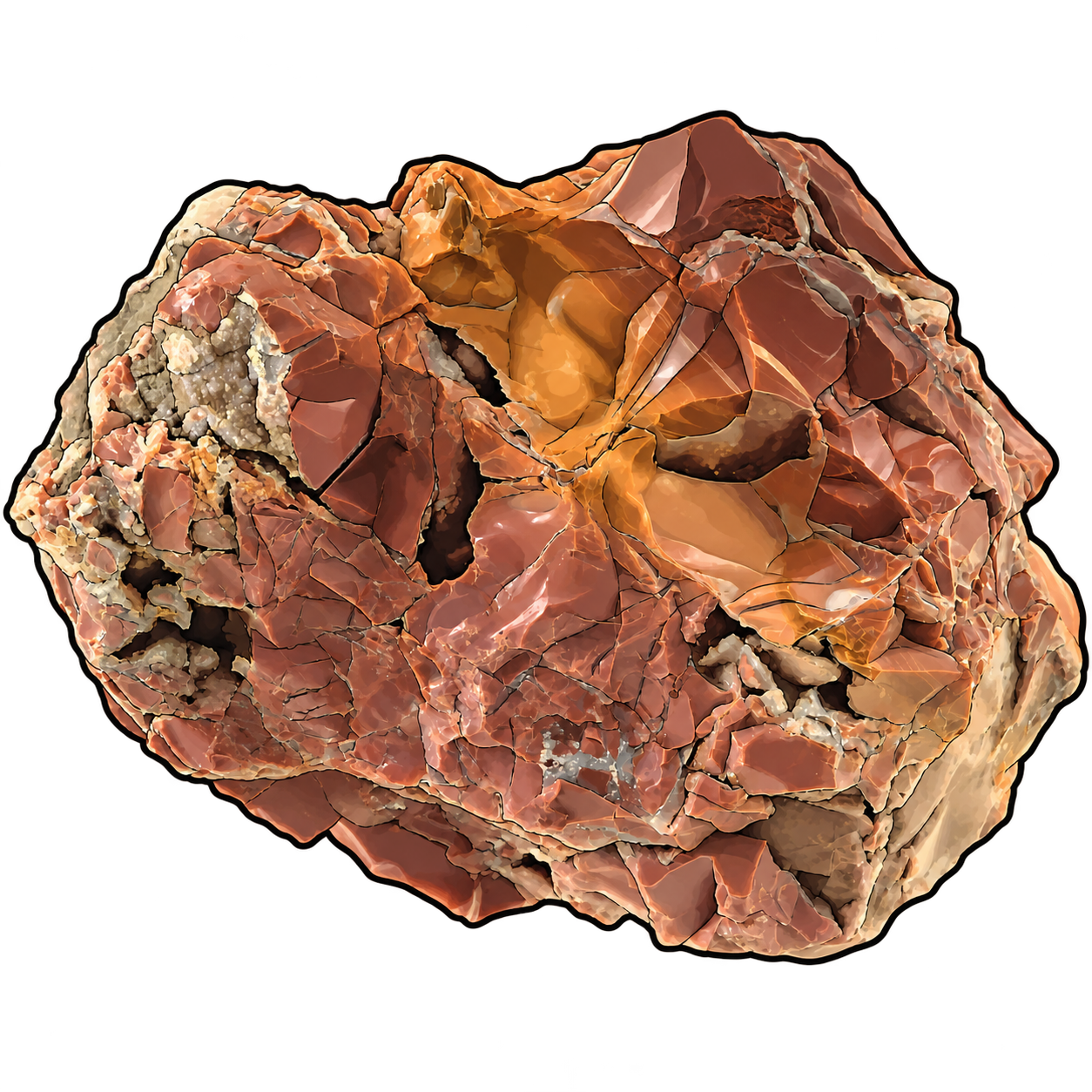
Opal can carry shifting spectral color, a quiet milky translucency or a rich brown body with no rainbow at all. These are not contradictory identities. Precious opal displays play-of-color; common opal does not. Both belong to a varied family of hydrated silica materials whose microscopic organization, water content and geological setting shape what we see. [1, 2]
Opal's changing color has encouraged an unusually rich symbolic vocabulary. GIA's historical overview associates it with love and hope in Roman appreciation and with purity and truth in later European symbolism. These are accounts of beliefs about the gem, not physical effects that its structure can establish. [3]
These meanings need not depend on possessing a costly precious opal. A common opal with appealing color or a meaningful origin may serve just as well as a personal emblem. An object's place in someone's life is not measured by the strength of its spectral display.
The formula SiO₂·nH₂O expresses silica with a variable amount of water, rather than a fixed ratio shared by every specimen. Published gem properties include a refractive index around 1.44–1.46 and a specific gravity commonly near 1.98–2.20. Variation is part of opal's character; a single numerical value cannot represent every porous or included piece. [2]
Structural names answer a different question from jewelry names. Opal-A is highly disordered; opal-CT and opal-C describe silica with greater cristobalite/tridymite-related ordering. A 2019 review emphasizes that play-of-color can occur in both opal-A and opal-CT. The presence of a rainbow therefore does not, by itself, determine the structural category. [4]
Hardness is roughly 5–6.5, while toughness can be very poor to fair. Scratch resistance and resistance to breaking are separate properties: a stone can survive a light surface rub yet remain vulnerable to an impact or an existing fracture. [5]
In precious opal, an appropriately ordered microscopic arrangement of silica structures diffracts visible light. The observed color depends on that organization and the viewing geometry. Bodycolor is different: it is the underlying appearance against which the flashes occur. An orange body is not the same thing as a red flash. [1]
The Australian Museum explains that the arrangement and scale of silica spheres help distinguish common from precious opal. A lack of visible play-of-color does not mean that an otherwise correctly identified common opal is fake or unfinished. It simply lacks the particular visible optical phenomenon celebrated in precious varieties. [2]
For a collector, this makes movement important. Examine an opal under more than one lighting direction and tilt it through a comfortable range. A still photograph may record a striking instant while concealing how narrow the viewing angle is; a video can reveal both strengths and quiet areas without changing the stone itself.
FORMATION: SILICA CARRIED BY WATER
GIA's account of Australian opal describes water carrying dissolved silica through older sedimentary rocks and depositing it within cracks and spaces as conditions change. This is one important setting, not a universal recipe for every opal deposit. [1]
Opal can preserve the shape of a vanished organism. The South Australian Museum's Addyman plesiosaur, discovered in an Andamooka opal mine in 1968, represents an animal about six metres long. Its opalized remains and the museum's assemblage of opalized shells connect gemstone formation with an ancient marine environment. [6]
The Smithsonian's 2,585-carat Roebling Opal records another pathway. At Virgin Valley, Nevada, silica-rich water filled spaces left after buried tree limbs decayed. The specimen's blue and green flashes occur within dark opal, but material from this locality can craze and is often unsuitable for jewelry. A spectacular collection specimen and a practical ring stone are not necessarily the same thing.
White and black opal describe body-tone categories; fire opal describes warm yellow, orange or red bodycolor and need not show play-of-color. Boulder opal retains part of its natural host rock. These terms can be combined where appropriate because they describe different features. [1]
Pattern vocabulary adds another layer. Pinfire consists of small patches; harlequin describes broader, closely arranged angular patches. GIA evaluates pattern along with color, clarity and other qualities rather than treating a name alone as a quality guarantee. [8]
An assembled opal needs a different disclosure. A doublet has an opal layer joined to a backing; a triplet adds a protective top. Such construction is not automatically deceptive when accurately described, but it is not equivalent to a solid opal. A buyer should know what the whole object contains before comparing prices or choosing a cleaning method. [8]
Hydrophane opal is porous enough to absorb water. GIA's laboratory work shows that absorption can change transparency and weight, while porosity varies even within one piece. In a treatment experiment, slices cut from the same rough responded differently, and the original appearance took time to return after drying. [9]
Porosity also makes treatment assessment important. Water absorption is not proof of dye, but absorbent material can take in coloring agents. GIA cautions that immersion can enlarge some existing cracks; a blanket instruction to keep every opal submerged is therefore inappropriate. [10]
Disclosure should identify known dyeing, impregnation, smoke or sugar treatment, as applicable. A change in appearance should not prompt an improvised attempt to restore the stone with oil or another household liquid. Laboratory identification is more useful than a test that risks altering the object. [5, 9]
GIA connects opal's later unlucky reputation with the reception of Walter Scott's novel Anne of Geierstein, contrasting this with older admiration. Its survey also records lightning-origin legends and prophetic associations. Such stories illuminate changing human responses; they do not establish that wearing opal brings either fortune or misfortune. [3]
Protect opal from knocks, strong heat and abrupt temperature changes. Intense lighting can contribute to crazing, so display should reveal color without heating the specimen. GIA recommends gentle soapy-water cleaning for suitable opals, but a hydrophane, treated or assembled piece requires advice appropriate to its particular construction and behavior. Do not assume that soaking is harmless. [5, 10]
Store pieces separately from harder jewelry and ask a jeweler about a protective setting for frequent wear. Preserve the record of origin, treatment and assembly with the object. Those details allow future care to begin with knowledge of the stone rather than a guess based on its color.
gia.edu · Reference for the accompanying text · Reference recorded October 15, 2026
australian.museum · Reference for the accompanying text · Reference recorded October 15, 2026
gia.edu · Reference for the accompanying text · Reference recorded October 15, 2026
mdpi.com · Reference for the accompanying text · Reference recorded October 15, 2026
gia.edu · Reference for the accompanying text · Reference recorded October 15, 2026
samuseum.sa.gov.au · Reference for the accompanying text · Reference recorded October 15, 2026
naturalhistory.si.edu · Reference for the accompanying text · Reference recorded October 15, 2026
gia.edu · Reference for the accompanying text · Reference recorded October 15, 2026
origin.prod.gia.edu · Reference for the accompanying text · Reference recorded October 15, 2026
gia.edu · Reference for the accompanying text · Reference recorded October 15, 2026