Blue-Green Microcline
Amazonite
Green to blue-green microcline feldspar.
Colored microcline feldspar variety
Loading this page…
Return homePlease wait while the next page arrives.


Blue-Green Microcline
Green to blue-green microcline feldspar.
Colored microcline feldspar variety
Amazonite is the blue-green variety of microcline feldspar.
Geology · Human history · Spiritual attributes
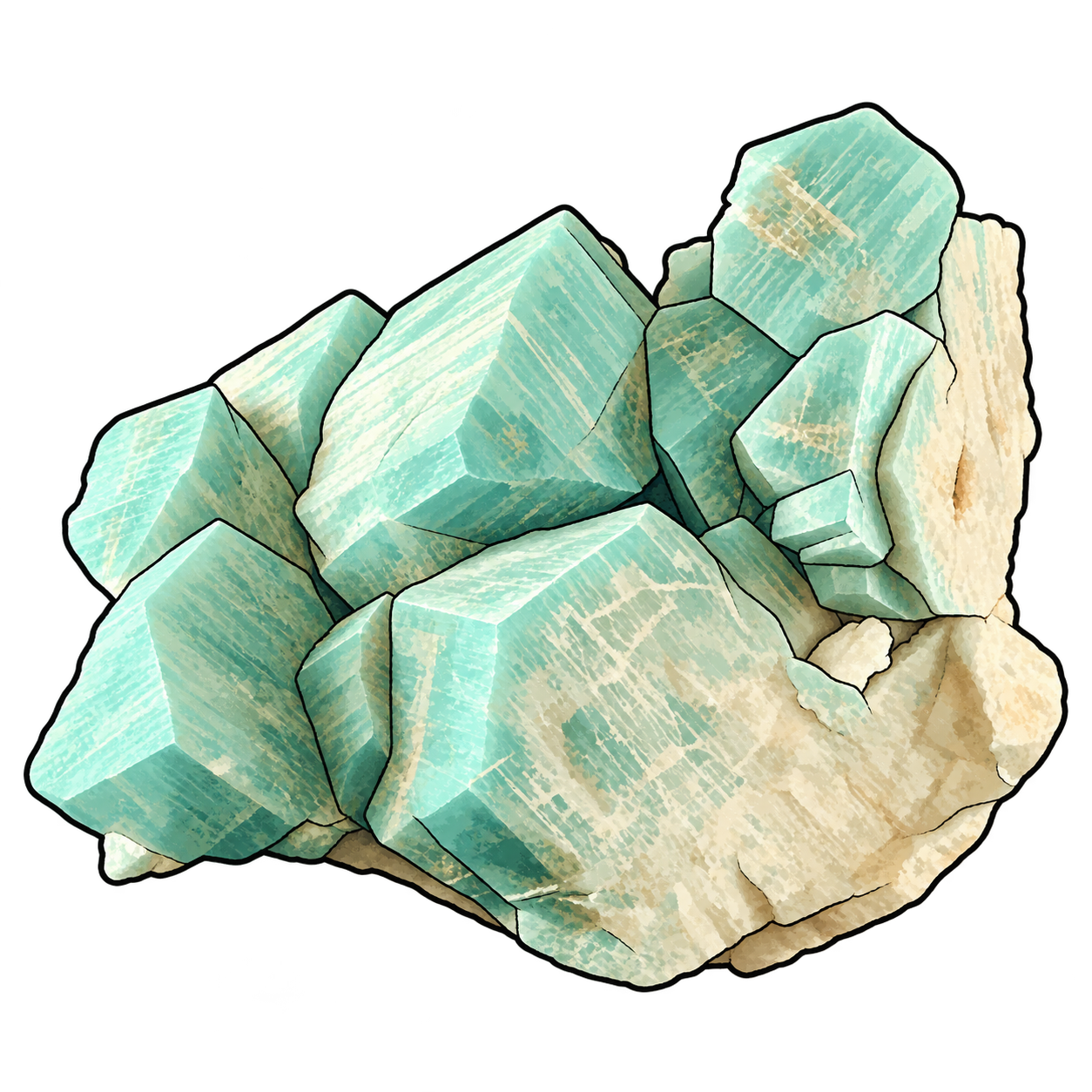
Amazonite is the blue-green variety of microcline feldspar. Its color can be almost mint-white, strongly green or distinctly turquoise, commonly crossed by pale streaks. Blocky crystals appeal to mineral collectors, while polished beads and cabochons emphasize the patterned interior. Its spiritual associations center on honest expression, harmony and the relationship between feeling and speech. [1–4]
In contemporary crystal practice, amazonite is associated with the heart and throat: understanding a feeling, then giving it a clear and considerate voice. The Crystal Council describes it as a stone of communication and peaceful relationships. These are spiritual interpretations, distinct from its measurable mineral properties. [4]
The stone can serve as a tactile reminder during reflection or conversation. That use does not imply that possessing it controls another person's response or guarantees an outcome.
Composition: KAlSi₃O₈ Crystal system: Triclinic Mohs hardness: 6–6.5 Specific gravity: Approximately 2.54–2.57 for microcline Luster: Glassy; sometimes pearly on cleavage surfaces Cleavage: Two prominent directions meeting close to 90 degrees Fracture: Uneven Tenacity: Brittle [1]
Microcline belongs to the potassium-feldspar group. Orthoclase and sanidine have closely related chemistry but different structural ordering. Their similarity helps explain why feldspar identification sometimes requires more than a hand specimen. Amazonite is a color-variety name, not an additional mineral species; “Amazon jade” obscures its identity rather than describing a kind of jade. [2, 5]
Amazonite's blocky shape accompanies a triclinic structure. Flat surfaces may be original growth faces or breaks following cleavage; interrupted edges and the relationship between faces help distinguish them. [1]
Microcline commonly contains intergrown albite, a sodium feldspar. Perthitic intergrowths develop when a feldspar separates into compositionally different regions during cooling. These can contribute to a pale, streaked pattern. A white patch may also belong to another attached mineral or a fracture, so its identity should not be assigned solely from a photograph. [1, 5]
The blue-green is not simply copper staining. Research summarized by GIA links amazonite's color to lead, structurally bound water and irradiation within the feldspar. Trace constituents and crystal defects can have a conspicuous optical effect without turning the host into a different mineral. [3]
This also distinguishes body color from apparent clarity. A vivid color and a translucent appearance describe separate qualities. In one GIA investigation, infrared analysis identified resin throughout a sample of unusually translucent material. That was evidence of impregnation in the examined specimens, not a rule that every translucent amazonite is treated. [3]
Amazonite is particularly associated with pegmatites and cavities where feldspar can develop well-defined crystals. In granitic associations, smoky quartz and pale feldspar may accompany it. A blue-green block joined to a brown quartz point preserves two mineral growth forms, not two colors of one crystal. [2]
Colorado's Pikes Peak region includes several collecting areas. A mine-level identification depends on the specimen's record. Microcline is widespread, but only a portion has amazonite's distinctive colour. [1,5]
The Smithsonian records amazonite from Virginia and describes the Morefield deposit's association with mica, beryl and other pegmatite minerals. Its account also corrects a misleading implication of the name: amazonite is named after the Amazon River, but that does not establish the river as its source. Brazil does produce amazonite, which is a different statement from assigning a specimen to the Amazon basin. [6]
Cabochons, beads and small carvings show off amazonite's color without requiring transparency. A uniformly colored piece and one with a conspicuous white pattern offer different visual effects; the latter is not automatically an inferior version of the former. Natural crystals, meanwhile, are judged for form, condition, association and provenance as well as saturation. [2, 5]
Choose the object rather than an unsupported grade label. For a cluster, ask whether crystals have been repaired or reattached and request views of the underside. For a strand, compare color and translucency under consistent lighting and ask about impregnation or other treatment. Photographs taken against different backgrounds can make matching pieces appear less alike—or unlike pieces appear more closely matched.
Hardness and toughness deserve separate attention. Amazonite can take a good polish yet split after a sharp blow. Pendants and earrings are generally less exposed than rings and bracelets, and a protective setting reduces the chance of striking a vulnerable edge. Harder neighboring gems can scratch it. [2]
Protect cleavage-prone edges from impact. Resin-impregnated pieces require care appropriate to the disclosed treatment. [1, 3]
Keep amazonite away from nail-polish remover and similar acetone-rich solvents. In GIA's tests, acetone exposed whitish fractures and reduced the appearance of some resin-impregnated beads. It is therefore an unsuitable home authenticity test. [3]
handbookofmineralogy.org · Reference for the accompanying text · Reference recorded October 15, 2026
geology.com · Reference for the accompanying text · Reference recorded October 15, 2026
gia.edu · Reference for the accompanying text · Reference recorded October 15, 2026
thecrystalcouncil.com · Reference for the accompanying text · Reference recorded October 15, 2026
minerals.net · Reference for the accompanying text · Reference recorded October 15, 2026
naturalhistory.si.edu · Reference for the accompanying text · Reference recorded October 15, 2026