Chatoyant Quartz
Tiger’s Eye
Chatoyant quartz-rich material associated with fibrous amphibole textures.
Chatoyant quartz-rich aggregate; associated composite rock forms
Loading this page…
Return homePlease wait while the next page arrives.


Chatoyant Quartz
Chatoyant quartz-rich material associated with fibrous amphibole textures.
Chatoyant quartz-rich aggregate; associated composite rock forms
Tiger's-eye is a quartz-rich ornamental stone whose golden-brown bands carry a moving, silky reflection.
Geology · Human history · Spiritual attributes
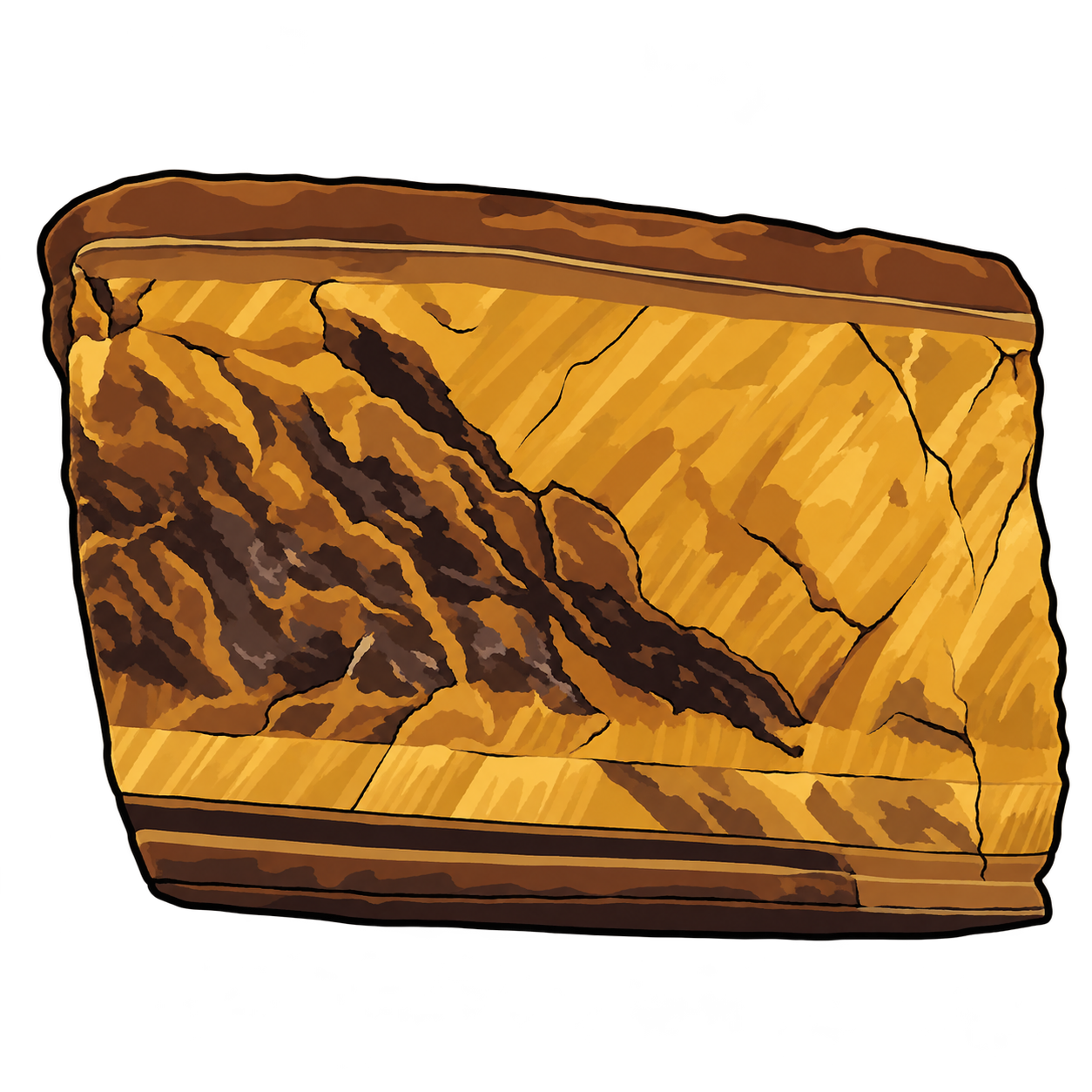
Tiger's-eye is a quartz-rich ornamental stone whose golden-brown bands carry a moving, silky reflection. Its appearance depends on aligned mineral fibers enclosed within the quartz, not on a metallic coating. A rounded cabochon can concentrate the reflection into a luminous band, while a slab reveals the broader arrangement of streaks and seams. Contemporary crystal traditions associate it with courage, determination and personal agency. [1, 2]
Tiger's-eye is associated in modern crystal practice with the solar plexus and the ability to act on a chosen purpose. It is often selected for intention-setting around effort, self-direction and the confidence to begin. These are spiritual associations, distinct from the optical mechanism responsible for the stone's changing light. [2]
Quartz component: SiO₂; Mohs hardness 7; density approximately 2.65 g/cm³. [3] Texture: Polycrystalline quartz with aligned fibrous inclusions [1] Quartz structure: Trigonal; refractive indices approximately 1.544 and 1.553. [11] Optical effect: Chatoyancy, a directional reflection associated with the fibrous texture [1]
Tiger's-eye contains numerous quartz crystals enclosing aligned fibrous material. Alteration of iron-bearing amphibole contributes its familiar brown and gold colors; less-altered blue material is called hawk's-eye. The mineral mixture can vary between bands, so the ideal properties of pure quartz do not fully describe every specimen. [6]
Move a small light relative to the stone. An appropriately oriented cabochon concentrates the reflection into a band; a flat slice can show broader streaks of sheen. Compare directional and diffuse lighting before judging how the finished piece will look in use. [1]
FORMATION: A REVISED GEOLOGICAL EXPLANATION
Older descriptions commonly present tiger's-eye as a pseudomorph: quartz replacing crocidolite while preserving the earlier fibers' shape. Peter Heaney and Donald Fisher challenged that explanation in a 2003 study. Their examination supported growth of quartz and crocidolite together through repeated fracture opening and mineral deposition, rather than simple replacement of an already completed fibrous mineral. [5]
In their crack-seal interpretation, a fracture admits mineral-bearing fluid and fills with new mineral growth. Renewed movement opens another space for deposition. Small offsets between episodes help account for changes in the direction of the enclosed fibers. Later alteration contributes brown and gold colors. [6]
Tiger iron combines chatoyant areas with other banded material, commonly including jasper and iron-rich minerals. GIA's Marra Mamba exhibit from Western Australia's Pilbara region preserves this relationship on an unusually large scale: a polished slab more than three meters long, weighing about 180 kilograms, with hematite, magnetite, jasper and tiger's-eye areas. [4]
The ancient iron-rich sedimentary setting and the later fracture-filling history are separate parts of the story. The age of the enclosing formation should not automatically be assigned to every mineral that later entered a crack. Nor should a label for a mixed rock be reduced to the composition of its brightest golden band. [4]
The museum also records the practical difficulty of mounting a slab only about five centimeters thick. It needed a specially designed support to prevent flexing and breakage. This is a particularly clear example of why a hard mineral can still require careful structural support. [4]
Treatments introduce a separate question. GIA lists bleaching among processes used on tiger's-eye quartz. A purchaser should ask about color alteration, filling, coatings and repairs rather than infer an untreated history from a familiar name. Treatment disclosure helps establish both what is being purchased and how it should be cared for. [7]
A moving reflection is not, by itself, proof that an object is natural tiger's-eye. Gemological identification examines the host material and its internal texture as well as the optical effect. For a purchase whose value depends on identity or origin, documentation and appropriate examination are more dependable than a photograph or an informal scratch test.
Choose according to the feature that matters most to you: a continuous moving band, strong contrast, unusual color transitions or the larger geological pattern. A specimen with interrupted sheen can be interesting without behaving like a perfectly aligned cabochon. Ask for a short video or several angles under ordinary lighting when buying remotely.
Examine edges, drill holes and visible seams. For a large slab, discuss support and transport before purchase; do not assume it can be stood unsupported because its polished face appears solid. Keep the original locality and treatment documentation with the piece rather than relying on appearance to reconstruct its history later.
Cutting and grinding require a different level of care from displaying an intact finished stone. Tiger's-eye can contain amphibole fibers, and disturbing mineral-bearing rock can release hazardous airborne material. Silica dust generated during stone fabrication is another established hazard. Do not dry-cut, sand or drill it as a casual household project; seek a suitably equipped professional. Leave visibly friable or fiber-shedding rough undisturbed. [5, 9, 10]
The relevant distinction is between an intact solid object and a process that creates dust or loose fibers. A warning about fabrication is not evidence that merely viewing a polished bead produces the same exposure, nor is a polished surface a substitute for assessing damaged rough material. [9]
gia.edu · Reference for the accompanying text · Reference recorded October 15, 2026
thecrystalcouncil.com · Reference for the accompanying text · Reference recorded October 15, 2026
webmineral.com · Reference for the accompanying text · Reference recorded October 15, 2026
gia.edu · Reference for the accompanying text · Reference recorded October 15, 2026
pure.psu.edu · Reference for the accompanying text · Reference recorded October 15, 2026
psu.edu · Reference for the accompanying text · Reference recorded October 15, 2026
gia.edu · Reference for the accompanying text · Reference recorded October 15, 2026
archive.cdc.gov · Reference for the accompanying text · Reference recorded October 15, 2026
osha.gov · Reference for the accompanying text · Reference recorded October 15, 2026
mints.uwc.ac.za · Reference for the accompanying text · Reference recorded October 15, 2026