Bronzy Iron-Bearing Orthopyroxene
Bronzite
Bronzy-shimmering orthopyroxene material associated with the enstatite–ferrosilite series.
Conventional variety/trade term for iron-bearing orthopyroxene material
Loading this page…
Return homePlease wait while the next page arrives.


Bronzy Iron-Bearing Orthopyroxene
Bronzy-shimmering orthopyroxene material associated with the enstatite–ferrosilite series.
Conventional variety/trade term for iron-bearing orthopyroxene material
Bronzite names iron-bearing enstatite with a bronze-like reflection.
Geology · Human history · Spiritual attributes
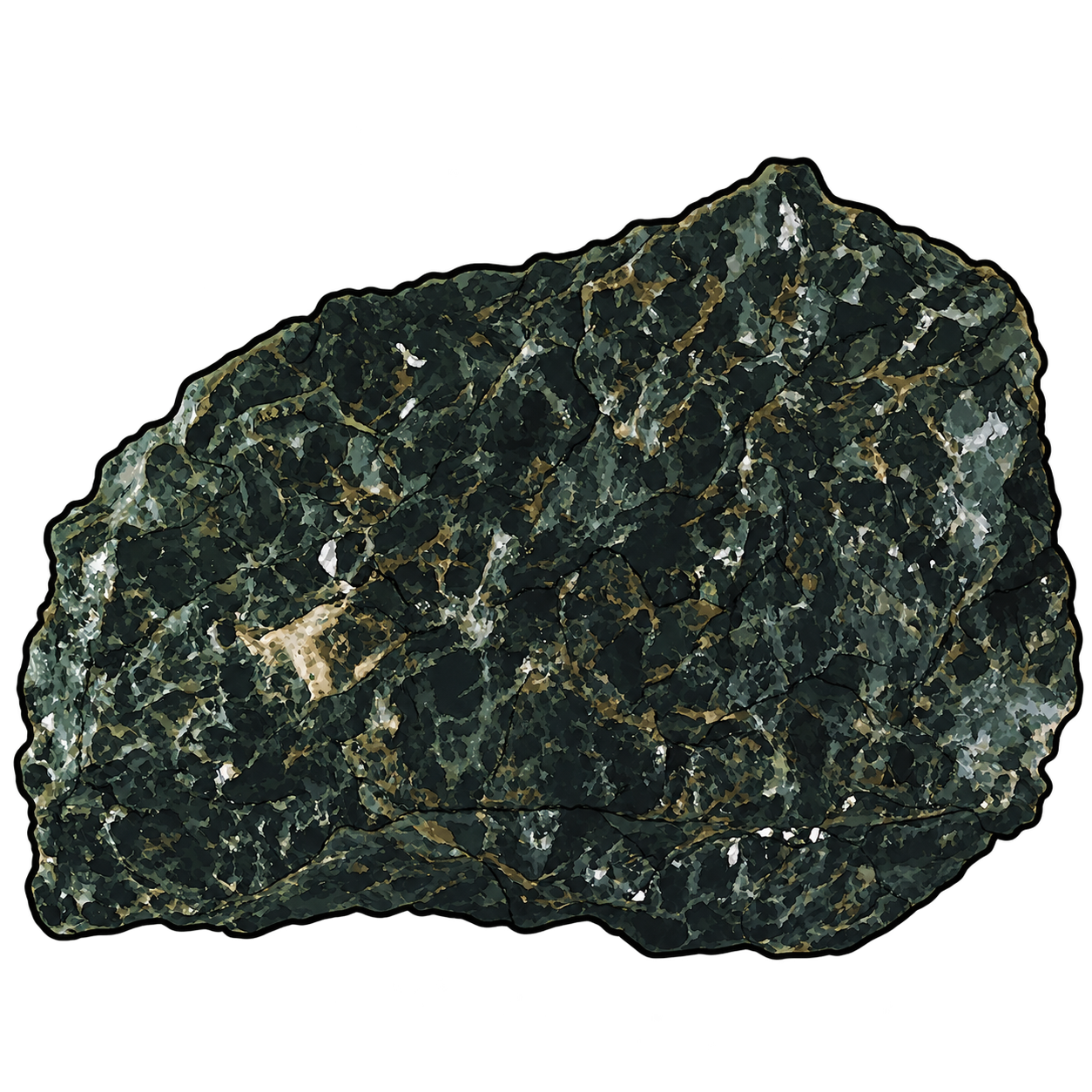
Bronzite names iron-bearing enstatite with a bronze-like reflection. It is a silicate, not bronze metal. [1]
Contemporary practitioners often call bronzite a stone of courtesy. Its symbolism combines consideration for others with the confidence to act on one's own priorities. Root- and sacral-chakra associations connect that practical resolve with grounding and motivation. [3]
Material name: Bronzite is a variety or trade designation, not a separate modern mineral species Underlying mineral family: Enstatite–ferrosilite orthopyroxenes General composition: Magnesium-iron silicate, commonly written (Mg,Fe)₂Si₂O₆ Crystal system: Orthorhombic Mohs hardness: Approximately 5–6 for the orthopyroxene material Cleavage: Good; impact can exploit internal planes of weakness Luster: Glassy to pearly or bronze-like on reflective surfaces Transparency: Variable; common ornamental material is not necessarily transparent [1, 2, 4]
Modern nomenclature recognizes enstatite and ferrosilite rather than every historical subdivision. Bronzite remains useful as a descriptive variety name, not an exact chemical analysis. [5]
Good cleavage makes narrow edges and drilled holes vulnerable to impact, despite moderate scratch resistance. [2]
Turn a polished specimen slowly beneath one light and watch which areas brighten together. Different grains may respond at different angles, producing a patchwork rather than a single continuous band. The effect should be described as observed: a broad sheen is not automatically the sharply defined eye associated with chatoyancy, and neither effect proves the stone's chemical composition.
Bronzite is also not restricted to the opaque brown stones familiar in bead strands. GIA's Gübelin collection includes a transparent 4.87-carat rectangular stone catalogued as bronzite from Tanzania's Umba Valley. Its recorded specific gravity is 3.36, and microscopy revealed inclusions arranged along parallel planes. Those are measurements of that specimen, not universal values for every commercial bronzite. [6]
Enstatite occurs in peridotite, pyroxenite, high-grade metamorphic rocks and meteorites; the name alone does not establish any one origin. [2]
In a rock specimen, the minerals around the orthopyroxene are part of its story. Their grain boundaries, relative abundance and alteration help determine the rock classification and its history. A polished cabochon may emphasize sheen while concealing much of that context; retaining an unpolished offcut and a locality label can preserve information that the finished ornament does not show.
Hypersthene is another legacy name within the same orthopyroxene range, not a standardized quality grade. [5]
Sparkling manufactured glass is a different material. GIA describes goldstone as glass containing small copper crystals. It may have a warm metallic sparkle, but that does not make it bronzite. A seller should identify it as manufactured glass rather than rely on an evocative color name. [7]
For a purchase whose value depends on a precise identity, request reliable mineralogical or gemological documentation. Do not assume that a metallic fleck is gold or pyrite without identification, and do not use destructive scratch testing on a finished piece. The aim is to preserve the object while establishing what it actually contains.
Decide whether your priority is a strong sheen, an attractive mosaic of grains, a well-documented rough specimen or a comfortable shape for jewelry. Ask for photographs under ordinary light and a brief rotation video. This shows how much of the appearance depends on a carefully positioned lamp.
Inspect the edges and drill holes of beads, the rim of a cabochon and any seams through a carving. A bright reflection can distract from an open crack. Ask about coatings, resin stabilization and repairs if the condition is unclear; do not infer their presence simply because the polish is good.
mindat.org · Reference for the accompanying text · Reference recorded October 15, 2026
handbookofmineralogy.org · Reference for the accompanying text · Reference recorded October 15, 2026
thecrystalcouncil.com · Reference for the accompanying text · Reference recorded October 15, 2026
gemsociety.org · Reference for the accompanying text · Reference recorded October 15, 2026
jstage.jst.go.jp · Reference for the accompanying text · Reference recorded October 15, 2026
gia.edu · Reference for the accompanying text · Reference recorded October 15, 2026
gia.edu · Reference for the accompanying text · Reference recorded October 15, 2026