Chatoyant Silica with a Patchwork Texture
Pietersite
Trade material with chatoyant fibrous inclusions in microcrystalline quartz.
Chatoyant mixed mineral aggregate described by a trade name
Loading this page…
Return homePlease wait while the next page arrives.


Chatoyant Silica with a Patchwork Texture
Trade material with chatoyant fibrous inclusions in microcrystalline quartz.
Chatoyant mixed mineral aggregate described by a trade name
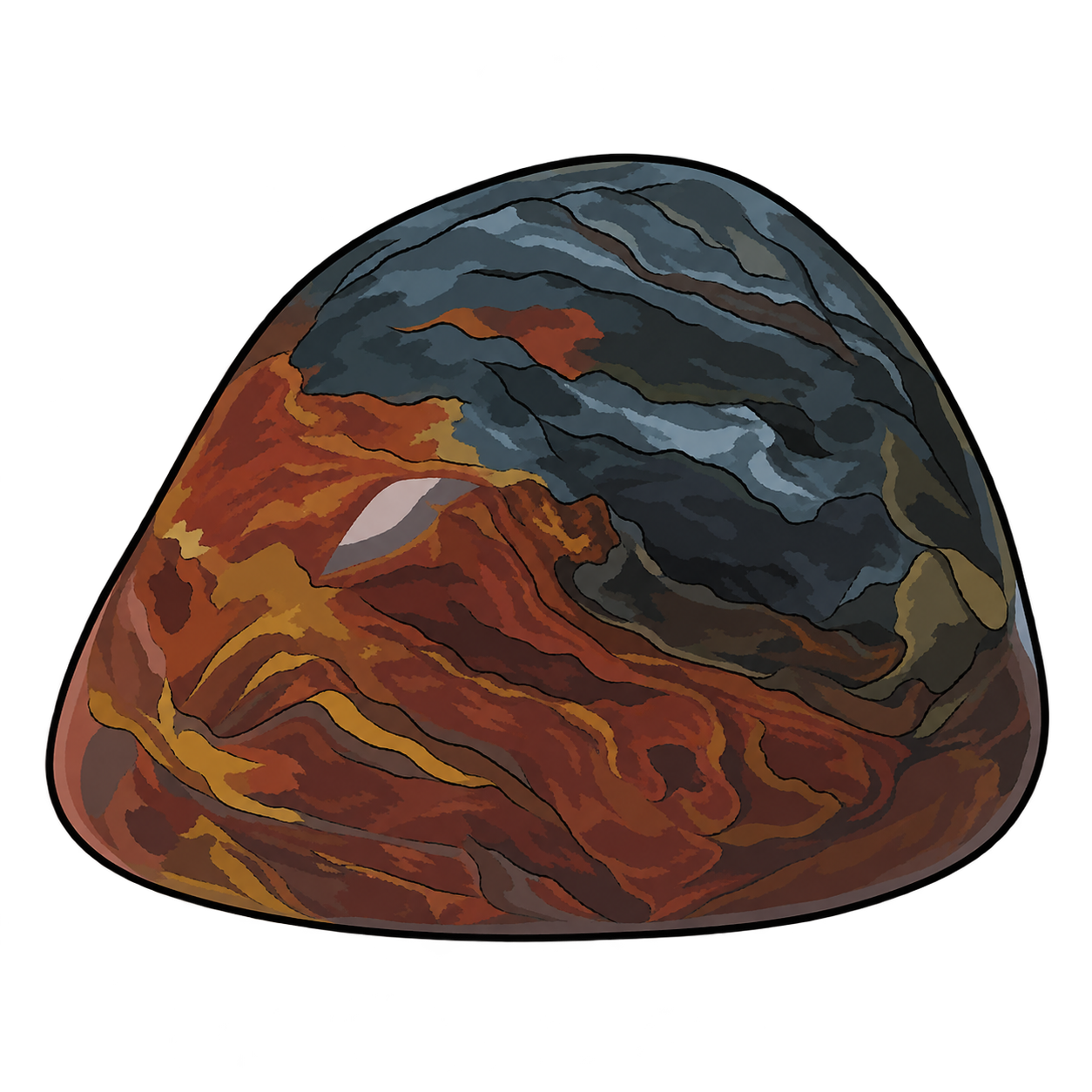
Pietersite is a silica-rich ornamental material whose blue-gray, gold and reddish-brown patches carry a shifting sheen.
Geology · Human history · Spiritual attributes
Insight · Purpose · Determination · Transformation · New beginnings [2]
Pietersite is associated in modern crystal practice with bringing inner vision and personal will together. The Crystal Council connects it with the third-eye and solar-plexus chakras: one representing insight, the other the resolve to act. This is a spiritual interpretation, not a measured property of its mineral fibers. [2]
Host: Fine-grained quartz, including chalcedony Inclusions: Fibrous amphibole and associated minerals Measured refractive index: 1.54–1.55 Measured specific gravity: Namibia 2.50–2.58; China 2.67–2.74 Transparency: Semitranslucent to opaque [3] Quartz chemistry: SiO₂; not a complete formula for the composite Quartz crystal system: Trigonal [4]
Aligned amphibole fibers produce pietersite's sheen. Their directions vary between patches, so neighboring areas need not brighten together. This irregular texture contrasts with the more consistently aligned bands of typical tiger's-eye. [3]
The Namibian samples examined by Hu and Heaney contained fibrous chalcedony and quartzine; their Chinese samples had finer, more equant quartz. Both differed from the characteristic columnar quartz of South African tiger's-eye. [3]
Hu and Heaney proposed that Namibian pietersite developed as a solution breccia: dissolution and silicification altered carbonate rock, with subsequent reactions contributing fibrous amphibole. They considered a related origin possible for the Chinese material. [3]
Pietersite has a documented modern trade history. A 1968 Journal of Gemmology account describes golden-brown cabochons marketed by Windhoek mineral dealer S. Pieters under this name, using material from near Outjo in what is now Namibia. [6]
The early account also measured a specimen's density at about 2.6 and compared its hardness with tiger's-eye. Its description belongs to the history of identifying the material; later microscopic studies provide a more detailed interpretation of the internal texture. Historical observations can remain valuable even as their geological explanations are refined. [6]
The name on a sales label is not sufficient proof of identity. In 2010, GIA reported material sold as pietersite from Arizona that proved to be predominantly serpentine. Some cabochons were doublets with black resin backing. Their refractive-index readings overlapped those expected for pietersite, demonstrating why one apparently matching measurement can mislead. [5]
Microscopic texture, density of suitable unbacked samples and mineral identification helped distinguish the material. A seller's geographic claim and an attractive chatoyant effect did not establish that the stones were pietersite. This is a documented misidentification case, not evidence that all material on the market is counterfeit. [5]
For a prospective purchase, ask whether the piece is a solid stone or an assembled object, and request disclosure of repairs, fillers or backing. Examine the reverse and edges as well as the face. If origin or identity is important to its value, obtain reliable documentation or suitable gemological assessment rather than attempting a destructive household test.
Evaluate the entire design, not just its brightest patch. Blue, bronze and red-brown areas can contribute differently to a composition. Some buyers prefer strong contrasts; others prefer a broad, coherent field of sheen. Neither preference requires every area to flash equally.
Ask to see the piece move under a fixed light. Then examine it under ordinary diffuse lighting. This comparison reveals how much of the effect depends on a carefully chosen viewing angle. A quiet area in one photograph may become reflective in another; an isolated brilliant image can also overstate what is visible during normal wear.
Check the edge, underside and any drilled opening for damage. Consider whether the setting protects narrow corners and whether a display stand supports the whole stone. Keep locality information and any laboratory record with the object so those details do not become detached from it.
Inspect existing seams before mounting; protect narrow edges from impact.
Do not scrape the surface to investigate the fibers or casually cut, drill or grind rough. Research identifies asbestiform amphibole within pietersite; disturbance that releases fibers and dust creates a different exposure situation from displaying an intact solid ornament. General asbestos guidance emphasizes airborne fibers, and stone fabrication can also generate respirable silica. Professional assessment and appropriate controls are needed for such work. [3, 8, 9]
Leave crumbling or fiber-shedding material undisturbed pending specialist advice. These precautions concern the condition of the object and the activity performed, not the symbolic Tempest Stone name or the movement of reflected light. [8]
thecrystalcouncil.com · Reference for the accompanying text · Reference recorded October 15, 2026
gia.edu · Reference for the accompanying text · Reference recorded October 15, 2026
mints.uwc.ac.za · Reference for the accompanying text · Reference recorded October 15, 2026
gia.edu · Reference for the accompanying text · Reference recorded October 15, 2026
gem-a.com · Reference for the accompanying text · Reference recorded October 15, 2026
archive.cdc.gov · Reference for the accompanying text · Reference recorded October 15, 2026
osha.gov · Reference for the accompanying text · Reference recorded October 15, 2026