A Legacy Name for Iron-Bearing Orthopyroxene
Hypersthene
Legacy name within the enstatite–ferrosilite series, retained in gem trade.
Legacy trade name within the orthopyroxene compositional range
Loading this page…
Return homePlease wait while the next page arrives.


A Legacy Name for Iron-Bearing Orthopyroxene
Legacy name within the enstatite–ferrosilite series, retained in gem trade.
Legacy trade name within the orthopyroxene compositional range
Hypersthene is a historical name for iron-bearing orthopyroxene, now classified within the enstatite–ferrosilite series.
Geology · Human history · Spiritual attributes
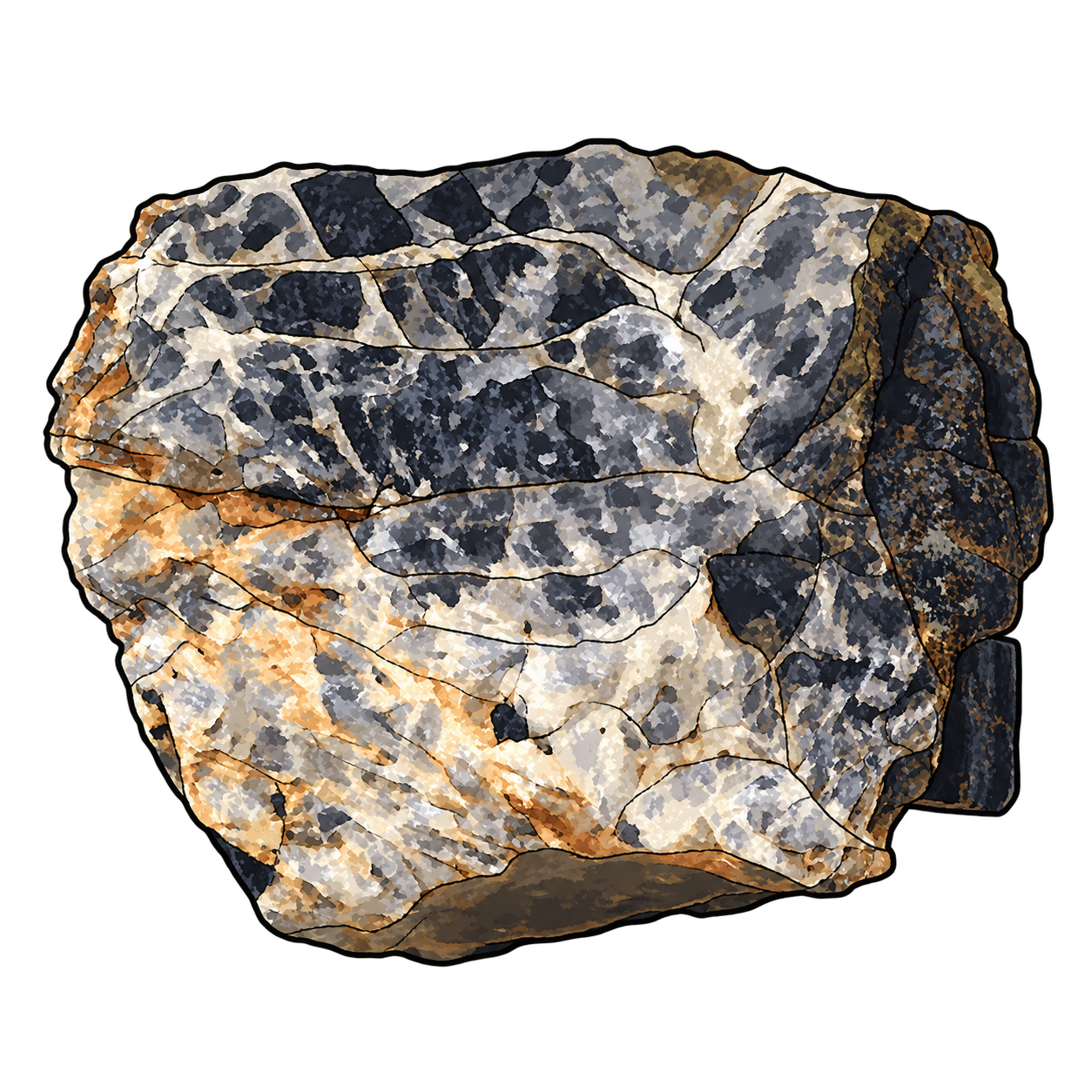
Hypersthene is a historical name for iron-bearing orthopyroxene, now classified within the enstatite–ferrosilite series. It remains familiar in gemstone collections. [1]
In modern crystal practice, hypersthene is associated with inward attention and self-knowledge. Practitioners use it during meditation to step back from external expectations and reflect on personal priorities. These are attributed spiritual meanings, not evidence of a mineral effect on physical or mental health. [4]
Status: Historical and commercial term, not an independent modern species General composition: (Mg,Fe)₂Si₂O₆; magnesium and iron proportions vary Crystal system: Orthorhombic Mohs hardness: Approximately 5–6 for the orthopyroxene material Cleavage: Good, with directions meeting at nearly right angles Typical form: Grains and masses in rocks; less commonly recognizable individual prisms Luster: Glassy to pearly or silky on appropriate surfaces Density and optical properties: Change with composition; one fixed value does not cover every trade specimen [1, 2, 3]
Enstatite and ferrosilite are the magnesium-rich and iron-rich members of a solid-solution series. In such a series, related elements substitute within a compatible crystal structure. Earlier names divided the range into smaller intervals; modern nomenclature uses the accepted end-member names and compositional information instead. A label can change while the physical specimen remains exactly the same. [1, 5]
Hypersthene can be useful for recognizing a familiar ornamental material, but it does not establish a precisely measured magnesium-to-iron ratio. Nor does it mean that every dark, reflective stone belongs to the series. A formal identification combines the mineral's properties and, where needed, chemical or spectroscopic examination. Recent research has used Raman spectroscopy with electron-microscope compositional analysis to study orthopyroxene grains and their geological provenance. [5]
Cleavage can make polished edges vulnerable to chipping. [2]
The subdued reflection is often the feature that attracts collectors. Observe it by turning the stone beneath a steady light: a broad highlight, separate reflective patches and a sharply confined cat's-eye band are not interchangeable descriptions. A dealer's video is useful for seeing how the effect travels rather than relying on its brightest photographed moment.
Tabular hematite and goethite inclusions are reported in material historically called hypersthene. [3]
Not every specimen is an opaque palm stone. GIA documents a transparent 6.47-carat oval from Karnataka, India, under the historical name hypersthene. It is dark orange, with refractive indices recorded as 1.670 and 1.680 and numerous parallel growth tubes. The record provides an example of the range encompassed by older gem labels, not a specification that all commercial hypersthene must meet. [6]
Orthopyroxenes occur in igneous and metamorphic rocks. Ferrosilite-rich examples include metamorphosed iron formations. [7]
This is different from assuming that a polished point grew in its present shape inside a cavity. Ornamental points, spheres and cabochons are shaped by cutting and polishing. Their appeal can lie in the internal mineral texture even when natural crystal faces no longer survive. Ask whether a point is carved or naturally terminated rather than allowing the shape to imply its own origin.
Bronzite and hypersthene are legacy names, not standardized quality grades. [1]
For a reflective cabochon, examine the sheen in ordinary light and from several directions. For a mineral-bearing rock, look at grain boundaries and the contrast between the orthopyroxene and surrounding constituents. A useful listing distinguishes a single-mineral piece from a mixed rock and discloses coatings, repairs or stabilization when present.
Keep the source locality and any analytical report with the specimen. Do not borrow the locality of a similar-looking museum object or infer a country's origin from a common trade appearance. Documentation becomes particularly important when a premium price depends on a claimed rare source or unusual optical effect.
jstage.jst.go.jp · Reference for the accompanying text · Reference recorded October 15, 2026
handbookofmineralogy.org · Reference for the accompanying text · Reference recorded October 15, 2026
gemsociety.org · Reference for the accompanying text · Reference recorded October 15, 2026
thecrystalcouncil.com · Reference for the accompanying text · Reference recorded October 15, 2026
sciencedirect.com · Reference for the accompanying text · Reference recorded October 15, 2026
gia.edu · Reference for the accompanying text · Reference recorded October 15, 2026
handbookofmineralogy.org · Reference for the accompanying text · Reference recorded October 15, 2026