Feldspar with Reflective Inclusions
Sunstone
Feldspar gem material with reflective inclusions, sometimes showing aventurescence.
Optical gem variety encompassing more than one feldspar host
Loading this page…
Return homePlease wait while the next page arrives.


Feldspar with Reflective Inclusions
Feldspar gem material with reflective inclusions, sometimes showing aventurescence.
Optical gem variety encompassing more than one feldspar host
Sunstone ranges from softly sparkling peach-colored material to transparent red, green and multicolored gems.
Geology · Human history · Spiritual attributes
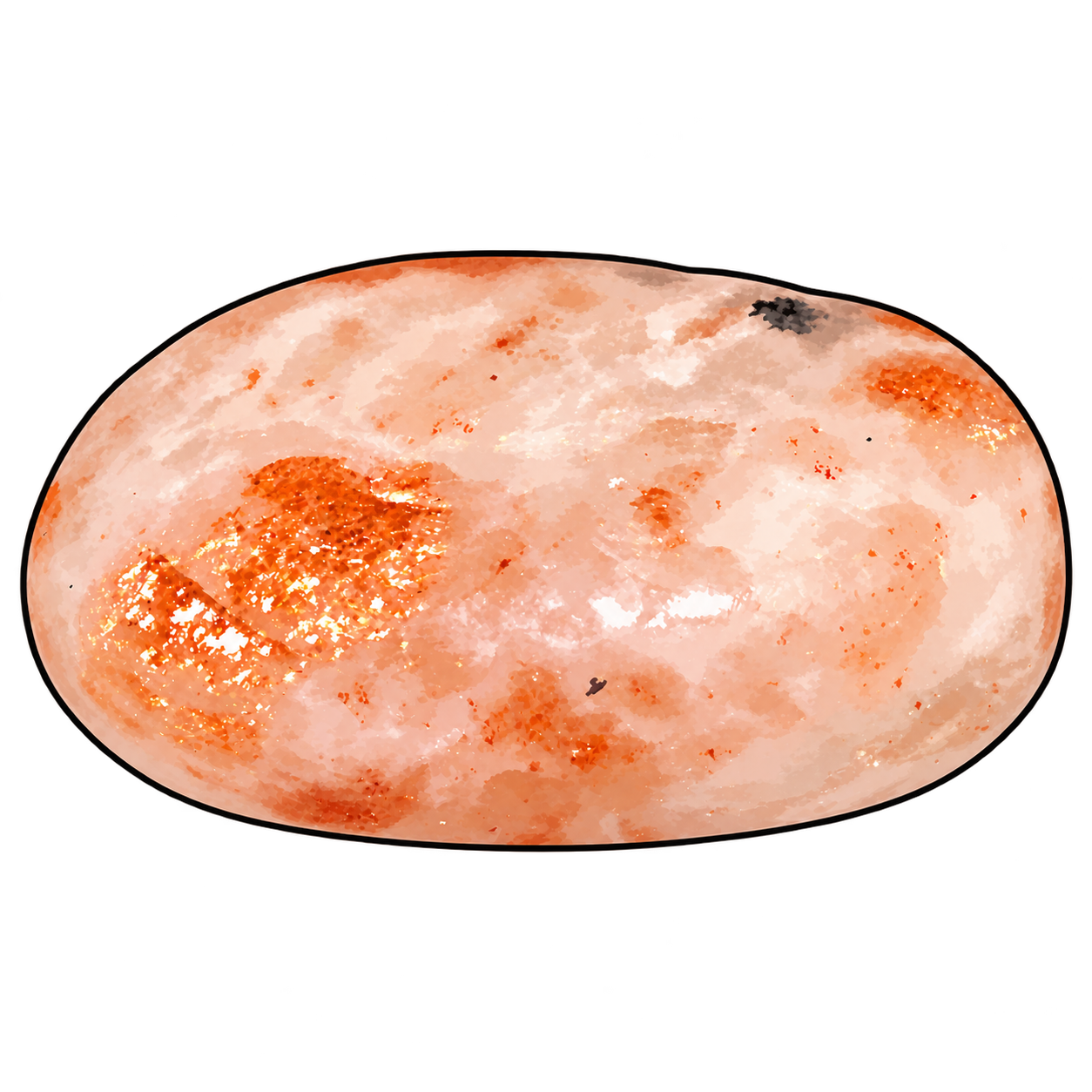
Sunstone ranges from softly sparkling peach-colored material to transparent red, green and multicolored gems. Its characteristic glitter, aventurescence, comes from reflective inclusions inside feldspar. The trade name covers more than one feldspar composition, and some material sold as Oregon sunstone has striking body color without obvious glitter. [1, 2]
Contemporary crystal practice associates sunstone with warmth, initiative and personal expression. The Crystal Council links it with the sacral and solar-plexus chakras, interpreting these correspondences in terms of creativity, will and determination. [3]
A sunstone can be placed where a daily task begins or carried as a reminder of an intention. These uses express personal meaning; copper inclusions do not provide scientific evidence of an energetic effect on a person's fortunes.
Host minerals: Orthoclase and plagioclase feldspars, including oligoclase and labradorite compositions Orthoclase formula: KAlSi₃O₈ Plagioclase composition: Between NaAlSi₃O₈ and CaAl₂Si₂O₈ Mohs hardness: Approximately 6–7.2 across material described by GIA as sunstone Specific gravity: About 2.58 for orthoclase, 2.65 for oligoclase and 2.70 for labradorite examples Cleavage: Feldspar cleavage; durability varies with host and condition Characteristic effect: Aventurescence from reflective inclusions [4]
A single chemical formula would be misleading for the whole category. The host supplies the crystal framework; the inclusions contribute additional optical behavior. Gemological measurements differ accordingly: GIA lists refractive-index ranges of approximately 1.518–1.526 for orthoclase sunstone, 1.537–1.547 for oligoclase and 1.559–1.568 for labradorite. A label identifying the host and origin is more informative than an unqualified claim that every sunstone is oligoclase. [4]
Larger reflective platelets can appear as individual flashes, while finer particles contribute a more diffuse effect. Hematite and copper are among the documented inclusion materials. Sunstone's glitter differs from moonstone's softer adularescence, even though both belong to the feldspar family. “Schiller” is widely used in the sunstone trade, but a description should still explain what is actually visible. [1]
Research on Oregon material shows that copper particles can absorb and scatter light as well as reflect it. Their size, shape and orientation help account for red and green appearances, including strong directional color differences. A 2023 study measured optical behavior at different orientations and polarizations; it also emphasized that further research was needed to explain fully how the natural copper distributions develop. The mechanism is more complex than the idea that every visible color comes from a large orange flake. [2]
Oregon sunstones occur as feldspar crystals in weathered basaltic lava flows. The weathered rock releases crystals that can be selected for color and clarity. Their geological setting differs from the cavity-grown crystal clusters familiar in some other gem collections. The 2023 study describes relatively poorly developed cleavage in its Oregon material, another reason not to assign identical toughness to every feldspar sold under the name. [2]
The Oregon Encyclopedia records mining in Lake and Harney counties and the state's 1987 adoption of sunstone as its official gemstone. This regional identity is useful provenance, but a red or green color alone does not establish Oregon origin. [5]
Sunstone also occurs outside Oregon. GIA describes nineteenth-century recognition of material from Norway and Siberia, and its gem encyclopedia illustrates Indian aventurine feldspar. The diversity of host feldspars and inclusions explains why sunstones from different sources need not look alike. [1, 6]
Australian rainbow lattice material offers a distinctive inclusion pattern rather than simply a more intensely orange version of ordinary sunstone. In a 2024 microscopy study, colored rays appeared when fiber-optic light reflected from hematite platelets. The rays changed direction as the stone tilted, demonstrating that the apparent lines were an optical effect rather than fixed internal rods. [7]
That observation suggests a useful way to examine any phenomenal gem: distinguish the inclusion itself from the light it redirects. A still photograph may show only one arrangement of reflections. Slow movement reveals which features remain fixed and which change with illumination.
Evaluate the body color, its distribution, clarity and the reflective effect separately. A transparent faceted red stone may be selected for color, while an orange cabochon may be selected for a dense field of glitter. Bicolored material can suit an imaginative cut that deliberately retains contrasting zones. There is no need to treat every inclusion as a defect when inclusions are central to the gem's appeal. [8]
Ask to see the stone under ordinary lighting and from several directions. In a video, note whether a glittering patch is attractive over a practical viewing range or visible only at one angle. Examine fractures reaching the surface, damaged edges and the security of the setting independently of the optical effect.
Goldstone is a common imitation: manufactured glass containing small copper crystals. It can be attractive in its own right, but it is not natural feldspar. A glittery appearance therefore establishes neither the host material nor geological origin. Accurate descriptions should name glass as glass and disclose any relevant treatment. [9]
For valuable red or green feldspar, provenance and treatment documentation matter. GIA has investigated copper-diffused material sold under source claims that did not withstand scrutiny. This does not invalidate genuine Oregon sunstone; it means that color and a geographic marketing name are not, by themselves, proof of untreated origin. [1]
GIA's account places reported Oregon discoveries in Warner Valley's ancient lava fields in the early twentieth century. Subsequent collecting and mining supported both jewelry and carving. The material lends itself to designs that emphasize a particular color zone or reflection rather than cutting every piece into a standardized transparent gem. [6, 8]
Oregon's state-gem designation recognizes a particular regional material and its place in local collecting and lapidary work. A documented Oregon origin adds that connection to a piece; an orange color or coppery glitter alone does not. [5]
Clean with lukewarm water, mild soap and a soft brush; rinse and dry without abrasion. GIA advises avoiding steam and ultrasonic cleaning, excessive heat and aggressive chemicals. Rare fracture-filled pieces require care appropriate to the filling as well as the feldspar. [10]
Protect edges from knocks and store jewelry in a separate padded compartment. Pendants and earrings generally receive fewer impacts than rings. A protective mounting reduces exposure but does not remove the possibility of cleavage or chipping. Check a piece after a significant blow before continuing to wear it. [10]
gia.edu · Reference for the accompanying text · Reference recorded October 15, 2026
gia.edu · Reference for the accompanying text · Reference recorded October 15, 2026
thecrystalcouncil.com · Reference for the accompanying text · Reference recorded October 15, 2026
gia.edu · Reference for the accompanying text · Reference recorded October 15, 2026
oregonencyclopedia.org · Reference for the accompanying text · Reference recorded October 15, 2026
gia.edu · Reference for the accompanying text · Reference recorded October 15, 2026
gia.edu · Reference for the accompanying text · Reference recorded October 15, 2026
gia.edu · Reference for the accompanying text · Reference recorded October 15, 2026
gia.edu · Reference for the accompanying text · Reference recorded October 15, 2026
gia.edu · Reference for the accompanying text · Reference recorded October 15, 2026