Norway's Blue-Flashing Ornamental Rock
Larvikite
Norwegian igneous rock rich in feldspar that can show blue-silver iridescence.
Feldspar-dominated intrusive igneous rock
Loading this page…
Return homePlease wait while the next page arrives.


Norway's Blue-Flashing Ornamental Rock
Norwegian igneous rock rich in feldspar that can show blue-silver iridescence.
Feldspar-dominated intrusive igneous rock
Larvikite is a coarse-grained igneous rock whose gray feldspars can flare blue or silver when the light catches them.
Geology · Human history · Spiritual attributes
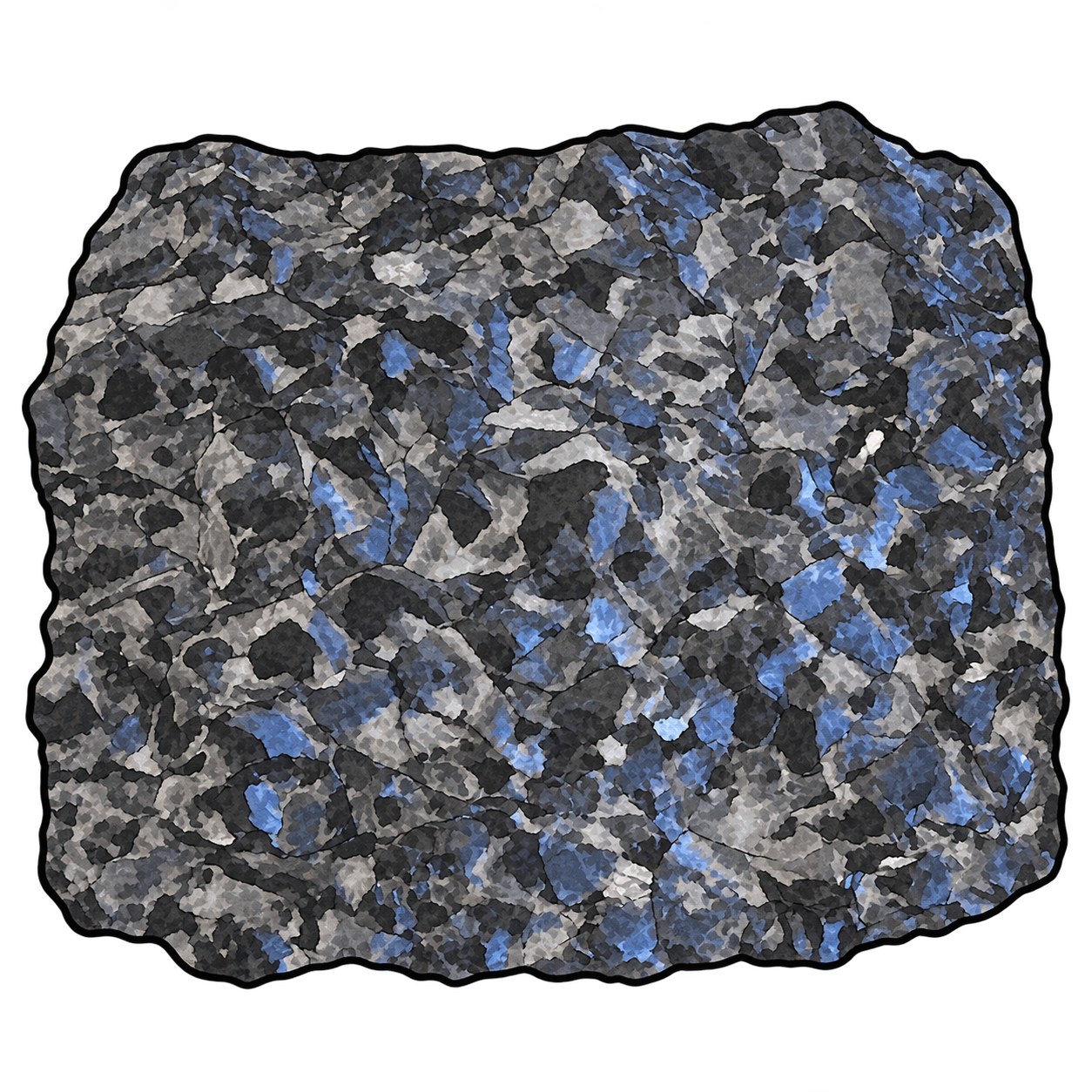
Larvikite is a coarse-grained igneous rock whose gray feldspars can flare blue or silver when the light catches them. Its identity belongs to the rock as a whole, not to a single mineral species. Named for Larvik in southeastern Norway, it is both a collector's material and an internationally important architectural stone. [1, 2]
Contemporary crystal practice associates larvikite with steadiness during change. The Crystal Council describes it as a protective stone and connects its use with inner strength and adaptation. These are modern spiritual interpretations, distinct from the geological properties that produce its appearance. [3]
A polished piece can serve as a tactile focus during reflection. Its personal significance does not depend on believing that the rock absorbs harmful energy, and spiritual use should not be confused with treatment for anxiety or other health conditions.
Rock type: Intrusive igneous rock, commonly described as monzonitic Principal constituent: Feldspar Other constituents: Variable dark silicates and iron–titanium oxides Chemical formula: None for the whole rock Crystal system: None for the whole rock; each constituent mineral has its own structure Characteristic appearance: Coarse interlocking grains with directional feldspar iridescence [1, 2]
Calling larvikite simply “feldspar” loses an important distinction. Feldspars dominate its texture, but individual pieces contain a mineral assemblage. A formula such as KAlSi₃O₈ describes an ideal potassium feldspar, not the complete larvikite rock. Similarly, a single crystal-system label would describe a constituent rather than the aggregate.
The Norwegian Geological Survey's detailed study reports approximately 80–95 percent feldspar in the studied larvikites, with such accompanying minerals as augite, amphibole, biotite, olivine and iron–titanium oxides. The wider complex includes quartz-bearing and nepheline-bearing varieties; these are not interchangeable descriptions of every specimen. [2]
What makes the blue flash? Microscopic intergrowths within feldspar interact with light to produce the iridescence. The apparent color changes with the relationship between the mineral's internal structure, illumination and viewing direction. Cutting and polishing expose favorable surfaces, but polishing does not create the underlying optical structure. [1, 2]
Look at a piece while slowly tilting it under a fixed light. One grain may brighten as another darkens because neighboring feldspars need not share the same orientation. In a larger slab, a careful choice of cutting direction can make the effect more consistent. A photograph taken at the brightest angle should not be interpreted as the stone's appearance from every viewpoint.
Dark grains, pale feldspar boundaries and small interruptions in the flash are part of a natural rock texture. A highly uniform commercial slab and a small specimen with more varied mineral patches can both be genuine larvikite. Examine the whole piece rather than treating every black speck as damage or every non-flashing area as evidence of an imitation.
Larvikite formed from magma that cooled underground in the Oslo Rift region. The Norwegian Geological Survey places the rock within the approximately 290-million-year-old geological history of the area. Its occurrence extends through parts of Vestfold and Telemark, rather than being confined to the modern town that supplied its name. [1]
The plutonic complex consists of multiple intrusions, not a single uniform body. Published zircon ages for parts of the larvikite sequence extend from approximately 297 to 293 million years. Variations in composition and cooling history help explain the range of textures and commercial appearances. [2]
Blue Pearl and Emerald Pearl are commercial names for selected appearances, not separate mineral species. IUGS describes lighter Blue Pearl material and darker Emerald Pearl varieties associated with different quarry areas. A seller's trade name can be useful, but it should accompany rather than replace a clear identification of the rock. [4]
Larvikite's reflective texture has made it a distinctive facing and decorative stone. IUGS records its use in buildings including Harrods in London, Galeries Lafayette in Paris and the Burj Al Arab in Dubai. It has also been exported for funerary monuments since the late nineteenth century. These applications exploit the visual interest of a polished surface while retaining the scale and solidity of natural stone. [4]
Its designation as an IUGS heritage stone in 2017 recognizes geological and cultural significance together. The same material can therefore be approached as a mineral-rich specimen, a decorative object or part of architectural history. A palm-sized piece preserves the grain-scale effects that give a much larger building surface its character. [4]
Larvikite is sometimes sold under names that suggest moonstone or labradorite. Those comparisons refer to a visual resemblance and should not erase the distinction between a rock and a named gem material. Choose a specimen with a clear label, and ask what a supplier means by any additional trade name.
For a polished piece, inspect the surface both in reflected light and at a less flattering angle. Fine scratches and polish residues can be difficult to see when a bright flash dominates the view. For a rough specimen, look for a coherent coarse-grained texture and intact edges; do not expect the same optical intensity as on a carefully oriented polished face.
Color alone cannot prove a quarry of origin. A documented supplier history is more useful than assigning a particular locality from the amount of blue in an image. Nor should an unverified hardness number be used as a home scratch test: scratching may damage the finish while providing little reliable information about a mixed-mineral rock.
For routine cleaning, use a soft cloth with water and a small amount of neutral stone cleaner or mild soap. Rinse away residue and dry. The Natural Stone Institute recommends nonabrasive cleaning and warns that even predominantly siliceous stones can contain components affected by acidic products. Avoid vinegar, acidic descalers and abrasive powders. [5]
Keep grit away from polished surfaces and protect corners from impacts. Do not assume that a decorative stone needs a sealer; treatment decisions depend on the material, finish and intended use. For countertops or installed architectural stone, follow the fabricator's instructions rather than applying a specimen-care recipe. Use coasters and protective mats, and avoid placing hot cookware directly on a polished surface. [5]
ngu.no · Reference for the accompanying text · Reference recorded October 15, 2026
static.ngu.no · Reference for the accompanying text · Reference recorded October 15, 2026
thecrystalcouncil.com · Reference for the accompanying text · Reference recorded October 15, 2026
iugs-geoheritage.org · Reference for the accompanying text · Reference recorded October 15, 2026
naturalstoneinstitute.org · Reference for the accompanying text · Reference recorded October 15, 2026