Iridescent plagioclase feldspar
Labradorite
A plagioclase feldspar variety known for labradorescence.
Plagioclase feldspar variety with an optical effect
Loading this page…
Return homePlease wait while the next page arrives.


Iridescent plagioclase feldspar
A plagioclase feldspar variety known for labradorescence.
Plagioclase feldspar variety with an optical effect
Labradorite is a feldspar best known for broad flashes of blue, green, gold and other colors that appear as the stone turns in the light.
Geology · Human history · Spiritual attributes
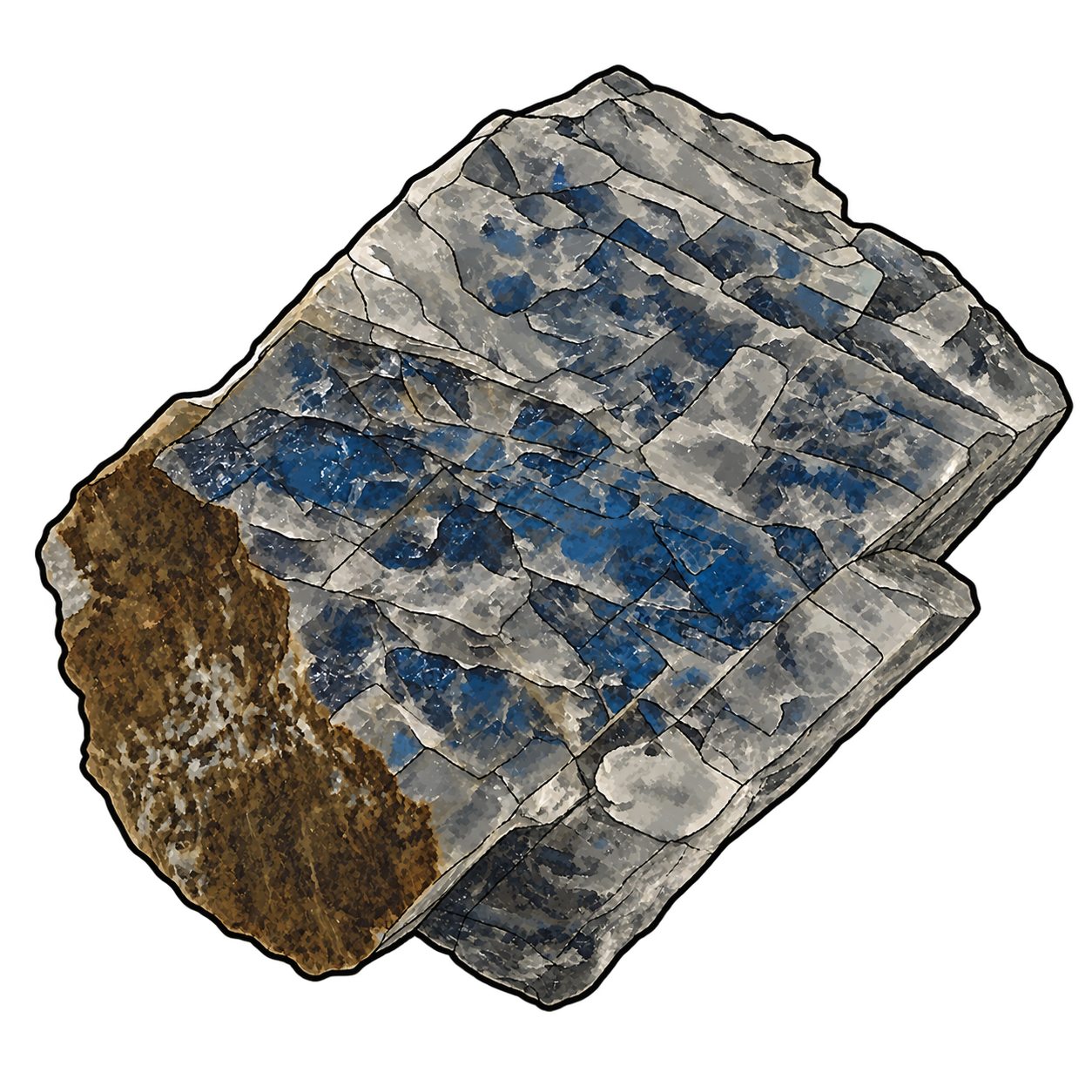
Labradorite is a feldspar best known for broad flashes of blue, green, gold and other colors that appear as the stone turns in the light. This directional effect, called labradorescence, comes from structures within the crystal rather than a colored surface coating. Its shifting appearance makes it popular for cabochons, carvings and display specimens, and contemporary crystal practice associates it with transformation, intuition and spiritual protection. [1, 5, 11]
Labradorite is used in contemporary crystal practice as a companion to change and spiritual exploration. Its sudden appearance of color is often interpreted as a symbol of potential that is present before it is fully recognized. Practitioners may carry it as an amulet or use it as a focus during meditation. [5]
These associations concern personal spiritual practice. The stone's measurable optical properties explain its flash; they do not establish the effects attributed to it in ritual.
Composition: Intermediate sodium-calcium feldspar, conventionally about 50–70% anorthite component Crystal system: Triclinic Mohs hardness: 6–6.5 Specific gravity: Approximately 2.68–2.72 Luster: Glassy; sometimes pearly on cleavage surfaces Cleavage: Two prominent directions Fracture: Uneven to conchoidal; brittle Refractive indices: Approximately 1.555–1.573, varying with composition [3, 4]
Plagioclase feldspars range between sodium-rich albite and calcium-rich anorthite. Labradorite names an intermediate portion of that series, not a mixture of separate loose albite and anorthite grains. The familiar An50–An70 notation expresses the proportion of the anorthite component. A mineral can have a labradorite composition without displaying the dramatic flash sought in ornamental material. [4, 6]
The mineral resists scratching better than softer carving stones, but its cleavage creates directions along which it can split. Corners, thin edges and projecting carved details need protection from knocks. A bright polish is therefore not evidence that a piece is resistant to impact. The numerical hardness range and the cleavage description answer different questions about durability. [3]
Labradorite commonly occurs in granular masses or as crystals within rock. Twinning—related crystal orientations growing together—is common. Its refractive indices and density help distinguish it from other materials, but the ranges overlap those of neighboring feldspars. A precise identification may require more than appearance and one measurement. [3, 4]
Labradorite is widespread in igneous rocks such as basalt, gabbro and anorthosite. Anorthosite is particularly rich in plagioclase feldspar; a polished surface can expose numerous crystals, each oriented differently. Labradorite also occurs in some metamorphic rocks and as grains released by weathering. [4]
Iridescent labradorite contains alternating calcium-rich and calcium-poor layers, typically tens to hundreds of nanometers thick. Their development is associated with separation within the feldspar during its geological history. These microscopic layers should not be confused with the much larger colored patches visible on a polished face. [11]
Light interacting with the repeated layers produces interference. Layer thickness influences the reflected color, while crystal orientation makes the flash directional. Electron-microscope studies distinguish this color-producing structure from other, finer structural patterns within the same mineral. Ordinary iron-oxide inclusions are not the cause of labradorescence. [11]
This is why orientation matters when the stone is cut. A cabochon is a shaped, polished gem rather than one covered in flat facets. A cutter studies the rough to place its strongest flash where it will be visible in the finished object. A poorly oriented cut may show attractive color only from an awkward angle. [1, 4]
Spectrolite is a trade name associated with richly colored Finnish labradorite. Color alone should not be used to establish Finnish provenance. GIA's Gübelin collection includes a documented 30.82-carat cabochon from Ylämaa Quarry, providing a specific example rather than a rule for identifying every multicolored stone. [1, 7]
Rainbow moonstone is an accepted trade name for iridescent, often transparent labradorite. It is related to traditional moonstone as a feldspar, but it is not the same material. Keeping the trade name alongside the mineral identity makes the distinction clear without dismissing a familiar jewelry term. [8]
Sunstone describes another optical appearance: reflections from small inclusions can produce a glittering effect called aventurescence. Some sunstone is itself labradorite by composition. A broad labradorescent flash and a field of glittering inclusions should not be treated as identical features, even when their host feldspar belongs to the same compositional range. [1, 6]
For labradorite, a still photograph records one favorable—or unfavorable—relationship with light. When choosing a piece, look at a short rotation under steady illumination. Notice how much of the face lights up, how broad the useful viewing angle is and whether different patches respond together. Check the unlit body and edges as well as the brightest flash.
For a pendant or display carving, consider its intended position. A piece that flashes strongly while lying flat may show less color when suspended vertically. The best choice is not necessarily the one with the widest advertised color range; a clear, well-positioned blue flash may suit the object better than several colors visible only from an inconvenient angle.
Gem artist Valentina Fetisova uses labradorite's light as part of painted miniature scenes. In GIA's account, she builds translucent layers on prepared cabochons so that changes in the stone's flash alter the image. Landscapes, animals and other subjects acquire a shifting background supplied by the mineral itself. [9]
Such work is a combination of natural gem and applied artwork. It should be described and cared for accordingly: the painting is an intentional artistic addition, while the underlying labradorescence comes from the feldspar. A painted piece must not be cleaned as though its surface were uncoated stone. [9]
Look for chips along corners, cleavage-related breaks, rough patches in the polish and any repairs. Ask about locality and whether the surface has been coated or painted. Because the mineral's own internal layers produce a directional flash, apparent proximity to the surface is not by itself a reliable coating test. [11]
Protect cleavage-prone edges from impact. Painted surfaces require care appropriate to their coating. [3, 9]
For a mounted, repaired or painted object, follow the maker's instructions. A setting, adhesive or varnish can be more vulnerable than the mineral beneath it. In everyday use, a soft cloth and careful handling are often sufficient; preserving the polish and edges matters more than frequent intensive cleaning.
gia.edu · Reference for the accompanying text · Reference recorded October 15, 2026
gia.edu · Reference for the accompanying text · Reference recorded October 15, 2026
handbookofmineralogy.org · Reference for the accompanying text · Reference recorded October 15, 2026
geology.com · Reference for the accompanying text · Reference recorded October 15, 2026
thecrystalcouncil.com · Reference for the accompanying text · Reference recorded October 15, 2026
origin.prod.gia.edu · Reference for the accompanying text · Reference recorded October 15, 2026
cms.gia.edu · Reference for the accompanying text · Reference recorded October 15, 2026
gia.edu · Reference for the accompanying text · Reference recorded October 15, 2026
gia.edu · Reference for the accompanying text · Reference recorded October 15, 2026
ejm.copernicus.org · Reference for the accompanying text · Reference recorded October 15, 2026