Feldspar with Adularescence
Moonstone
Adularescent feldspar material, classically intergrown alkali feldspars.
Optical gem variety encompassing more than one feldspar host
Loading this page…
Return homePlease wait while the next page arrives.


Feldspar with Adularescence
Adularescent feldspar material, classically intergrown alkali feldspars.
Optical gem variety encompassing more than one feldspar host
Moonstone is admired for a moving sheen that seems to float within or just above its surface.
Geology · Human history · Spiritual attributes
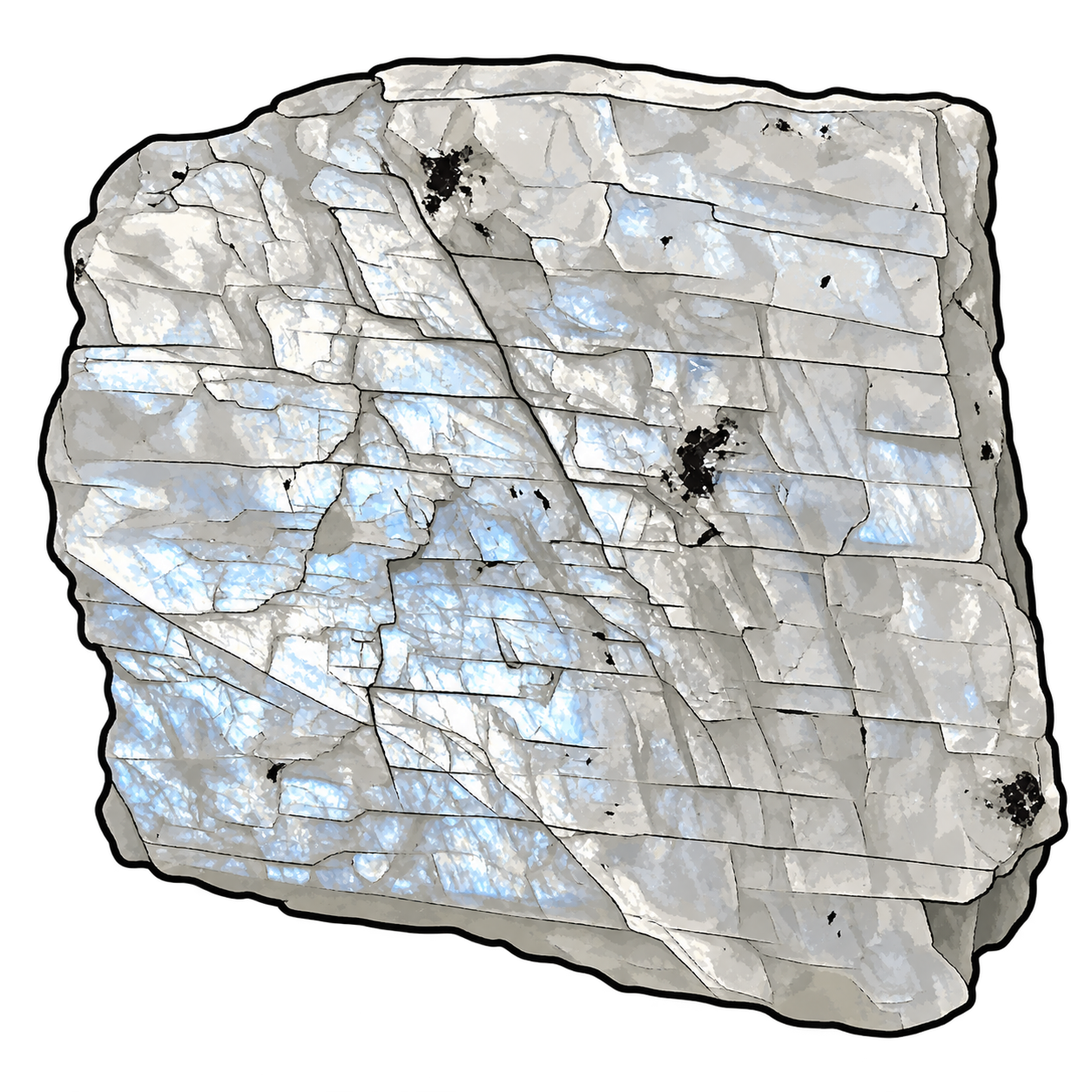
Moonstone is admired for a moving sheen that seems to float within or just above its surface. This optical effect, called adularescence, may be blue, silvery or white against a clear, milky, peach or darker body. The gem belongs to the feldspar family; its lunar name describes an appearance, not a material from the Moon. [1, 2]
Moonstone is associated in contemporary crystal practice with inward attention and intuitive understanding. The Crystal Council places it within crown- and third-eye symbolism and recommends it as a meditation stone. Such associations concern spiritual practice, not a scientific explanation of its light or a promise of supernatural knowledge. [3]
The stone may accompany journaling, meditation or a personal lunar ritual. Its significance comes from the practitioner's interpretation; the optical sheen itself does not measure intuition or spiritual development.
Conventional host: Orthoclase with albite intergrowth Orthoclase composition: KAlSi₃O₈ Albite component: Sodium feldspar Crystal system of orthoclase: Monoclinic Mohs hardness: Approximately 6–6.5 Cleavage: Two prominent directions Luster: Glassy; pearly on some cleavage surfaces Characteristic optical effect: Adularescence [1, 4, 5]
The traditional gem is often described as orthoclase moonstone, but its sheen depends on a fine intergrowth, not simply an isolated potassium-feldspar crystal. Other feldspars can produce related effects. A physical-property table for orthoclase is useful for the conventional material; it should not silently be treated as a universal analytical description of every stone sold under a moonstone trade name. [1]
As the relevant feldspar cools, compositions that were initially intermingled separate into very fine alternating layers. Their interaction with incident light produces the soft optical field. The stone is redirecting light rather than generating it. Tilting changes the angle of observation, making the sheen gather, spread or retreat. A polished dome can emphasize that movement, but a rough specimen may also show it. [1]
Orthoclase is brittle and has strongly developed cleavage. A blow may therefore create a planar break even though the material resists some everyday scratching. A smooth cabochon is not necessarily tough merely because it has no projecting crystal points. The distinction matters in jewelry: exposed ring settings experience different risks from a pendant. [4, 5]
Orthoclase's measured density is approximately 2.55–2.63, with refractive indices around 1.518–1.525. These are identification properties, not desirability scores. Microscopy, optical testing and—where necessary—more specialized analysis establish material identity more reliably than judging a blue flash from one photograph. [4]
Rainbow moonstone is an established trade name for a light-bodied variety of labradorite with multicolored iridescence. It is a natural feldspar, but it is not the same host as conventional orthoclase moonstone. The name can be used clearly when the accompanying description identifies labradorite. It should not be interpreted as proof that a transparent stone has been dyed or manufactured. [6]
The comparison is especially helpful when buying online. Ask whether the seller is describing an orthoclase-based gem or rainbow moonstone, and request views with and without the flash. A beautiful iridescent field can obscure the body's transparency, fractures or inclusions when photographed only at its brightest angle.
Orthoclase is a common rock-forming mineral in granites, pegmatites and other geological settings, but attractive adularescence requires the appropriate internal structure. The abundance of feldspar in general does not make every feldspar a moonstone. [4]
India and Sri Lanka are important moonstone sources, with material also reported from Madagascar, Myanmar, Brazil, Tanzania and parts of the United States. These are source regions for the gem trade, not reliable origin tests based on color. A retailer's documented provenance is more useful than a claim that all peach, blue or white material must come from a particular country. [7]
Moonstone has been used by designers who valued its subtle light rather than the sharply defined sparkle of a faceted diamond. GIA's historical survey identifies its popularity in Arts and Crafts jewelry and the work of Art Nouveau designers such as René Lalique and Louis Comfort Tiffany. It later reappeared prominently in twentieth-century jewelry fashions. [8]
A particularly instructive surviving object is Tiffany's necklace with pendant, dated about 1910, in the Metropolitan Museum of Art. Irregular moonstones alternate with platinum scrolls and small Montana sapphires. The jewel could be divided into a choker or bracelet and a separate brooch. Its construction demonstrates that a gemstone's role in a design includes movement, contrast and versatility—not just the appearance of one isolated stone. [9]
Lunar legends are another part of moonstone's reception. GIA reports a Hindu story describing it as solidified moonlight. That is an attributed account of lore, not a mineralogical origin or a belief to assign indiscriminately to every Hindu tradition. Moonstone is also one of the modern June birthstones. [7, 8]
Judge body color, sheen color and sheen placement separately. A well-oriented cabochon presents its effect across a useful range of angles, rather than requiring one precise position. Blue sheen over a nearly colorless body is a highly valued combination, but peach, gray and milky material can offer a different aesthetic. [2]
Characteristic microscopic stress cracks are sometimes called centipedes because of their branching appearance. These are not fossil organisms. Some moonstones also display a cat's-eye or four-rayed star; those effects should be shown under suitable lighting rather than assumed from the name. [2]
Ask for a short rotating video in ordinary light. View the surface edges, the back and the unlit body as carefully as the flash. A loose stone's behavior should suit the intended setting: a beautiful effect visible from the side may become difficult to see once mounted. Repairs, coatings and any treatment should be disclosed independently of the descriptive trade name.
Use warm, mildly soapy water and a soft brush, then rinse and dry gently. GIA advises against steam and ultrasonic cleaning. High heat and abrupt temperature changes can fracture moonstone; routine cleaning should not involve boiling water or a heated appliance. [5]
Protect jewelry from impact and remove it for strenuous work. A bezel can shelter an edge, but it does not make the feldspar indestructible. Store moonstone separately from harder gems and inspect settings for looseness after a knock. For a rough specimen with a fragile matrix, obtain care advice before immersion. These measures preserve both the polished surface and the internal structure responsible for its sheen. [5]
gia.edu · Reference for the accompanying text · Reference recorded October 15, 2026
gia.edu · Reference for the accompanying text · Reference recorded October 15, 2026
thecrystalcouncil.com · Reference for the accompanying text · Reference recorded October 15, 2026
handbookofmineralogy.org · Reference for the accompanying text · Reference recorded October 15, 2026
gia.edu · Reference for the accompanying text · Reference recorded October 15, 2026
gia.edu · Reference for the accompanying text · Reference recorded October 15, 2026
gia.edu · Reference for the accompanying text · Reference recorded October 15, 2026
gia.edu · Reference for the accompanying text · Reference recorded October 15, 2026
metmuseum.org · Reference for the accompanying text · Reference recorded October 15, 2026