Deep blue copper silicate, delicate fibers, and quartz that preserves a growth history
Shattuckite
A copper silicate hydroxide mineral, often present in blue-green mixed rocks.
Mineral species; ornamental specimens may include other minerals
Loading this page…
Return homePlease wait while the next page arrives.


Deep blue copper silicate, delicate fibers, and quartz that preserves a growth history
A copper silicate hydroxide mineral, often present in blue-green mixed rocks.
Mineral species; ornamental specimens may include other minerals
Shattuckite brings an intense blue to the oxidized zones of copper deposits.
Geology · Human history · Spiritual attributes
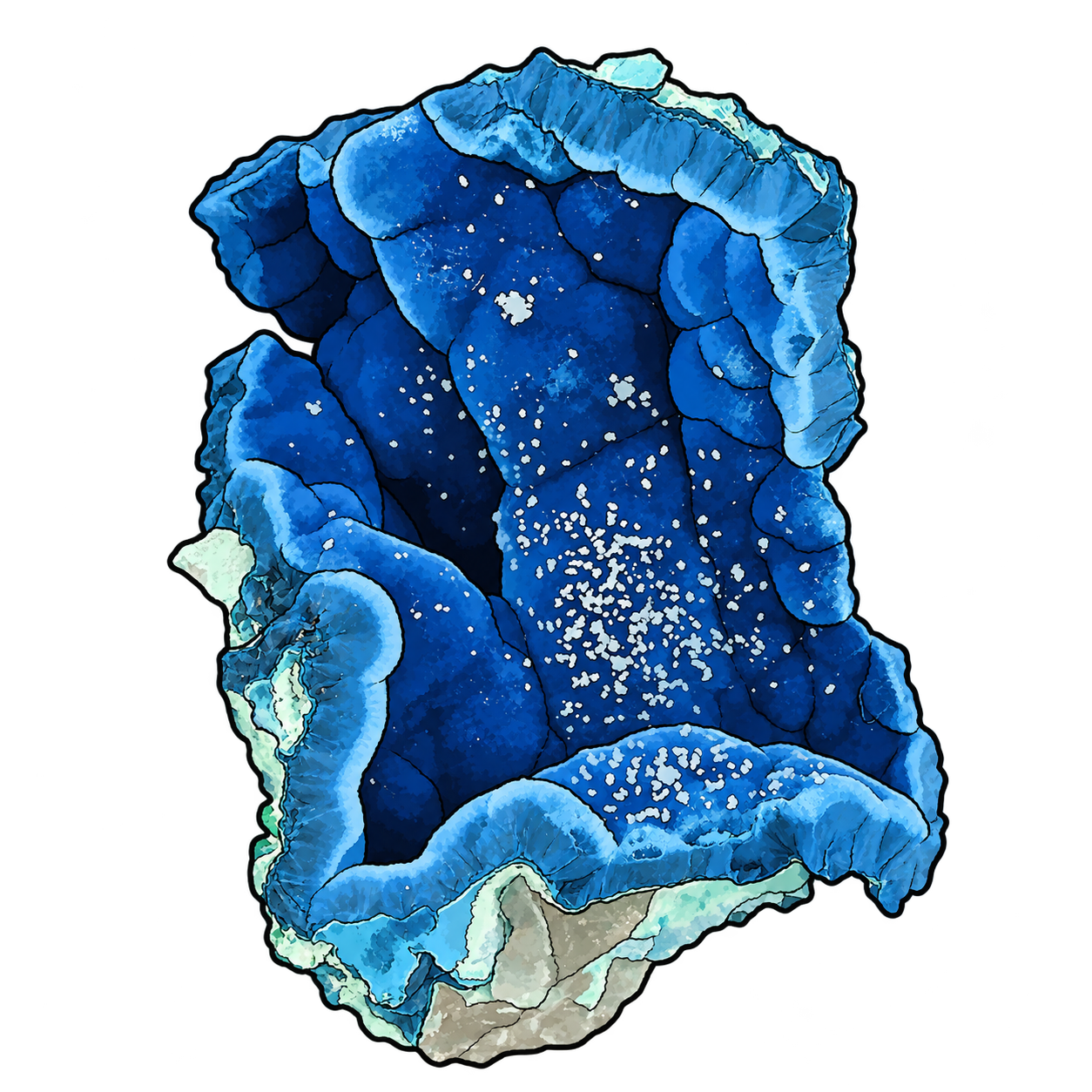
Shattuckite brings an intense blue to the oxidized zones of copper deposits. Its crystals are often too small to read individually with the unaided eye, gathering instead into rounded, radiating, or felt-like masses. Some specimens expose that delicate surface; others preserve shattuckite inside quartz. The distinction matters, because a quartz host and exposed copper-silicate fibers do not have the same durability. [1,3]
The Crystal Council associates shattuckite with truth, intuition, and communication that joins thought with feeling. Its chakra correspondences emphasize the throat, heart, and third eye; its account also includes mediumship and symbolic messages. These are practitioner beliefs, not established abilities produced by a copper mineral. [2]
This symbolism lends itself to a pause before a difficult conversation or a period of reflective writing. It does not guarantee persuasive speech, legal success, or access to information unavailable through ordinary means. The stone can serve as a chosen reminder while the responsibility for careful communication remains with the person.
Shattuckite crystallizes in the orthorhombic system. Well-formed prisms are rare; needle-like crystals more often cluster into rounded or radiating aggregates. The Handbook of Mineralogy gives a hardness of about 3.5, a measured density near 4.11, and perfect cleavage in two directions. Its silky luster is especially characteristic of finely fibrous surfaces. [1]
Those properties explain why an attractive rough specimen should not be treated like a durable quartz tumble. Small crystals can detach, projecting fibers can wear, and a hard host does not protect every exposed mineral patch. Conversely, a polished composite containing abundant quartz should not automatically be assigned the hardness of pure shattuckite.
The ideal formula identifies copper as an essential constituent. It is not a recipe for safe ingestion, a reason to prepare mineral water, or a measure of how a specimen will behave in a household liquid. Keep collector minerals out of food and drink preparation and avoid generating dust through casual grinding or scraping.
Shattuckite is a secondary mineral associated with alteration in oxidized copper deposits. It may occur with malachite, chrysocolla, ajoite, and quartz. Neighboring blue and green areas can therefore represent different minerals sharing a geological environment rather than a single species changing color across the rock. [1,3]
This mixed setting is important in the ornamental trade. A piece may be sold under the name of its most visually prominent mineral even when much of its volume is another material. A useful description identifies a mixed copper-mineral rock as such and avoids assigning every blue patch to shattuckite without evidence.
The type locality is the Shattuck Mine at Bisbee, Arizona, after which the mineral was named. Local historical records connect its recognition with material studied by W. T. Schaller in 1915. That documented history is separate from modern metaphysical associations and does not establish an ancient ceremonial tradition. [4]
QUARTZ PHANTOMS: A RECORDED GROWTH SEQUENCE A 2017 GIA examination described a quartz cluster from Namibia's Kandesei Mine containing blue shattuckite aggregates. Raman analysis confirmed the inclusion identity. The shattuckite had accumulated on an earlier quartz surface and was then enclosed as quartz growth continued, preserving an internal outline of that earlier stage. [3]
Collectors call such an outline a phantom. The word is descriptive: it is a former growth surface made visible within a later crystal, not a separate supernatural phenomenon. A transparent host can preserve the arrangement of minute fibers that would be difficult to appreciate in an opaque mass.
The study is an example of what careful observation and analysis can reveal about one specimen. It is not a rule that every blue phantom is shattuckite or that every shattuckite inclusion originated in Namibia. Similar-looking inclusions require their own identification.
A 2014 GIA trade report described intensely blue material from the Democratic Republic of Congo that was being stabilized before jewelry manufacture. That report establishes a real use of stabilization in shattuckite-bearing material; it does not mean every specimen has been treated. [5]
Stabilization and mineral identity answer different questions. A genuine mineral can be reinforced, and a composite can contain natural shattuckite while also incorporating a treatment. Ask for disclosure of resin or other reinforcement rather than relying on a general statement that the stone is natural.
For a costly piece, useful questions include whether the blue material was analytically identified, what the surrounding minerals are, and whether the object is suitable for frequent wear. A spectacular specimen with delicate exposed fibers may be better suited to a display case than a bracelet. Appearance alone cannot answer that durability question.
Handle rough shattuckite by its stable matrix or base, not by a velvety crystal surface. Do not rub the blue fibers to improve their shine. A dry, protected display and gentle handling preserve features that cannot be restored once brushed away.
For polished objects, begin with a soft cloth and follow any known treatment guidance. Avoid steam, ultrasonic cleaning, solvents, and extended soaking when resin or mixed copper minerals may be present. Keep the object separate from harder stones and metal edges. Do not attempt chemical identification tests or hot-point tests at home; these can damage a specimen or treatment without providing a reliable identification.
Maintain its locality label and treatment information with the collection record. The blue color is visually immediate, but provenance, composition, and condition are what allow the specimen to remain scientifically and commercially intelligible over time.
handbookofmineralogy.org · Reference for the accompanying text · Reference recorded October 15, 2026
thecrystalcouncil.com · Reference for the accompanying text · Reference recorded October 15, 2026
gia.edu · Reference for the accompanying text · Reference recorded October 15, 2026
bisbeeminingandminerals.com · Reference for the accompanying text · Reference recorded October 15, 2026
gia.edu · Reference for the accompanying text · Reference recorded October 15, 2026