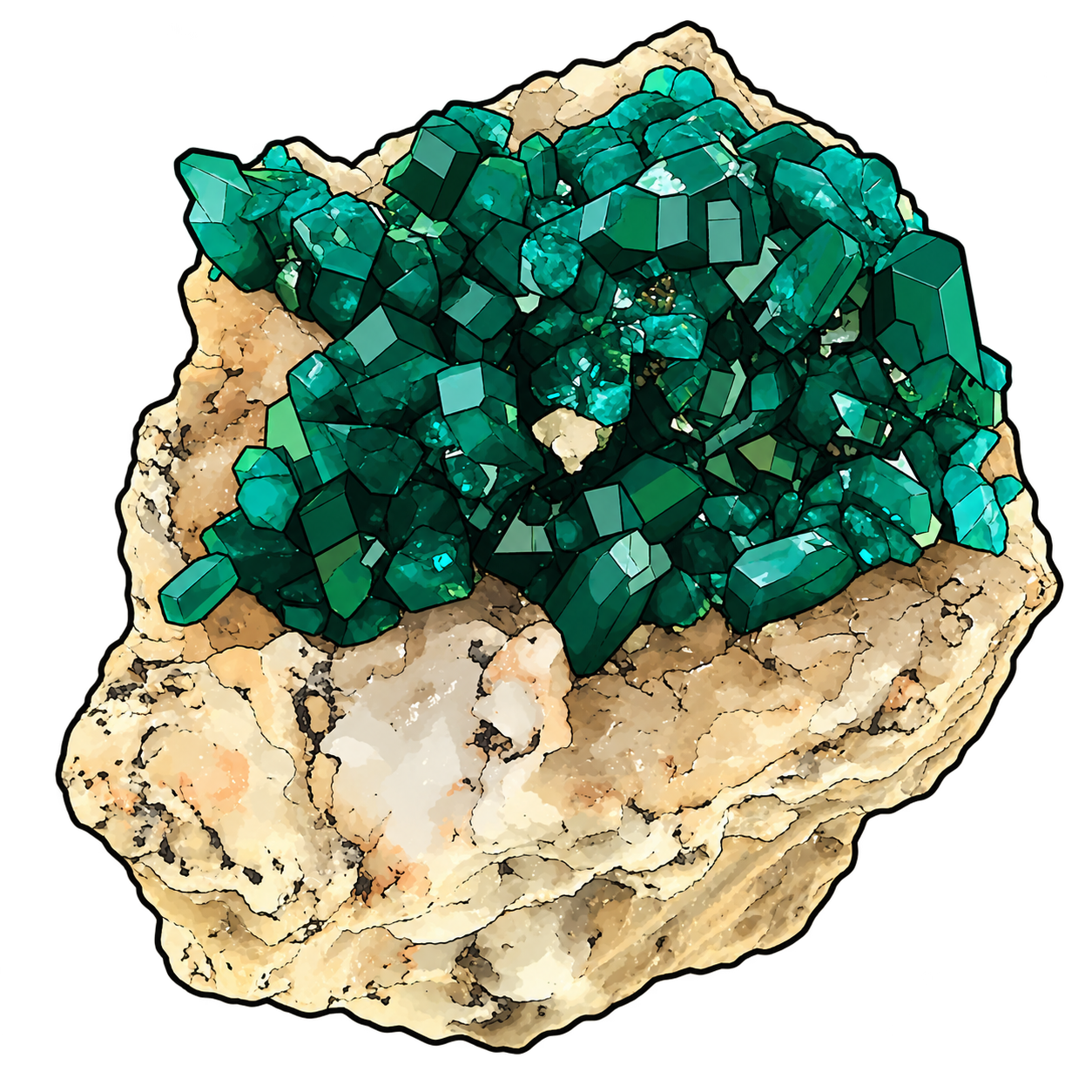
Vivid copper-green crystals with an intricate structure and vulnerable edges
Dioptase
Hydrated copper silicate, often emerald green.
Mineral species; ornamental specimens may include other minerals
Loading this page…
Return homePlease wait while the next page arrives.


Vivid copper-green crystals with an intricate structure and vulnerable edges
Hydrated copper silicate, often emerald green.
Mineral species; ornamental specimens may include other minerals
Dioptase's vivid green invites comparison with emerald, but it is hydrated copper silicate, not beryl.
Geology · Human history · Spiritual attributes
The Crystal Council places dioptase within heart-centered practice, associating it with compassion, emotional understanding, renewed confidence, and patience. Its meaning is concerned with acknowledging difficult feelings and considering a way forward. These are spiritual interpretations, not evidence that the stone treats grief, trauma, anxiety, or other health conditions. [2]
A specimen may serve as a contemplative focus for forgiveness or a fresh commitment. Fragile crystals do not need to be carried against the skin or passed from hand to hand to fulfill that symbolic role. A protected display can preserve the stone while leaving room for personal meaning.
The compact formula CuSiO3·H2O can also be written Cu6Si6O18·6H2O to emphasize dioptase's ring-based structure. It has trigonal symmetry and commonly develops prismatic or rhombohedral-looking crystals. Its copper supplies the vivid green. Hardness is about 5, measured density approximately 3.28–3.35, and the material is brittle with perfect cleavage. [1,3]
Hardness concerns resistance to scratching; cleavage concerns a preferred direction of breakage. A crystal can therefore look substantial while remaining vulnerable to a knock or pressure from an ill-fitting mount. Its internal cleavage is also reflected in the name, derived from Greek words concerning seeing through a crystal. [1]
The structure contains more than a simple framework with incidental moisture. A 1977 refinement described puckered rings of six silicate tetrahedra and corresponding arrangements of water molecules linked through copper and hydrogen bonding. Water is part of the crystalline architecture, not liquid trapped in an open reservoir. [4]
This distinction matters when reading mineral formulas. A hydrated mineral is not necessarily water-soluble, drinkable, or safe for immersion in a beverage. Chemical notation describes composition; it does not provide household-use instructions.
Dioptase occurs in the oxidized zones of certain copper deposits. Its associates can include malachite, chrysocolla, quartz, and minerals containing other metals. The pale supporting matrix should not be assumed to be chemically identical to the green crystals or identified solely from its color. [1]
The Tsumeb Mineralogical Network provides a particularly useful example of locality-specific evidence. Its account questions the often-repeated claim that dioptase was abundant in Tsumeb's earliest near-surface workings. The database notes the weakness of early specimen evidence and describes its major occurrence in deeper oxidation zones associated with intensely silicified portions of the deposit. [5]
This is a more informative geological story than treating a famous mine name as a guarantee of uniform abundance. Minerals occur within particular zones and stages of a deposit. A reliable specimen label preserves that history; an attractive green crystal without documentation cannot supply it on its own.
In 2019, GIA examined a Namibian quartz crystal bearing blue-green dioptase both within and on one side of its surface. The inclusion identity was confirmed by Raman spectroscopy. Their restricted distribution supported a growth interpretation involving directional deposition late in the quartz crystal's development. [3]
The relationship is important because mineral specimens are records of sequences, not merely arrangements of colors. Enclosed crystals and exposed crystals can belong to a related episode while occupying different positions in the final object. A transparent host makes some of that sequence visible.
The study does not establish that every green inclusion in quartz is dioptase. Shape and color suggested the identification in this example; spectroscopy confirmed it. Clear separation between an initial visual impression and a tested result is valuable in both collecting and commerce.
An emerald comparison is descriptive rather than classificatory. Emerald is beryl, while dioptase is copper-bearing and substantially more vulnerable to scratching and cleavage damage. A seller should name the actual mineral, disclose any repairs, and avoid implying that color equivalence means equivalent durability.
Good collection descriptions record the condition of terminations, attachment to the matrix, and any reconstructed sections. A repaired specimen may remain attractive, but the repair is part of its history. Do not test an intact group by scratching a face or attempting to demonstrate cleavage: the test can destroy precisely the feature that makes it desirable.
Lift a matrix specimen from underneath. Avoid pressure on projecting crystals, abrasive brushing, and contact with harder minerals. Store it so that movement cannot bring a lid or neighboring specimen against the terminations.
Do not use steam, ultrasonic cleaning, acids, or prolonged soaking on a mixed or repaired specimen. The matrix and any adhesive may be more vulnerable than the dioptase itself. If soil or residue obscures the crystals, ask a mineral conservator before applying chemical cleaners. Keep the material away from food preparation and avoid creating dust. Preservation of its original crystal surfaces is more valuable than an aggressively cleaned appearance.
handbookofmineralogy.org · Reference for the accompanying text · Reference recorded October 15, 2026
thecrystalcouncil.com · Reference for the accompanying text · Reference recorded October 15, 2026
gia.edu · Reference for the accompanying text · Reference recorded October 15, 2026
rruff.net · Reference for the accompanying text · Reference recorded October 15, 2026
tmn.fas.harvard.edu · Reference for the accompanying text · Reference recorded October 15, 2026