An Amphibole Rock with Hidden Iridescence
Nuummite
Iridescent amphibole-bearing metamorphic rock associated with Nuuk, Greenland.
Ornamental amphibole-rich metamorphic rock
Loading this page…
Return homePlease wait while the next page arrives.


An Amphibole Rock with Hidden Iridescence
Iridescent amphibole-bearing metamorphic rock associated with Nuuk, Greenland.
Ornamental amphibole-rich metamorphic rock
Nuummite is a dark ornamental rock whose polished surface can reveal narrow flashes of gold, bronze, blue or violet.
Geology · Human history · Spiritual attributes
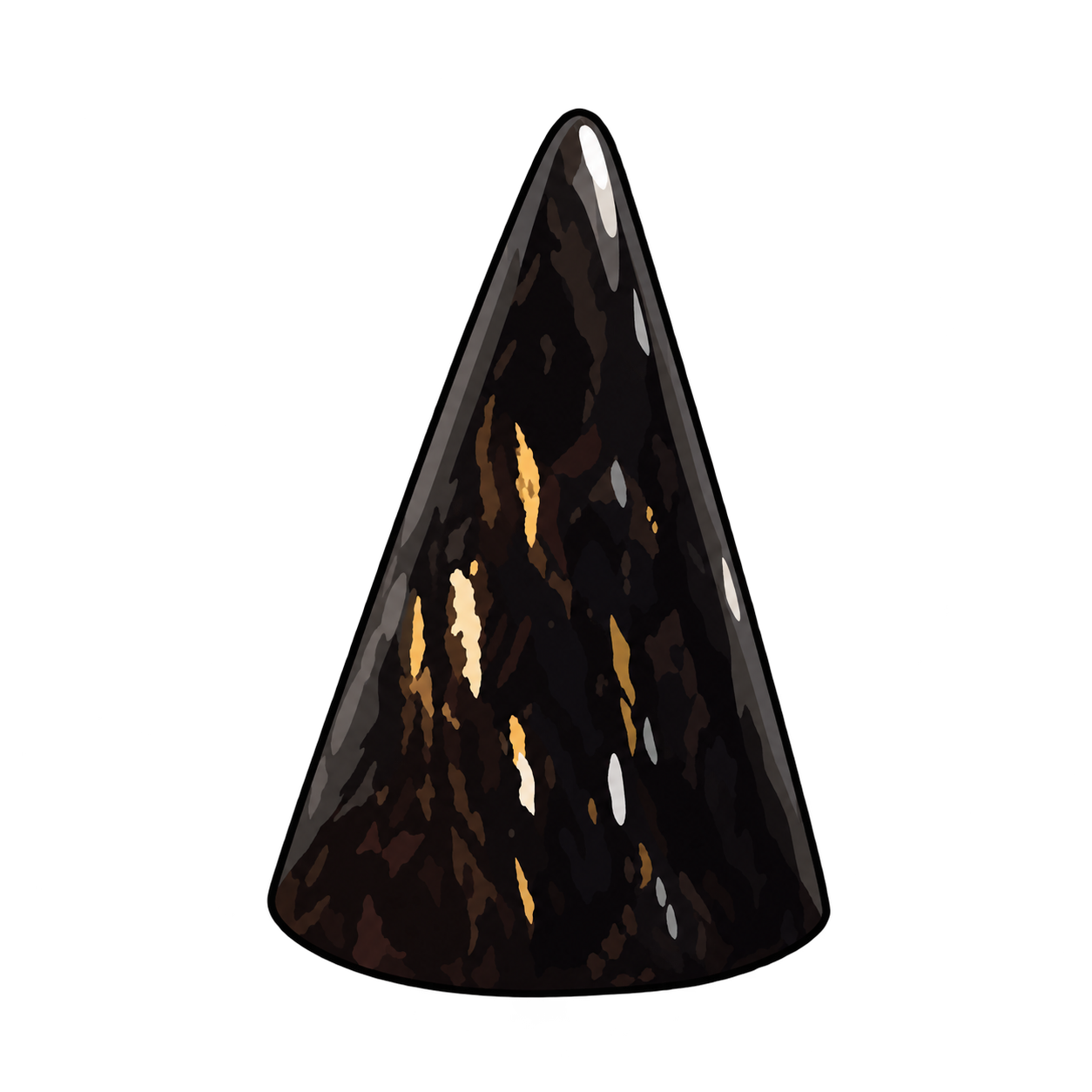
Nuummite is a dark ornamental rock whose polished surface can reveal narrow flashes of gold, bronze, blue or violet. Its principal constituents are anthophyllite and gedrite, related amphibole minerals intergrown at a microscopic scale. The name belongs to the stone trade rather than to a single mineral species. Its Greenlandic identity is especially important: nuummite takes its name from Nuuk, and the development of the material as a gemstone is closely connected with the region. [1, 2]
Contemporary crystal practitioners associate nuummite with protection, inner exploration and the discovery of personal purpose. Its dark body and fleeting flashes lend themselves to symbolism concerned with things not immediately visible. These are spiritual interpretations, not established effects of the rock on health or perception. [3]
Some modern practitioners connect nuummite with dream work or past-life meditation. Those beliefs should not be mistaken for a documented ancient Greenlandic tradition. A stone's geological age does not establish the age of the spiritual practices currently attached to it. [3]
Classification: Rock and gemstone trade name, not one mineral species Principal minerals: Anthophyllite and gedrite Chemical character: Magnesium-iron silicates containing hydroxyl; gedrite is richer in aluminum Crystal system of the principal amphiboles: Orthorhombic Mohs hardness: Around 6; the principal amphiboles are approximately 5½–6 Cleavage: Pronounced in the amphibole grains Typical optical feature: Directional iridescence within individual grains Body color: Dark gray, brown or black [1, 4, 5]
Nuummite's golden iridescence has been investigated with transmission electron microscopy. Researchers found alternating, coherent layers of anthophyllite and gedrite with spacing on the order of the wavelengths involved in visible light. Reflections from these layers interfere, strengthening particular colors at particular viewing angles. The effect is structural: a gold flash need not mean that a gold-colored metal is present. [7]
The spacing matters. Research summarized by Gem-A associates narrower layers with violet-blue effects and wider spacing with yellow. Rotating a polished specimen can make one grain light up while its neighbor darkens, because their orientations differ. The angle-dependence is part of the material's character, so a single photograph rarely shows every flash available in a specimen. [6]
Metamorphic nuummite occurs in lenses and bands among deformed rocks. Kangerluarsuk material has small blue-flashing grains; Simiuttat examples can have larger grains and blue or gold effects. [2]
Mineralogist K. L. Giesecke collected comparable material in 1810, and its iridescence was discussed in the early twentieth century. Its modern gemstone development followed Peter Appel's work in 1982. Nuuk's municipal enterprise supported collecting, cutting and jewelry production, helping introduce the stone locally and internationally. This is a specific history of geological investigation and craft, not evidence that the material had always circulated under its present trade name. [1]
The 1987 gemological report introduced the Greenland material to an international readership and described its commercial use in polished gems. Related iridescent orthoamphiboles were already known outside Greenland. Thus, a similar appearance does not by itself establish Nuuk provenance; the distinction between mineral character and geographical origin remains important. [8]
View nuummite from several directions under a movable light. Look for the distribution of flashes, the condition of the polish and fractures crossing the chosen shape. A broad, attractive flash on one face may disappear when the stone is set at another angle. Cutting and presentation therefore influence how readily its optical character is seen. [6, 8]
Request the seller's recorded locality and any treatment information, particularly when provenance contributes substantially to price. A black stone with attractive blue streaks cannot be authenticated as Greenlandic nuummite from a sales photograph alone. Laboratory mineral identification can resolve its constituents; establishing origin also requires credible provenance records. An illustration is a visual introduction, not a certificate for a separate specimen.
Do not grind, drill or sand an unidentified ornamental rock as a casual home-cleaning method. Displaying a finished object and generating fine mineral dust are different activities. Nuummite's appeal is already present in the carefully polished surface: controlled lighting brings it out without altering the stone.
geus.dk · Reference for the accompanying text · Reference recorded October 15, 2026
igc-gemmology.org · Reference for the accompanying text · Reference recorded October 15, 2026
thecrystalcouncil.com · Reference for the accompanying text · Reference recorded October 15, 2026
handbookofmineralogy.org · Reference for the accompanying text · Reference recorded October 15, 2026
handbookofmineralogy.org · Reference for the accompanying text · Reference recorded October 15, 2026
gem-a.com · Reference for the accompanying text · Reference recorded October 15, 2026
hero.epa.gov · Reference for the accompanying text · Reference recorded October 15, 2026
gia.edu · Reference for the accompanying text · Reference recorded October 15, 2026