Bronze Blades in Pale Stone
Astrophyllite
Titanium-bearing silicate mineral with often radiating golden-brown blades.
Mineral species; ornamental specimens may include other minerals
Loading this page…
Return homePlease wait while the next page arrives.


Bronze Blades in Pale Stone
Titanium-bearing silicate mineral with often radiating golden-brown blades.
Mineral species; ornamental specimens may include other minerals
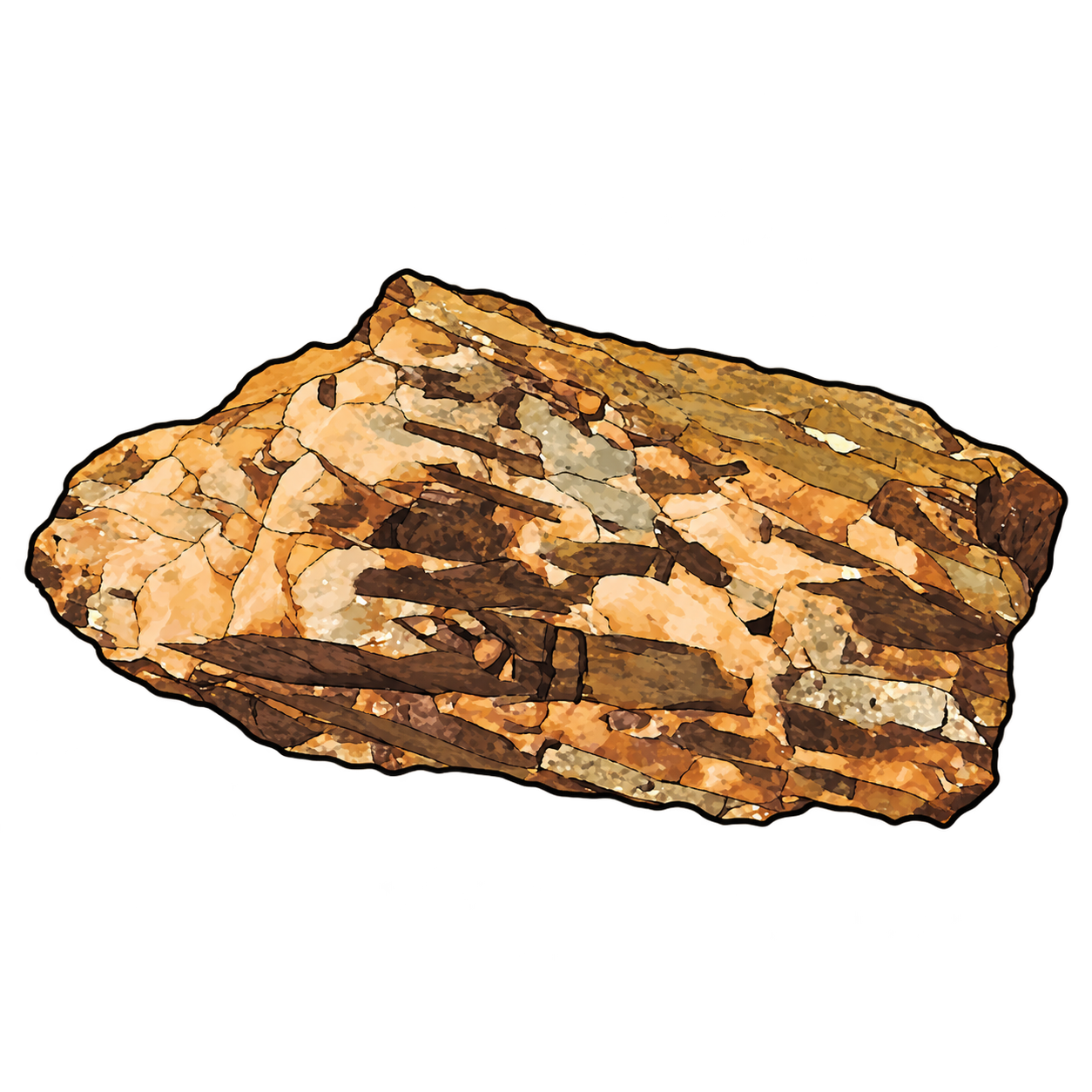
Astrophyllite is a titanium-bearing silicate best known for bronze and golden-brown blades that spread through a contrasting host rock.
Geology · Human history · Spiritual attributes
Self-trust · Inner clarity · Self-acceptance · Spiritual openness [3]
Astrophyllite is a titanium-bearing silicate best known for bronze and golden-brown blades that spread through a contrasting host rock. Some crystals radiate from a center; others lie in overlapping or nearly parallel groups. The Greek roots of its name refer to a star and a leaf, an unusually apt description of both the collective pattern and the flattened individual crystals. [1, 2]
In contemporary crystal practice, astrophyllite is associated with self-understanding and openness to spiritual exploration. Practitioners may choose its radiating patterns as a focus for meditation on direction, possibility and an integrated sense of self. These are attributed meanings, not scientifically demonstrated mineral effects. [3]
Modern chakra interpretations sometimes associate the stone with the whole chakra system rather than a single center. That is a contemporary spiritual framework; it is separate from the mineral's crystallographic structure and should not be presented as a physiological mechanism. [3]
Composition: Complex potassium-sodium-iron-titanium silicate, with possible substitutions including manganese Crystal system: Triclinic Mohs hardness: Approximately 3 Cleavage: Perfect in one principal direction; weaker in another Tenacity: Brittle Luster: Pearly, greasy or submetallic Typical form: Flattened blades, plates and slender crystals; sometimes radiating groups Transparency: Usually opaque in substantial specimens, translucent in thin blades [1]
A polished stone sold as astrophyllite usually contains more than astrophyllite. The contrasting background is host rock, and its minerals contribute to the piece's overall weight, color and durability. Calling the entire object a single crystal obscures this distinction. The bronze blades may be the feature that attracts attention, but the surrounding grains are part of its geological context. [2]
The submetallic appearance does not indicate native metal. Soft blades remain vulnerable even within harder host rock. [1]
Astrophyllite is a recognized mineral species within a broader family of related titanium silicates. Modern classification considers both chemical occupancy and the arrangement of structural units, not just color or crystal outline. Research on the supergroup distinguishes the astrophyllite, kupletskite and devitoite groups using these structural relationships. The complexity explains why a short commercial ingredient list is not a complete mineral definition. [4]
The most relevant look-alike is kupletskite. At Mont Saint-Hilaire the two can be closely associated and practically indistinguishable by color and habit. A knowledgeable locality record helps, but visual inspection cannot always separate related species. Scientific identification may require compositional or structural analysis. A collector should therefore be cautious of an identification offered solely because a specimen has a golden spray. [5]
Astrophyllite occurs in alkaline igneous rocks and pegmatites, associated with feldspar, aegirine, arfvedsonite, nepheline and zircon. [1]
At Mont Saint-Hilaire, astrophyllite occurs notably in nepheline syenite near pegmatitic structures, with rarer occurrences in other settings. A species that is uncommon in the world as a whole can be conspicuous at a particularly favorable locality. That distinction prevents a useful collecting description—common at this locality—from being misread as a statement about global abundance. [5]
Norway, Greenland, Québec, Russia's Kola Peninsula and Colorado are among its recognized sources. Museum descriptions draw attention to the visual contrast between dark crystals and pale, felsic matrix. Different host minerals, crystal orientations and proportions can make specimens from these regions look quite unlike one another while retaining the characteristic blades. [2]
Astrophyllite entered mineralogical literature in the nineteenth century. Its descriptive name has remained useful even as structural research has refined the relationships among its close relatives. That continuity is worth preserving: historical collecting names often emphasize appearance, while later mineralogy explains why similar-looking materials may require different classifications. [2, 4]
For a collector, a complete radiating group can be more informative than a uniformly polished surface. It shows the direction in which individual blades developed and how they interact with the host. A polished slab, by contrast, can reveal a cross-section through otherwise concealed crystals. Neither presentation is inherently more authentic; they reveal different aspects of the same material.
Golden color and a radiating habit do not alone distinguish astrophyllite from its close relative kupletskite. [5]
Examine a specimen under changing light and moderate magnification. Look at whether the bright areas are individual blades, their relationship to the surrounding grains and the condition of their edges. Record the original locality and supplier information with the stone. Avoid destructive scratch tests on a display face; laboratory examination is preferable when a precise identity matters.
Protect soft, brittle blades from abrasion and knocks. Lift a specimen by the matrix. [1]
Use gentle dust removal rather than vigorous brushing. Do not assume an unknown host, coating or filler will tolerate immersion, chemicals or ultrasonic cleaning. A specimen with fragile, lifting blades is best assessed by a knowledgeable mineral preparator before cleaning. Preserving the edge of one complete blade may be more valuable than achieving a perfectly dust-free surface.
handbookofmineralogy.org · Reference for the accompanying text · Reference recorded October 15, 2026
calvin.edu · Reference for the accompanying text · Reference recorded October 15, 2026
thecrystalcouncil.com · Reference for the accompanying text · Reference recorded October 15, 2026
iris.unito.it · Reference for the accompanying text · Reference recorded October 15, 2026
saint-hilaire.ca · Reference for the accompanying text · Reference recorded October 15, 2026