A Dark Amphibole with a Complex Interior
Arfvedsonite
Sodium-rich amphibole mineral commonly in alkaline igneous rocks.
Mineral species; ornamental specimens may include other minerals
Loading this page…
Return homePlease wait while the next page arrives.


A Dark Amphibole with a Complex Interior
Sodium-rich amphibole mineral commonly in alkaline igneous rocks.
Mineral species; ornamental specimens may include other minerals
Arfvedsonite is a sodium-iron amphibole found in alkaline igneous rocks.
Geology · Human history · Spiritual attributes
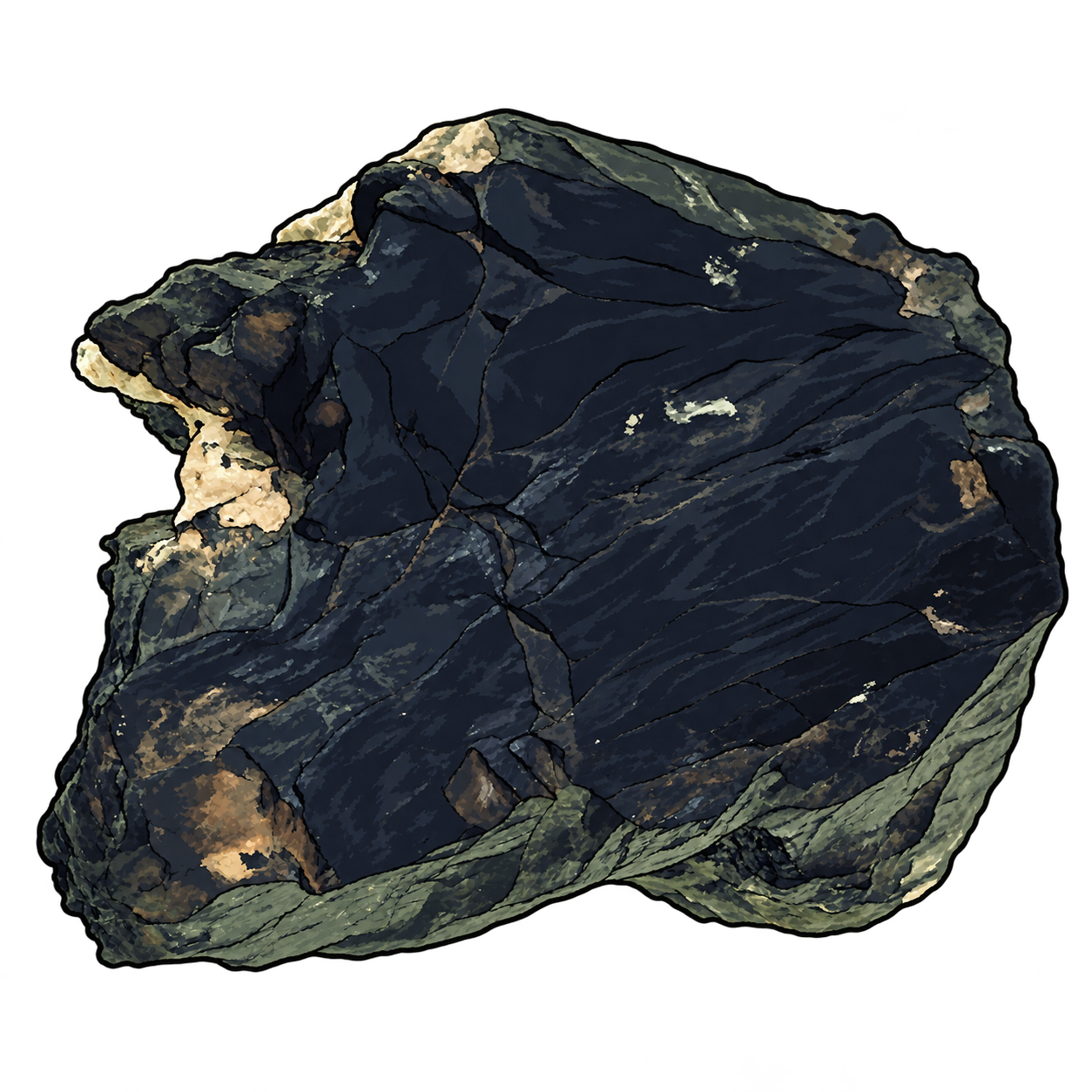
Modern crystal practitioners associate arfvedsonite with finding words for feelings and reflecting before responding. In chakra-based interpretations it is connected with the throat and third eye, linking expression with inward attention. These associations describe a contemporary spiritual use, not a demonstrated effect on communication, emotion or health. [2]
A stone can accompany a chosen reflective practice without being responsible for its outcome. Its symbolic role should not imply that distress must be hidden, that every difficult situation can be resolved by contemplation, or that professional support is unnecessary.
Idealized composition: NaNa₂(Fe²⁺₄Fe³⁺)Si₈O₂₂(OH)₂ Crystal system: Monoclinic Mohs hardness: Approximately 5–6 Cleavage: Perfect, meeting at about 56° and 124° Tenacity: Brittle Luster: Glassy on fresh surfaces; altered surfaces may look dull Habit: Elongated prisms, tabular crystals and aggregates Transparency: Commonly opaque in hand specimens, with translucency in sufficiently thin material [1, 3]
The formula distinguishes two iron oxidation states. Substitutions and the distribution of elements within the crystal structure help determine the precise amphibole species. [4]
Amphibole cleavage produces oblique intersections; polishing can conceal this useful feature. [1]
Strong pleochroism gives thin sections different colors in different viewing directions, unlike the almost black appearance of a thick specimen. [1]
A bright line moving across a polished stone is a different observation. Surface reflection, grain orientation and adjacent minerals can all influence it. A seller's photograph showing a blue flash does not establish that the flash is pleochroism—or that the stone is arfvedsonite. Describing what is visible and identifying what causes it are separate steps.
Alkaline granites and pegmatites host arfvedsonite with feldspar, nepheline or aegirine. [1]
Mont Saint-Hilaire illustrates this range particularly well. Its mineral descriptions record substantial prisms in pegmatite dikes, black crystals in marble inclusions and surfaces changed by later alteration. Related magnesium- and fluorine-bearing amphiboles occur at the locality, too; some cannot be reliably separated by appearance without chemical analysis. An apparently familiar crystal can therefore deserve a more careful label. [3]
A study of lithium-bearing fluor-arfvedsonite from Hurricane Mountain, New Hampshire, examined how lithium and other elements occupy the structure. Such work shows why amphibole classification depends on chemistry and crystallography rather than one striking color. It does not mean ordinary arfvedsonite should be advertised as a lithium mineral or assumed to share the exact composition of those analyzed crystals. [4]
GIA identified arfvedsonite in the dark spots of three commercial Dalmatian-stone specimens. Their pale matrix contained feldspar and quartz; the study did not establish a source locality. [5]
The name honors Swedish chemist Johan A. Arfvedson. [1]
Mont Saint-Hilaire specimens can contain several closely related amphiboles. A precise species label may require analysis. [3]
Support projecting crystals by their matrix and protect them from impacts and abrasion. [1]
Do not cut or grind a specimen as a casual identification exercise: these methods damage it and generate dust. Ask a mineral preparator about cleaning altered or fragile material.
handbookofmineralogy.org · Reference for the accompanying text · Reference recorded October 15, 2026
thecrystalcouncil.com · Reference for the accompanying text · Reference recorded October 15, 2026
saint-hilaire.ca · Reference for the accompanying text · Reference recorded October 15, 2026
usgs.gov · Reference for the accompanying text · Reference recorded October 15, 2026
gia.edu · Reference for the accompanying text · Reference recorded October 15, 2026