Green Orbicular Volcanic Rock
Kambaba Stone
Green-and-black orbicular rhyolitic rock in the documented trade material.
Ornamental trade rock; studied material is rhyolitic
Loading this page…
Return homePlease wait while the next page arrives.


Green Orbicular Volcanic Rock
Green-and-black orbicular rhyolitic rock in the documented trade material.
Ornamental trade rock; studied material is rhyolitic
Kambaba stone's dark rings and olive-green ground make it distinctive.
Geology · Human history · Spiritual attributes
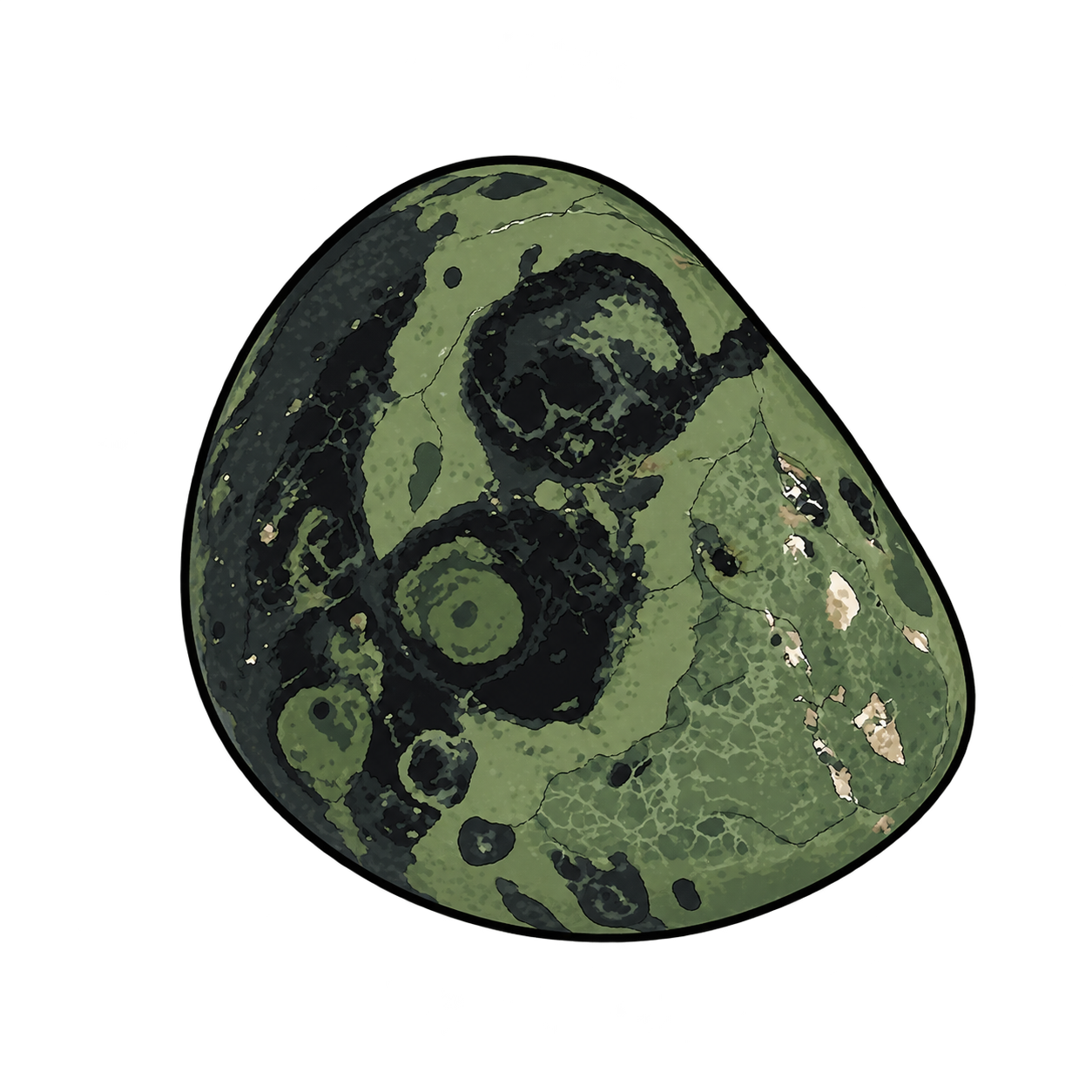
Kambaba stone's dark rings and olive-green ground make it distinctive. Despite the familiar name Kambaba jasper, laboratory analysis of Madagascan material identified a rhyolitic volcanic rock, not fossil algae. [1]
In contemporary crystal practice, Kambaba is associated with steadiness and an attentive relationship with the natural world. Practitioners connect it with the root and heart chakras, pairing a sense of grounding with emotional openness. These are spiritual associations, not properties established by mineral analysis. [2]
Classification: Ornamental trade rock, not a single mineral species Composition: Quartz and feldspars with green amphibole and dark pyroxene in the examined material Crystal system: No single system applies to the whole rock Texture: Fine-grained, with rounded and radially arranged mineral aggregates Transparency: Opaque in the familiar polished material Hardness and density: Depend on the constituent minerals and their proportions; a single mineral value should not be assigned to every specimen [1, 3]
Rhyolite is a silica-rich volcanic rock containing multiple minerals, not one crystal species. [3]
Quartz has Mohs hardness 7. [4] Aegirine, one of the minerals identified in the examined Kambaba, is a sodium-iron silicate of the pyroxene group. It has hardness about 6, good cleavage and a dark green to nearly black appearance. These differences help explain why a polished mixed rock need not wear uniformly. A hardness figure for one ingredient is not a guarantee against scratches, chips or damage along a seam in the finished object. [5]
EPI's thin-section and microprobe examination found radial amphiboles bordered by fine aegirine among quartz and feldspars. It interpreted the intergrowth as crystallized melt, while acknowledging the limits of reconstructing a geological history from a hand specimen. [1]
Volcanic textures preserve cooling, flow and sometimes fragmentation. A polished face exposes only one section through that history. [3]
EPI distinguished Madagascan Kambaba from Mexican Nebula Stone despite broadly comparable mineral assemblages. Their proportions and patterns differed. Similar mineral ingredients do not make their locality records interchangeable. [1]
Stromatolites are structures associated with layered microbial communities and the sediments or minerals they accumulate. Their interpretation depends on geological setting and detailed structure, not merely on resemblance to circles. Researchers studying ancient stromatolites examine combinations of features such as domed laminations, microscopic textures and growth relationships. [6]
This distinction matters when buying Kambaba. “Three-billion-year-old fossil algae” is a substantial geological claim, not another way of saying that a stone is natural. A seller should be able to support a fossil identification and a proposed age independently. The scientific value of the piece does not disappear if it is volcanic: mineral growth and rock texture are worthwhile subjects in their own right.
On a sphere, examine how the ring patterns change around the surface; on a cabochon, consider their arrangement on the face that will be worn. Inspect pale seams and carving edges for open cracks or repairs. Retain locality information and any disclosure of coatings, filling or stabilization. Avoid scratching a finished object to identify a rock made from several minerals.
epigem.de · Reference for the accompanying text · Reference recorded October 15, 2026
thecrystalcouncil.com · Reference for the accompanying text · Reference recorded October 15, 2026
nps.gov · Reference for the accompanying text · Reference recorded October 15, 2026
webmineral.com · Reference for the accompanying text · Reference recorded October 15, 2026
handbookofmineralogy.org · Reference for the accompanying text · Reference recorded October 15, 2026
nhm.ac.uk · Reference for the accompanying text · Reference recorded October 15, 2026