Unlike crystal ends, zinc-rich origins, and a surprisingly varied appearance
Hemimorphite
Hydrated zinc silicate.
Mineral species; ornamental specimens may include other minerals
Loading this page…
Return homePlease wait while the next page arrives.


Unlike crystal ends, zinc-rich origins, and a surprisingly varied appearance
Hydrated zinc silicate.
Mineral species; ornamental specimens may include other minerals
Hemimorphite forms pale crystal fans and rounded blue crusts.
Geology · Human history · Spiritual attributes
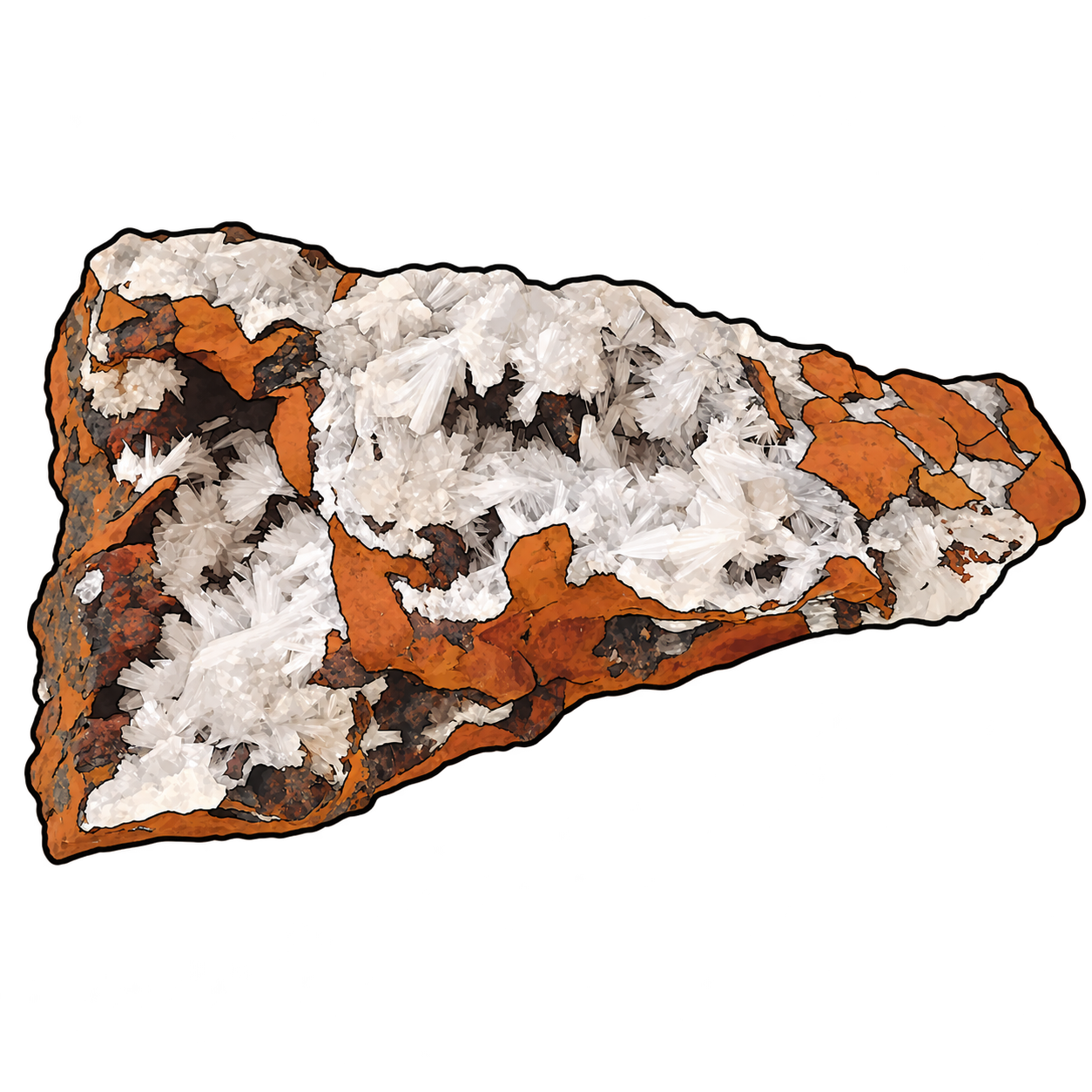
Hemimorphite forms pale crystal fans and rounded blue crusts. Its name describes unequal forms at opposite crystal ends, a feature often concealed in compact aggregates. [1]
The Crystal Council associates hemimorphite with expressing difficult feelings while remaining attentive to others. Its heart and throat correspondences combine openness with considerate speech; its upper-chakra language also includes spiritual listening and intuitive impressions. These are practitioner beliefs rather than verified changes to communication ability or emotional health. [2]
The Council describes using a piece as a turn-taking object during a sensitive conversation. The useful symbolic action is the pause and opportunity to listen, not a proven power of zinc silicate. A delicate crystal spray should stay protected; a conversation does not require handling a fragile specimen or using a stone instead of appropriate support.
Hemimorphite is orthorhombic. Thin tabular crystals may gather into sheaves or fans, while closely packed growth produces rounded, stalactitic, or fibrous surfaces. A doubly terminated crystal can show the contrasting end forms behind the name. This feature is not expected to remain obvious in a cut cabochon. [1]
Its hardness is approximately 4.5–5 and measured density about 3.48. It is brittle and has perfect cleavage in one direction. Small crystals may be transparent, whereas larger aggregates are commonly translucent or opaque. Pure material is colorless or white; impurities can produce several colors. [1,3]
No single shade defines the species. A white spray is not a lesser version of the mineral because a jewelry market favors blue. Likewise, a rounded blue surface is not automatically hemimorphite: several unrelated minerals can share that visual combination.
Hemimorphite is a secondary mineral of oxidized zinc-bearing deposits. It may form alongside smithsonite, hydrozincite, calcite, and other minerals as an ore body changes near the surface. Those mineral associations record chemical alteration rather than one simple episode of crystal growth. [1,4]
The Tsumeb Mineralogical Network records hemimorphite from both the first and second oxidation zones there. Early near-surface material was associated with hydrozincite and aurichalcite, and the account identifies a Natural History Museum specimen obtained in 1909 as an example. That is a documented local history, not a claim that every hemimorphite shares the same matrix or origin. [4]
Historical terminology can make a collection confusing. The Tsumeb account notes that calamine was used for both hemimorphite and smithsonite, and that the name occurs on older labels. These are not interchangeable modern mineral identities: hemimorphite is a silicate, whereas smithsonite is a carbonate. [4]
An old label should be preserved as part of provenance, but its wording may need a modern explanatory note. Replacing it without a record loses historical information; accepting it without interpretation can perpetuate an identification error. A useful catalogue keeps the original term and the current determination distinct.
This also explains why historical claims about calamine cannot automatically be assigned to hemimorphite alone. The old material category was broader than the modern species name.
In 2020, GIA examined a 5.61-carat electric-blue cabochon submitted for a Paraíba tourmaline origin report. Some optical observations appeared compatible with that expectation, but its specific gravity did not. Raman spectroscopy identified hemimorphite, and chemical analysis detected copper associated with the color. [3]
The case demonstrates a sequence of reasoning rather than a shortcut based on one impressive hue. The initial commercial identity was a proposition to test. Several measurements, including a structural fingerprint, established the mineral. Copper-bearing blue color does not by itself make a material Paraíba tourmaline.
For a purchase, a clear name and disclosure of any filling, coating, or reinforcement are more useful than comparisons to a more expensive gem. If an object is valuable or disputed, seek a laboratory identification rather than attempting destructive acid or scratch tests.
Support crystal groups by their base and protect projecting blades from rubbing and impact. A fine spray can be damaged by vigorous brushing even when its matrix looks robust. A rounded aggregate may also have fragile edges or hidden fractures.
Avoid steam, ultrasonic cleaning, aggressive chemicals, and prolonged soaking where matrix composition or treatment is unknown. A stable polished surface can be gently wiped with a soft cloth; delicate specimens are better left undisturbed than repeatedly cleaned. Keep pieces apart from harder stones and record repairs with the specimen's documentation. Preservation should respect the whole object, not just the named mineral.
handbookofmineralogy.org · Reference for the accompanying text · Reference recorded October 15, 2026
thecrystalcouncil.com · Reference for the accompanying text · Reference recorded October 15, 2026
gia.edu · Reference for the accompanying text · Reference recorded October 15, 2026
tmn.fas.harvard.edu · Reference for the accompanying text · Reference recorded October 15, 2026