Salt Crystals, Vanished Waters and Preserved History
Halite
Sodium chloride mineral, occurring in evaporite deposits.
Mineral species; ornamental specimens may include other minerals
Loading this page…
Return homePlease wait while the next page arrives.


Salt Crystals, Vanished Waters and Preserved History
Sodium chloride mineral, occurring in evaporite deposits.
Mineral species; ornamental specimens may include other minerals
Halite is sodium chloride in mineral form.
Geology · Human history · Spiritual attributes
Salt has a documented place in ritual purification, while contemporary crystal practitioners attach more personal meanings to pink halite. These should be distinguished rather than combined into an invented single ancient tradition. The form, context and intention of a practice matter as much as the mineral involved. [2, 3]
The Crystal Council associates pink halite with the heart and emotional openness. Such interpretations can support a personal contemplative practice without establishing that a crystal treats anxiety, changes a body's chemistry or makes decisions on a person's behalf. A mineral specimen also should not be dissolved into a bath merely because a spiritual source proposes doing so. [3]
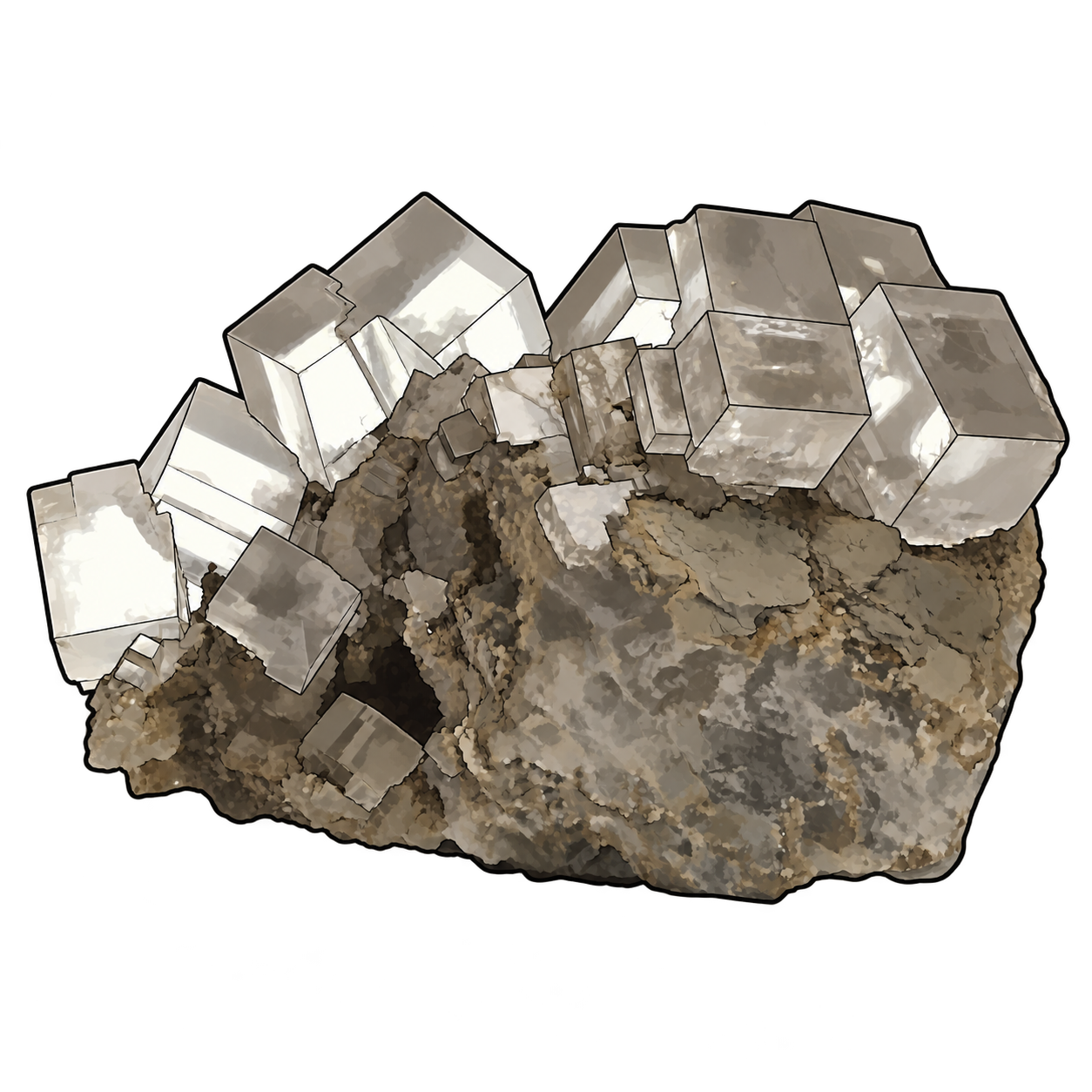
Halite crystallizes in the cubic system and has perfect cubic cleavage. A cube may therefore be an original growth form or a fragment produced by breakage; the outline alone does not tell the whole story. Skeletal or hopper-shaped faces also occur, making growth look like a series of recessed steps. [1]
The mineral is soft, about 2–2.5 on the Mohs scale, brittle and readily soluble in water. Its specific gravity is approximately 2.17 and its refractive index about 1.544. Pure material is colorless or white; colored specimens include pink, orange, blue and purple. A color name is not proof of a particular origin or a single universal coloring agent. [1]
As an identification exercise, observe geometry and surface character without tasting an unknown specimen. A collector's piece may contain other minerals or residues and has not been processed or assessed as food. Familiar chemistry does not make every object sold as halite an edible product.
Evaporite deposits form as dissolved materials precipitate during the concentration of water. The British Geological Survey lists halite alongside gypsum, anhydrite and potash or magnesium salts in this family of deposits. A salt-bearing formation can thus be a succession of different materials rather than a single homogeneous block. [4]
This makes the distinction between mineral and rock useful. Halite names sodium chloride as a mineral; rock salt describes a geological material dominated by it and potentially containing other constituents. A rough specimen's matrix, a colored seam and its transparent crystals need not all have identical composition.
Salt's uses extend well beyond flavoring and winter deicing. USGS identifies it as a feedstock for chlorine and caustic soda, chemicals used in manufacturing products such as PVC and paper-processing materials. A mineral that seems ordinary at home therefore participates in extensive industrial supply chains. [5]
That industrial familiarity should not erase the differences between grades and uses. A chemical feedstock, a road-treatment product, culinary salt and a display crystal are prepared for different purposes. None should be substituted for another solely because sodium chloride is the principal ingredient.
The properties of thick salt deposits also make them important to underground storage research. BGS describes halite beds beneath parts of Britain and studies of the integrity of caverns subjected to changing gas pressures. The engineering problem concerns how a whole rock mass behaves over time, not simply whether an individual crystal is hard. [6]
HALLSTATT: MINING AND A HUMAN RECORD
The Natural History Museum Vienna records a developed salt-mining industry at Hallstatt around 1500 BCE. Its evidence includes tools, wooden structures and traces of different extraction methods. Later miners removed salt in bars, rather than merely breaking it into smaller pieces as in the earlier workings. [7]
The mine's preservation conditions retained materials that normally disappear. Wood, food remains and other organic finds make it possible to examine working lives rather than relying only on durable stone and metal. The value of these objects lies partly in their context: a fragment whose location and association were recorded can answer questions that an unprovenanced souvenir cannot. [7]
Textiles provide a particularly intimate example. The museum's research follows fabrics from about 1500 to 400 BCE, including plant-based fibers and wool. Hundreds of surviving fragments preserve evidence of changing textile technology at a single locality. The salt sought by miners helped preserve details of the world in which they worked. [8]
Jinja Honcho's account connects purification salt with seawater and with the narrative of Izanagi cleansing himself after returning from the land of the dead. It explains present salt-water use in shrine rites and customary salt use around funerals as expressions of this inherited religious framework. [2]
This is a specific account of salt, seawater and ritual boundaries. It does not give a modern pink crystal or an electrically lit salt carving a special ancient status. Keeping those contexts distinct makes both the historical practice and contemporary personal symbolism more intelligible.
Keep halite dry: washing dissolves its surface. Support the base and prevent contact with harder minerals. [1]
If a specimen develops moisture or surface change, reconsider its display conditions instead of repeatedly wiping or rinsing it. An enclosed, suitably dry display may be preferable to a humid room. For a significant specimen, seek collection-care advice before applying a coating that changes its surface.
handbookofmineralogy.org · Reference for the accompanying text · Reference recorded October 15, 2026
jinjahoncho.or.jp · Reference for the accompanying text · Reference recorded October 15, 2026
thecrystalcouncil.com · Reference for the accompanying text · Reference recorded October 15, 2026
earthwise.bgs.ac.uk · Reference for the accompanying text · Reference recorded October 15, 2026
usgs.gov · Reference for the accompanying text · Reference recorded October 15, 2026
bgs.ac.uk · Reference for the accompanying text · Reference recorded October 15, 2026
nhm.at · Reference for the accompanying text · Reference recorded October 15, 2026
nhm.at · Reference for the accompanying text · Reference recorded October 15, 2026