A Borosilicate of Clear Crystals and Quiet Color
Danburite
Calcium borosilicate mineral.
Mineral species; ornamental specimens may include other minerals
Loading this page…
Return homePlease wait while the next page arrives.


A Borosilicate of Clear Crystals and Quiet Color
Calcium borosilicate mineral.
Mineral species; ornamental specimens may include other minerals
Danburite occupies an interesting space between mineral cabinet and jewelry case.
Geology · Human history · Spiritual attributes
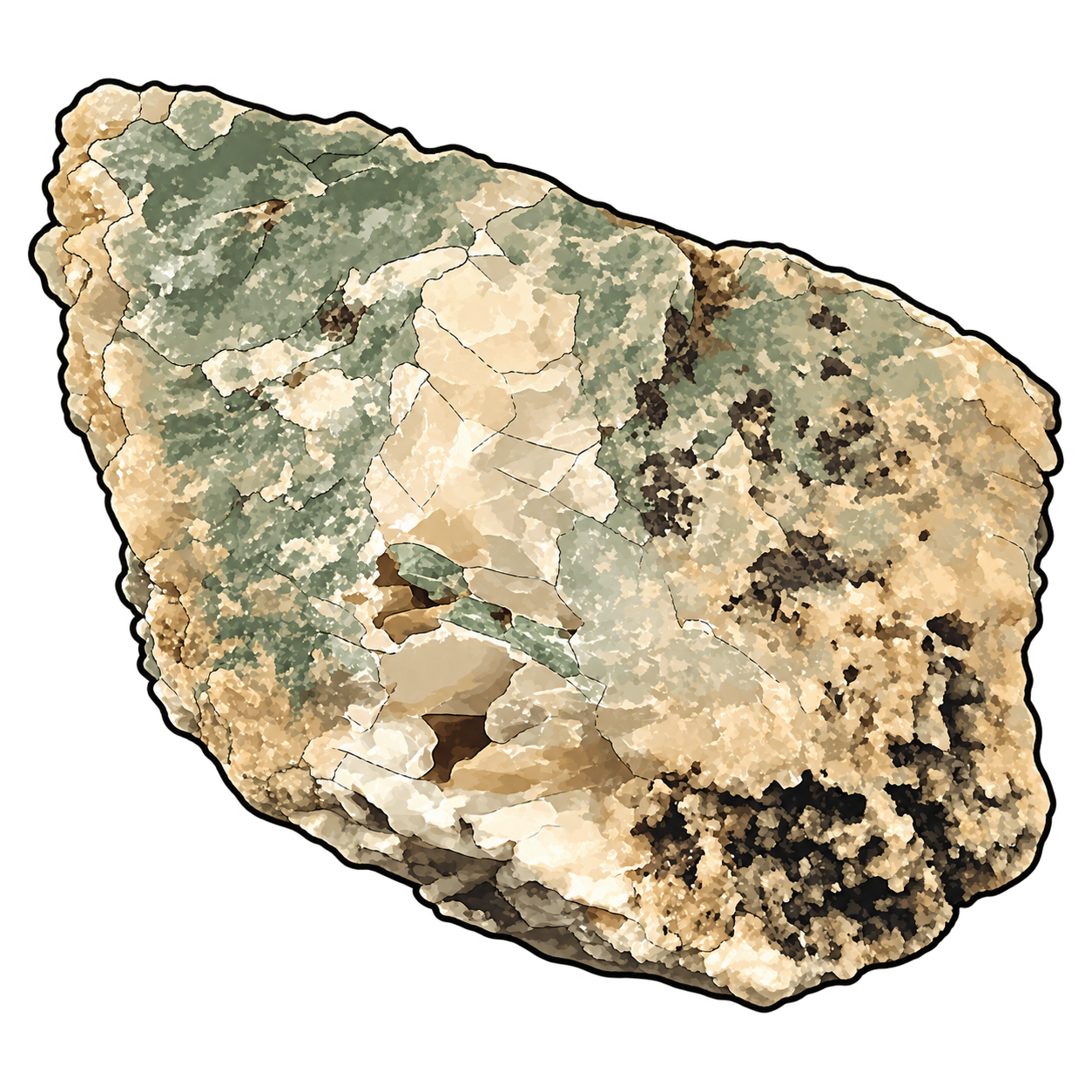
Danburite occupies an interesting space between mineral cabinet and jewelry case. Its pale crystals can be mistaken for more familiar materials, yet its calcium-boron-silicon chemistry gives it a distinct identity. Transparent pieces reward careful cutting; cloudier, fractured or matrix-bound specimens preserve another part of the story, showing a mineral before a cutter has isolated its brightest interior. Neither presentation is more authentic than the other. [1, 2]
Contemporary crystal practitioners associate danburite with gentleness, compassion and the connection between thoughtful feeling and spiritual reflection. Heart and crown chakra symbolism appears in this modern practice; it is a framework of belief, not a description of the mineral's physical action. [4]
A meaningful practice need not depend on a flawless or expensive crystal. Someone might place a specimen beside a journal, use it to mark the beginning of a period of reflection, or simply appreciate its pale colors. These are personal uses of an object, not demonstrated treatment effects or promises that a relationship will change.
Danburite has the formula CaB₂Si₂O₈ and belongs to the orthorhombic crystal system. Well-developed crystals are prismatic, but the mineral also occurs in less distinct aggregates. Its hardness is approximately 7–7¼, its cleavage is indistinct, and broken surfaces can be uneven or partly shell-like. Reported specific gravity is close to 3. These properties apply to the mineral; a mixed rock or included specimen may behave differently. [1]
Hardness measures resistance to scratching, not immunity to damage. An exposed crystal point, pre-existing fracture or thin girdle remains a vulnerable part of an otherwise serviceable stone. In a collection, preserving those surfaces matters more than attempting a scratch test to confirm a number.
Danburite's refractive index is substantially lower than diamond's, and its dispersion is modest. A well-proportioned faceted gem can nevertheless be bright. Rare cat's-eye examples are known, while ordinary transparent material is more familiar. Its visual appeal need not be presented as an imitation of a different gemstone. [2]
The mineral is recorded in several geological settings, including granitic and hydrothermal environments and metamorphosed carbonate rocks. Boron must be available during its formation, but the presence of danburite alone does not reconstruct every detail of a deposit. Associated minerals and the enclosing rock provide the necessary context. Mexico's Charcas district, Madagascar and other localities have supplied notable specimens. The name commemorates Danbury, Connecticut. [1]
Keeping a locality label is especially valuable for a stone that can occur in such different settings. A cut gem's appearance does not reveal whether it was collected from bedrock or recovered after weathering released it into a secondary deposit. Those histories require documentation rather than a confident interpretation of color.
A gemological study of material recovered at Bai Cat in Vietnam's Luc Yen area examined honey-yellow crystals that miners initially considered quartz. Testing established danburite. The investigators documented growth zoning, healed fractures and two-phase inclusions; darker zones fluoresced more strongly blue under long-wave ultraviolet light. Analyses found elevated rare-earth-element concentrations and explored their relationship to optical behavior. [3]
Begin with what is actually present: crystal outlines, transparency, fractures, inclusions and any surviving matrix. A terminated prism and an opaque mass may be the same species while offering very different evidence to the eye. Similarly, attractive color is not a chemical analysis.
The Vietnamese find illustrates the value of optical and compositional testing when a visual resemblance suggests quartz. [3]
Sound danburite is suitable for jewelry. Color enhancement by irradiation has been documented and should be disclosed. [2]
When choosing a piece, distinguish the appeal of the object from claims about rarity. A clean, well-cut gem, an unusually attractive crystal and a documented locality specimen represent different collecting priorities. Compare like with like rather than assuming that size alone determines quality.
Avoid steam and strong heat. Protect exposed edges and consider the setting or associated minerals before cleaning. [2]
For an important or uncertain specimen, a jeweler or mineral conservator can advise on cleaning without sacrificing its surfaces. Retain labels and treatment information with the object. These modest records make future identification, repair and responsible resale much easier.
handbookofmineralogy.org · Reference for the accompanying text · Reference recorded October 15, 2026
gemsociety.org · Reference for the accompanying text · Reference recorded October 15, 2026
gia.edu · Reference for the accompanying text · Reference recorded October 15, 2026
thecrystalcouncil.com · Reference for the accompanying text · Reference recorded October 15, 2026