Carbonate, Sulfide Pigments and Striking Bands
Bumblebee Stone
Carbonate-rich Indonesian decorative rock, despite the common jasper label.
Carbonate-rich ornamental rock assemblage
Loading this page…
Return homePlease wait while the next page arrives.


Carbonate, Sulfide Pigments and Striking Bands
Carbonate-rich Indonesian decorative rock, despite the common jasper label.
Carbonate-rich ornamental rock assemblage
Bumblebee stone takes its trade name from the contrast of yellow, orange, gray and black.
Geology · Human history · Spiritual attributes
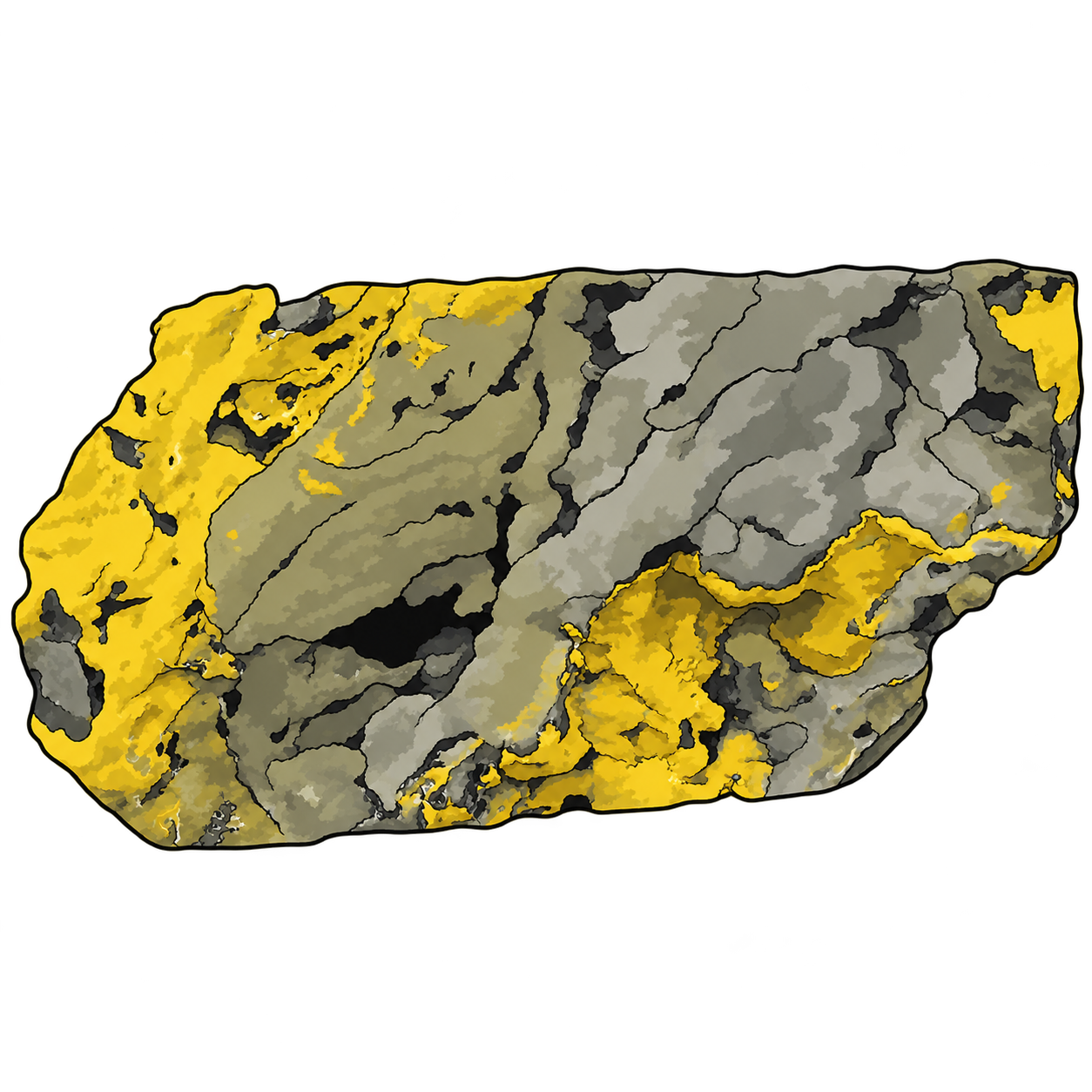
Bumblebee stone takes its trade name from the contrast of yellow, orange, gray and black. The familiar name bumblebee jasper is misleading: examined Indonesian material is a carbonate-rich rock, not ordinary silica-rich jasper. Its appeal lies in several minerals working together, with fine pigments and growth layers creating a pattern that changes dramatically with the direction of a cut. [1, 2]
Contemporary crystal practice associates bumblebee stone with motivation and purposeful action. Its vivid colors are linked with solar-plexus and sacral chakra symbolism, particularly confidence, creativity and engagement with life. These are attributed meanings, not demonstrated biological effects. [5]
For this arsenic-bearing material, a protected display is the appropriate way to retain that visual focus. Spiritual use does not require placing it on the body, carrying loose rough material or putting it into drinking water. Its colors can accompany a personal intention while the specimen remains intact and safely stored.
The 2018 investigation summarized by Gem-A identified calcite as the principal material, yellow pararealgar pigment, orange mixtures involving realgar, and dark aggregates of microscopic pyrite. The yellow and orange arsenic sulfides are not simply elemental sulfur. The analysis gives a more precise explanation than identifying a component by its color alone. [1]
Calcite, CaCO₃, has hardness 3 and perfect cleavage; it is a common carbonate mineral. Pararealgar is a much softer arsenic sulfide, with hardness about 1–1½, and can occur as fine powder. These component properties help explain why the whole rock should not be assigned the hardness or durability of quartz merely because a trade label calls it jasper. [3, 4]
A mixed rock has no single mineral formula or crystal system. One layer may be richer in pigment, another more porous, and another dominated by carbonate. Treating those layers as one ideal crystal hides the very structure that makes the material interesting.
The studied deposit lies near Mount Ciremai in West Java. Mineralization developed in a sulfurous hydrothermal setting, with bands deposited in fractures through volcanic ash and tuff. Rounded growth surfaces can yield concentric patterns when sliced across, whereas a different cut emphasizes stripes. This is deposition within a volcanic environment, not simply a patterned piece of lava. [1]
The distinction matters when reading a finished cabochon. The surface is a section through three-dimensional growth, so two stones from related material can look quite different. A band continuing around a rounded growth does not have to appear as a complete circle in every slice. The cutter selects a view of an existing structure rather than creating the original color distribution.
GIA reported the material at the Tucson show in 2014 under both bumblebee and eclipse trade names. Its report emphasized the carbonate-rich, relatively soft and porous nature of the rock and noted resin filling in much of the material discussed. Such preparation can improve the appearance of pores and help a piece take a finish, but should be disclosed. [2]
Different trade names do not establish different mineral species. Likewise, a glossy surface does not prove that a piece is untreated or that its interior lacks pores. Ask about filling, coatings and repairs when buying a finished object, and preserve those details with its record.
Yellow-and-black coloration is a useful description, not a complete identification. The scientific work used microscopy and instrumental methods to distinguish the pigments. Naming every yellow inclusion sulfur, or every black area manganese oxide, bypasses the evidence that made the investigation valuable. [1]
For a collector, observation should begin without abrasion: examine banding, visible pores, fractures and the finish. Do not grind a corner, heat the material or apply acid to imitate a laboratory demonstration. If a composition claim matters, seek a qualified laboratory that can select an appropriate method and manage the sample safely.
ARSENIC: A PRACTICAL, PROPORTIONATE PRECAUTION
The presence of arsenic-bearing minerals calls for care, but it does not establish an exposure dose merely from looking at a specimen. Arsenic compounds differ in solubility and toxicity, and inhalation or ingestion of contaminated material are important exposure routes. Public-health guidance about concentrated compounds should not be used to claim that a brief encounter with every intact cabochon causes poisoning. [6]
The sensible collector's boundary is nevertheless clear: do not ingest the stone, prepare an elixir with it, or generate dust by cutting, sanding or crushing it. Avoid handling loose powder; wash hands after handling rough material, and keep it away from food, children and pets. A coating should not be assumed to make every use safe. These are precautionary handling recommendations, not a certification of a particular piece. [6]
Lapidary processing is a separate workplace exposure question. Anyone considering it needs a material-specific professional assessment and effective controls; ordinary household crafting precautions are not an adequate substitute.
Use a supported display that limits abrasion, dust loss and unnecessary handling. Avoid aggressive chemical cleaning, heat or attempts to improve the color at home. Realgar-related mineral assemblages can be light-sensitive, so prolonged intense illumination is an unnecessary preservation risk; the behavior of a mixed finished stone also depends on its constituents and treatments. [4]
Keep a label that identifies the material as a carbonate-rich rock with arsenic-bearing sulfide pigments and records any known filling. A precise label is more useful than either an alarming slogan or an unsupported assurance that the material is completely harmless. The pattern remains remarkable when its composition is explained honestly.
gem-a.com · Reference for the accompanying text · Reference recorded October 15, 2026
gia.edu · Reference for the accompanying text · Reference recorded October 15, 2026
handbookofmineralogy.org · Reference for the accompanying text · Reference recorded October 15, 2026
handbookofmineralogy.org · Reference for the accompanying text · Reference recorded October 15, 2026
thecrystalcouncil.com · Reference for the accompanying text · Reference recorded October 15, 2026
wwwn.cdc.gov · Reference for the accompanying text · Reference recorded October 15, 2026