Yellow and orange quartz, with a color history worth knowing
Citrine
Yellow to orange quartz.
Quartz color variety
Loading this page…
Return homePlease wait while the next page arrives.


Yellow and orange quartz, with a color history worth knowing
Yellow to orange quartz.
Quartz color variety
Citrine ranges from pale yellow to warm orange and brownish orange.
Geology · Human history · Spiritual attributes
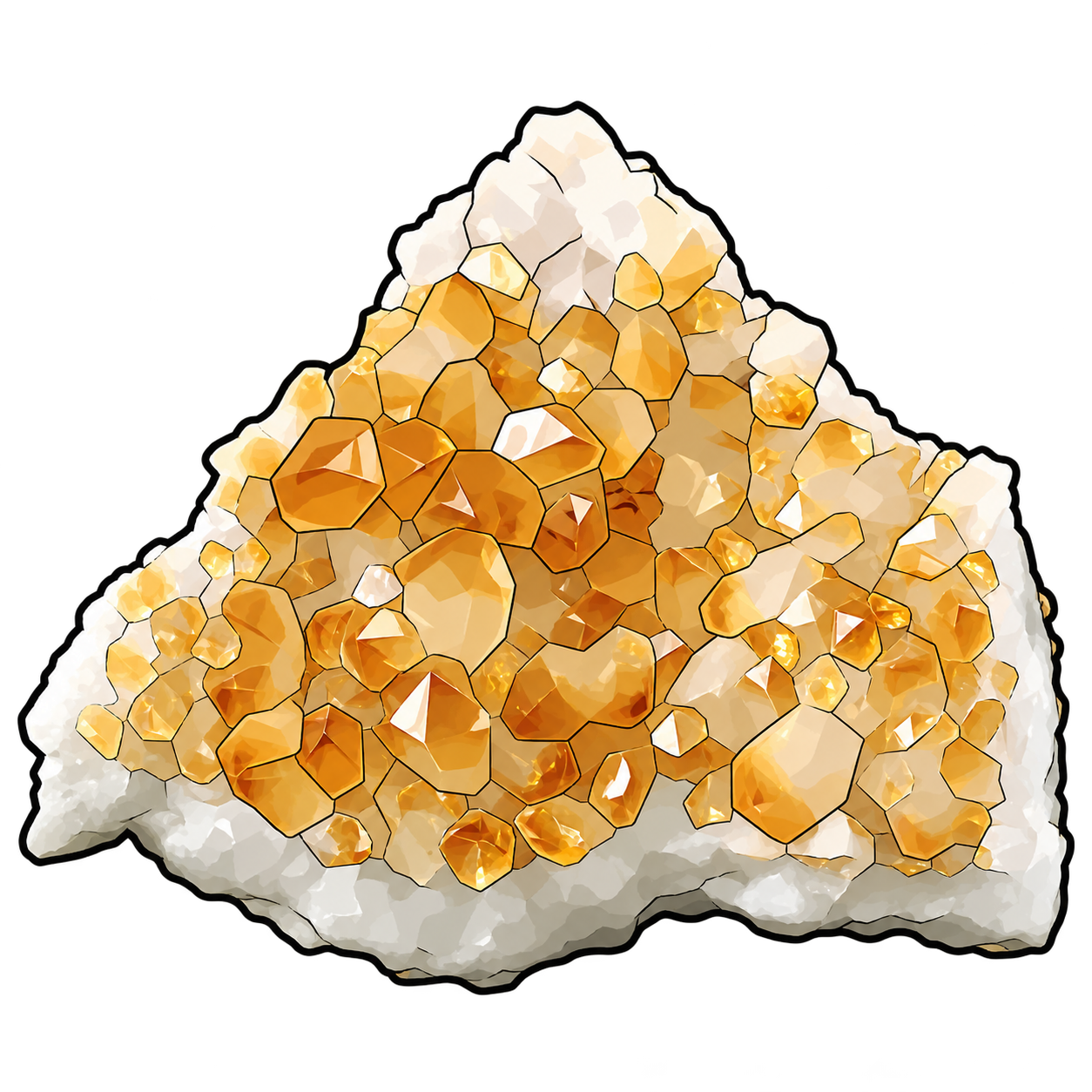
Citrine ranges from pale yellow to warm orange and brownish orange. It belongs to the quartz family, but its familiar color can have more than one history: naturally colored citrine is uncommon, while much commercial material obtains its yellow or orange through heating amethyst. Knowing that distinction makes a specimen more understandable, not less enjoyable. [1]
Citrine's contemporary spiritual associations center on aspiration and action. Practitioners use it when considering a new direction, developing an idea or seeking a more confident relationship with their own ambitions. In this setting, a stone can serve as a tangible reminder of an intention rather than a substitute for the work that intention requires. [7, 8]
Contemporary practices include holding citrine while voicing an intention or keeping it nearby during reflective work. Prosperity is a spiritual association, not a promise that owning a particular stone will produce income or success. The value of a specimen as a personal symbol is separate from the evidence needed to describe its material and treatment history. [7, 8]
Citrine is SiO₂, with Mohs hardness 7, specific gravity approximately 2.66 and refractive indices 1.544–1.553. [3] Its quartz structure is trigonal. [2]
These measurements identify properties of the gem, not its treatment history. Much commercial citrine is heat-treated amethyst; the altered color does not make the material a different mineral species. [3]
Hardness should not be mistaken for indestructibility. Citrine can chip at a thin edge or fracture after a sharp impact. A substantial pendant and a delicate ring setting expose the same mineral to different kinds of wear. Assess the setting and intended use along with the stone. [9]
Gemological descriptions associate citrine's yellow-to-orange color with iron. Treatment can change how quartz absorbs light, producing warmer colors from suitable amethyst; the starting material influences the result. The familiar orange crystal clusters sold as citrine may therefore retain the growth form of amethyst while displaying a later, deliberately altered color. [1, 3]
Three descriptions should remain distinct:
An imitation is another matter: a different material presented as citrine. Calling every heated specimen “fake” obscures the important distinction between disclosed treatment and misrepresentation. Ask what the material is, how it grew and what treatment is known, rather than relying on the word “genuine.”
Lemon quartz illustrates another route to a yellow appearance. Spain's Geominero Museum describes a display gem produced through irradiation followed by mild heating. That is a documented treatment history for the material described, not a rule that lets a viewer identify every yellow quartz from its shade. A bright photograph or a pale color alone cannot settle the question. [5]
A 2024 investigation of citrine from Karacasu in western Türkiye examined yellow quartz in thin veins along fracture zones at contacts between metamorphic units. Chemical and spectroscopic analysis characterized the collected material. This documents a particular occurrence rather than a universal formation model for citrine. [10]
Commercial origin and geological origin are not interchangeable. A stone bought or cut in one country may have been mined elsewhere, and a treated piece has both a growth history and a processing history. For a locality collection, retain the mine or district information supplied with the specimen and distinguish documented details from a seller's inference.
Yellow quartz and yellow topaz can resemble one another, but topaz is a different mineral. Topaz contains aluminum, silicon, oxygen, fluorine and hydroxyl; it has a higher specific gravity and perfect cleavage in one direction. Its Mohs hardness of 8 does not erase that cleavage-related vulnerability. Citrine's quartz properties are different, even when the colors look similar. [3, 11]
Historical and loose trade names should therefore not replace a proper identification. “Citrine topaz” is not a mineral species. If a label uses both names, ask which material is actually being offered. Visual resemblance can suggest a comparison, but it cannot confirm the identity of an unfamiliar yellow gemstone. [1, 11]
The Smithsonian's Jolie Citrine Necklace, catalogued as NMNH G11524, demonstrates the material's scope in contemporary jewelry. Donated by Angelina Jolie and Robert Procop in 2015, it contains 64 graduated cushion-cut citrines and a 177.11-carat pear-shaped drop, mounted in yellow gold. The museum records Brazil as the locality. [4]
For a faceted citrine, look for a color you enjoy across the whole face, not just in the most saturated corner of a photograph. GIA's quality guidance emphasizes attractive saturation, limited visible zoning and clarity. Many faceted examples are eye-clean, meaning that inclusions are not readily visible without magnification; this does not mean that they lack microscopic features. [6, 12]
Turn the stone under ordinary light. Ask whether the cut distributes brightness attractively and whether large dark or see-through areas distract from the design. For an online purchase, images from more than one angle are more useful than a single intensely lit view. Compare dimensions as well as carat weight, particularly when choosing a stone for an existing setting.
Large citrines are available, and their price per carat does not necessarily rise sharply with size. A large gem is therefore not automatically rare or unusually valuable. Cutting, appearance, condition and accurately disclosed history remain important. [6]
For a rough cluster, inspect the attachment of points and the condition of the base. Record repairs or polishing separately from color treatment. A specimen can be visually attractive while having several kinds of human intervention; a clear description allows a collector to decide which matter to them.
Clean sound citrine with warm water, mild soap and a soft cloth or brush. Avoid steam, abrupt temperature changes and prolonged exposure to intense light, which can fade some material. Ultrasonic cleaning is generally compatible with sound citrine, but dyed or fracture-filled stones are exceptions. Gentle hand cleaning is preferable when treatments, repairs or the stability of a cluster's matrix are uncertain. [9]
Store pieces separately to prevent rubbing and impact, and check jewelry settings before wear. Keep the original description with a specimen so that a later owner does not have to reconstruct its treatment history from its appearance.
gia.edu · Reference for the accompanying text · Reference recorded October 15, 2026
mints.uwc.ac.za · Reference for the accompanying text · Reference recorded October 15, 2026
gia.edu · Reference for the accompanying text · Reference recorded October 15, 2026
naturalhistory.si.edu · Reference for the accompanying text · Reference recorded October 15, 2026
web.igme.es · Reference for the accompanying text · Reference recorded October 15, 2026
gia.edu · Reference for the accompanying text · Reference recorded October 15, 2026
thecrystalcouncil.com · Reference for the accompanying text ·
crystalsandme.com.au · Reference for the accompanying text · Reference recorded October 15, 2026
gia.edu · Reference for the accompanying text · Reference recorded October 15, 2026
doi.org · Reference for the accompanying text · Reference recorded October 15, 2026
handbookofmineralogy.org · Reference for the accompanying text · Reference recorded October 15, 2026
gia.edu · Reference for the accompanying text · Reference recorded October 15, 2026