The Ivory Paddle Plate
Variegated Prickly Pear
Opuntia cochenillifera, variegated form
Loading this page…
Return homePlease wait while the next page arrives.


The Ivory Paddle Plate
Opuntia cochenillifera, variegated form
Green and cream paddles build a branching silhouette. Grow this variegated prickly pear in bright light with free drainage, and handle pads with tools even when they look smooth.
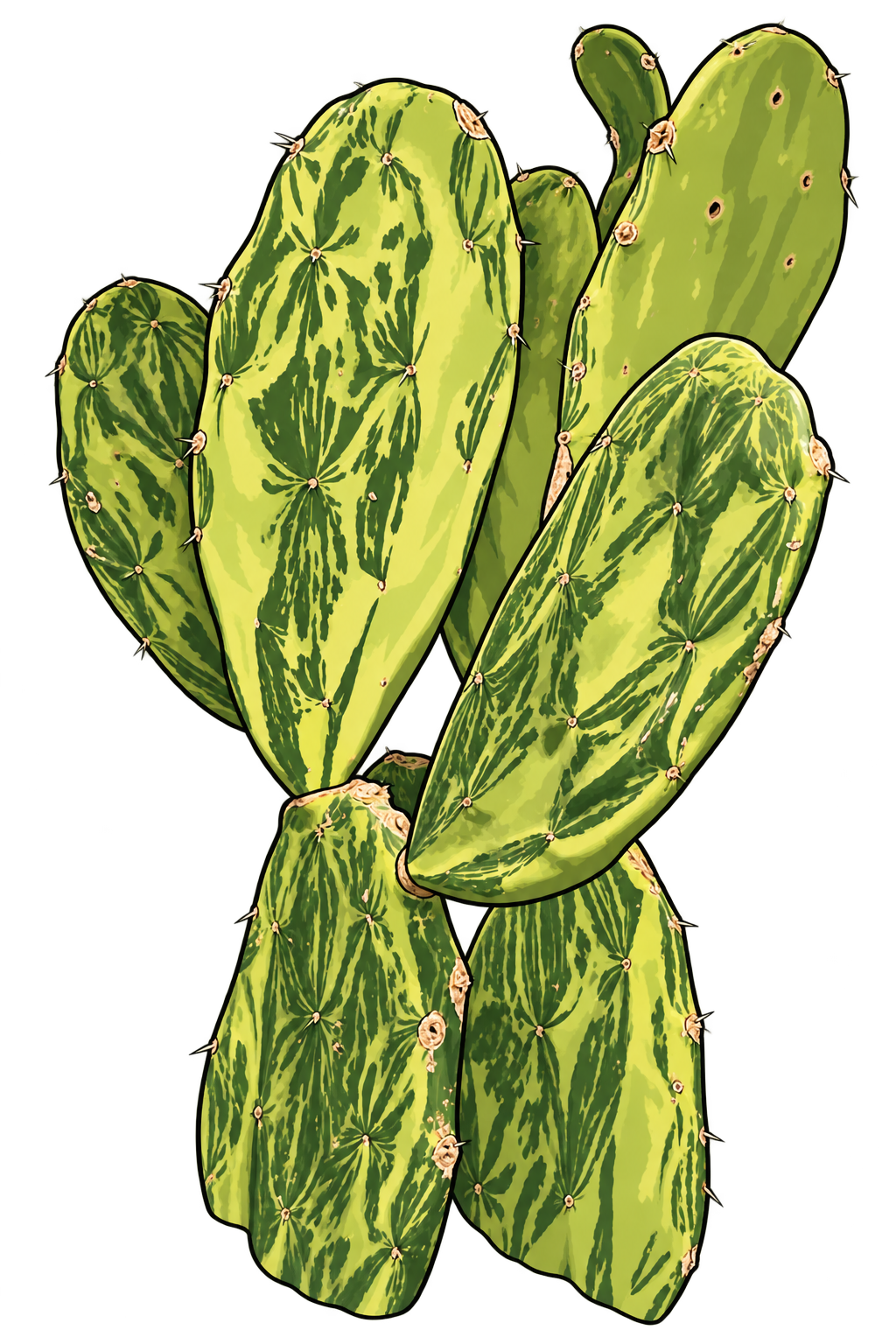
Source photograph · Mila’s Exotic Plants and Curiosities / Luminary Oddities; photographer not separately credited
Reference photograph from the owner’s shop listing; no public open license is stated.
This variegated prickly pear develops branching, flattened stem pads. Each pad is part of the stem system; the small surface cushions are called areoles. [2]
Opuntia belongs to Cactaceae. Even a smooth-looking pad should be handled as a cactus: small bristles can be much less obvious than long spines. [1]
Use bright light and introduce direct sun in stages. The green species grows in sun, while a gradual transition helps protect unfamiliar nursery-grown tissue. [2]
If a newly exposed surface develops pale, dry patches, reduce the sudden intensity. Judge healthy growth and firmness rather than trying to intensify color through stress. [19]
Waterlogged roots may lose function. [4]
Appearance alone cannot determine watering need. [15]
Keep the plant in the brightest practical winter position and reduce watering with slower growth. Reacclimate gradually before any summer move outside. [8]
Fine barbed bristles can injure skin even when long spines are absent. Do not stroke, brush or handle pads bare-handed. [1]
Keep detached pieces beyond children’s and animals’ reach. Treat this as an ornamental plant rather than food. [16]
Human poisoning (U.S.): 1-800-222-1222. Medical emergencies: 911. [17]
Pet poisoning: veterinarian; ASPCA 888-426-4435 (consultation fee). [18]
This plant builds broad paddle-shaped branches. Gumby uses cylindrical stems; Mini Cinnamon carries conspicuous bristle clusters. A lack of long spines does not make a prickly pear safe to touch. [1]
References checked October 5, 2026. Botanical identity, cultivation and handling guidance are linked to the sources below; general growing advice is adapted to container conditions.
Royal Horticultural Society
Accessed October 5, 2026
National Parks Board, Singapore
Accessed October 5, 2026 · Updated: 2022-02-23
Royal Horticultural Society
Accessed October 5, 2026
Clemson Cooperative Extension
Accessed October 5, 2026
Royal Horticultural Society
Accessed October 5, 2026
Gradual exposure changes reduce scorch risk. [19]
Scale can cause honeydew and declining vigor. [20]
Iowa State University Extension
Accessed October 5, 2026
University of Minnesota Extension
Accessed October 5, 2026 · Updated: Reviewed 2026
West Virginia University Extension
Accessed October 5, 2026
Colorado State University Extension / PlantTalk
Accessed October 5, 2026
Colorado State University Extension / PlantTalk
Accessed October 5, 2026
UC Master Gardeners of Tulare and Kings County
Accessed October 5, 2026 · Publisher date: 2026-06-27
Montana State University Extension
Accessed October 5, 2026 · Publisher date: April 2022
University of Illinois Extension
Accessed October 5, 2026 · Publisher date: 2024-01-08
University of Illinois Extension
Accessed October 5, 2026
Royal Horticultural Society
Accessed October 5, 2026
National Capital Poison Center
Accessed October 5, 2026
National Capital Poison Center
Accessed October 5, 2026
ASPCA Poison Control
Accessed October 5, 2026
University of Maryland Extension
Accessed October 5, 2026 · Updated: 2023-03-13
University of Maryland Extension
Accessed October 5, 2026 · Updated: 2024-10-17