The Cinnamon Areole
Mini Cinnamon Cactus
Opuntia rufida ‘Minima Monstrose’
Loading this page…
Return homePlease wait while the next page arrives.


The Cinnamon Areole
Opuntia rufida ‘Minima Monstrose’
A small sculptural prickly pear with cinnamon-colored bristle clusters. Give Mini Cinnamon strong light, a complete drying cycle and careful hands-off handling.
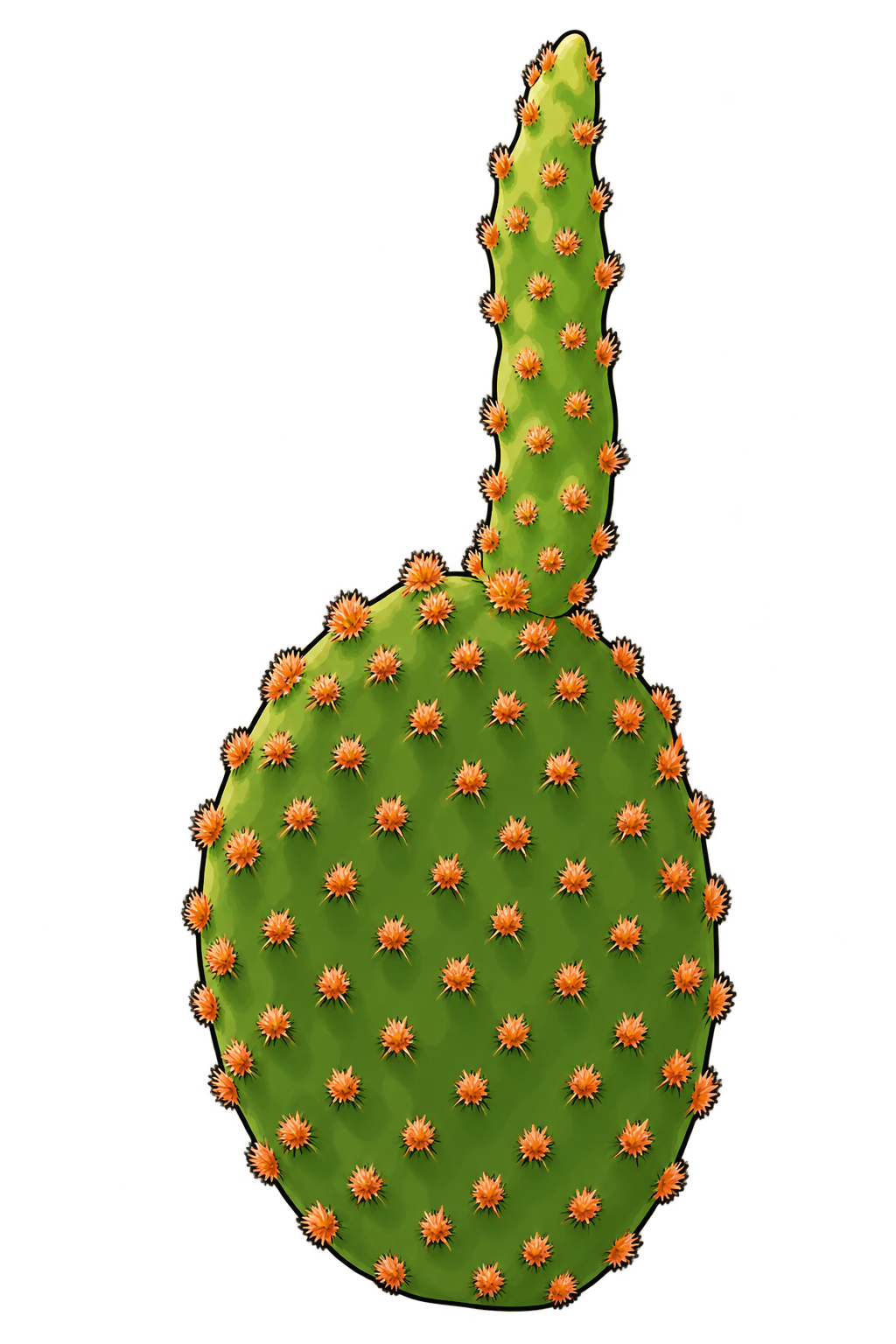
Source photograph · Mila’s Exotic Plants and Curiosities / Luminary Oddities; photographer not separately credited
Reference photograph from the owner’s shop listing; no public open license is stated.
For an established rooted plant, let the mix dry throughout before watering again. Check deeper than the surface using a clean wooden probe away from the pads. [5]
Then soak the root ball and let it drain completely. Repeated small splashes can leave the lower roots dry while keeping the surface damp. [6]
Waterlogged roots may lose function. [18]
Appearance alone cannot determine watering need. [14]
Keep light strong as growth slows and extend drying intervals. Check for severe shriveling rather than withholding water for a fixed number of months. [8]
Fine barbed bristles can injure skin even when long spines are absent. Do not stroke, brush or handle pads bare-handed. [2]
Keep detached pieces beyond children’s and animals’ reach. Treat this as an ornamental plant rather than food. [15]
Human poisoning (U.S.): 1-800-222-1222. Medical emergencies: 911. [16]
Pet poisoning: veterinarian; ASPCA 888-426-4435 (consultation fee). [17]
References checked October 5, 2026. Botanical identity, cultivation and handling guidance are linked to the sources below; general growing advice is adapted to container conditions.
Royal Horticultural Society
Accessed October 5, 2026
National Park Service — Big Bend National Park
Accessed October 5, 2026 · Updated: 2025-07-18
Royal Horticultural Society
Accessed October 5, 2026
Royal Horticultural Society
Accessed October 5, 2026
Iowa State University Extension
Accessed October 5, 2026
Low light can elongate growth. [19]
Mealybugs produce wax and feed on sap. [20]
University of Minnesota Extension
Accessed October 5, 2026 · Updated: Reviewed 2026
Colorado State University Extension / PlantTalk
Accessed October 5, 2026
Colorado State University Extension / PlantTalk
Accessed October 5, 2026
UC Master Gardeners of Tulare and Kings County
Accessed October 5, 2026 · Publisher date: 2026-06-27
Montana State University Extension
Accessed October 5, 2026 · Publisher date: April 2022
University of New Hampshire Extension
Accessed October 5, 2026 · Publisher date: 2019-01-17
University of Illinois Extension
Accessed October 5, 2026 · Publisher date: 2015-06-04
Virginia Cooperative Extension
Accessed October 5, 2026 · Publisher date: August 2018
Royal Horticultural Society
Accessed October 5, 2026
National Capital Poison Center
Accessed October 5, 2026
National Capital Poison Center
Accessed October 5, 2026
ASPCA Poison Control
Accessed October 5, 2026
University of Maryland Extension
Accessed October 5, 2026 · Updated: 2023-03-13
University of Maryland Extension
Accessed October 5, 2026 · Updated: 2023-03-13
University of Maryland Extension
Accessed October 5, 2026 · Updated: 2024-10-17