

The Triangular Spire
African Milk Tree
Euphorbia trigona
Loading this page…
Return homePlease wait while the next page arrives.
Upright angular branches and short-lived leaves give African Milk Tree its tall architectural form. Use bright light, free drainage and deliberate protection from its irritating milky sap.
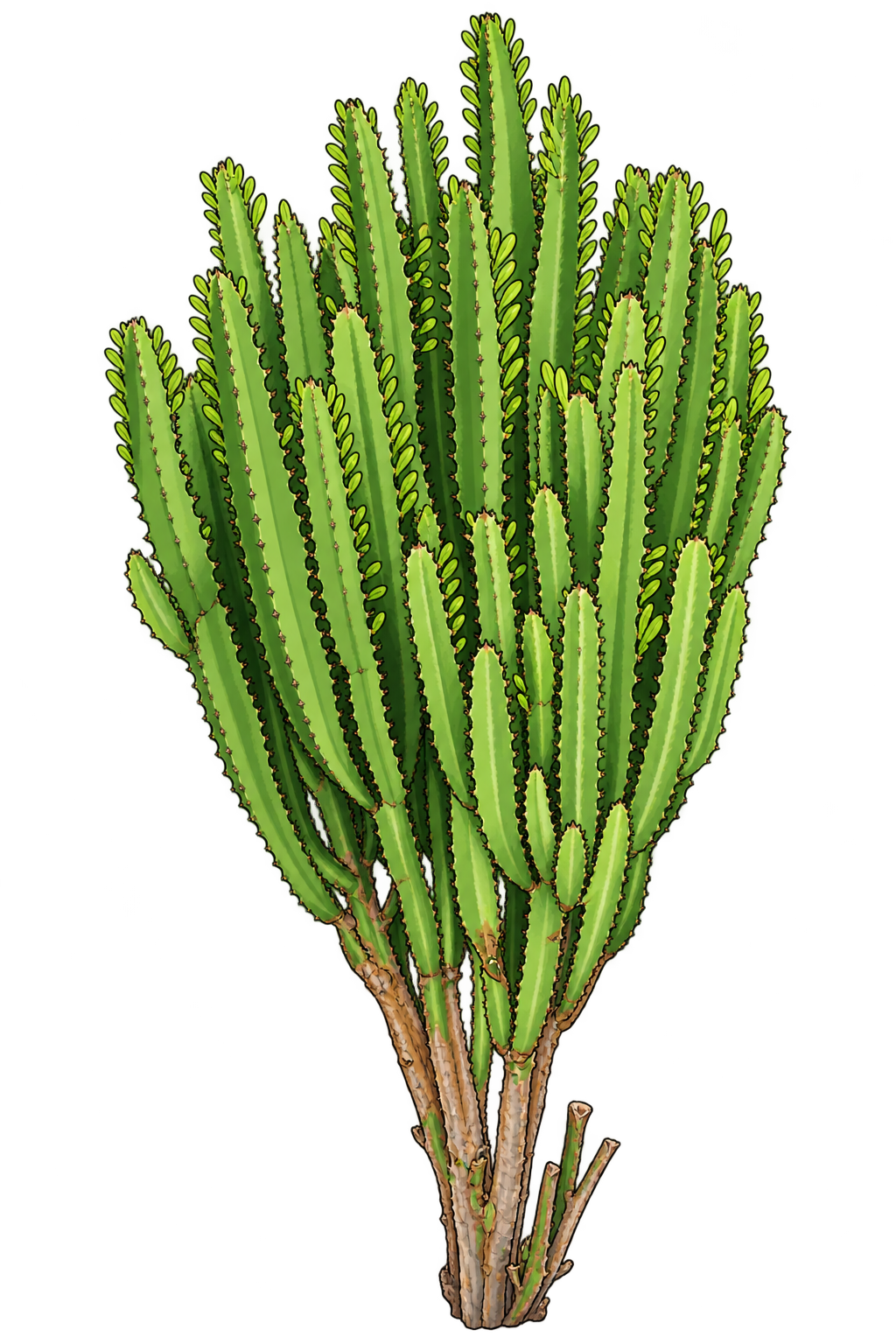
Source photograph · David E Mead
Reference photograph African_milk_tree_(Euphorbia_trigona)_habit.jpg: CC0 1.0 (https://creativecommons.org/publicdomain/zero/1.0/). Adaptation: plant isolated and graphically stylized.
African Milk Tree is Euphorbia trigona, a succulent member of the spurge family. Its upright angular stems carry small leaves and paired spines along their edges. [1]
The leaves are short-lived; firm green stems remain the main framework. A few lost leaves do not, by themselves, mean that the whole plant is dying. [2]
Waterlogged roots may lose function. [8]
Appearance alone cannot determine watering need. [12]
Gradual exposure changes reduce scorch risk.
Retain a bright position through winter, with reduced watering as growth slows. Keep the pot away from cold drafts and avoid a wet root ball during rest. [4]
The milky sap can injure skin and eyes and is harmful if swallowed. Keep the plant, cuttings and debris away from children and pets. [2]
For sap on skin, wash with soap and water. For eyes, rinse with running water for 15–20 minutes and get poison-service advice promptly. [5]
Human poisoning (U.S.): 1-800-222-1222. Medical emergencies: 911. [13]
Pet poisoning: veterinarian; ASPCA 888-426-4435 (consultation fee). [14]
African Milk Tree resembles a cactus but is a Euphorbia. True cacti have areoles; succulent euphorbias have a different stem structure and irritating milky latex. [4]
References checked October 5, 2026. Botanical identity, cultivation and handling guidance are linked to the sources below; general growing advice is adapted to container conditions.
NC State Extension
Accessed October 5, 2026
Royal Horticultural Society
Accessed October 5, 2026
National Parks Board, Singapore
Accessed October 5, 2026 · Updated: 2026-09-17
Royal Horticultural Society
Accessed October 5, 2026
National Capital Poison Center
Accessed October 5, 2026
Mites can cause fine mottling and webbing. [16]
Iowa State University Extension
Accessed October 5, 2026
Iowa State University Extension
Accessed October 5, 2026
Iowa State University Extension
Accessed October 5, 2026
UC Master Gardeners of Tulare and Kings County
Accessed October 5, 2026 · Publisher date: 2026-06-27
University of Illinois Extension
Accessed October 5, 2026
Virginia Cooperative Extension
Accessed October 5, 2026 · Publisher date: August 2018
Royal Horticultural Society
Accessed October 5, 2026
National Capital Poison Center
Accessed October 5, 2026
ASPCA Poison Control
Accessed October 5, 2026
University of Maryland Extension
Accessed October 5, 2026 · Updated: 2023-03-13
Royal Horticultural Society
Accessed October 5, 2026
Penn State Extension
Accessed October 5, 2026 · Updated: 2026-02-23
University of Georgia Cooperative Extension — Lincoln County
Accessed October 5, 2026 · Publisher date: 2022-08-31
