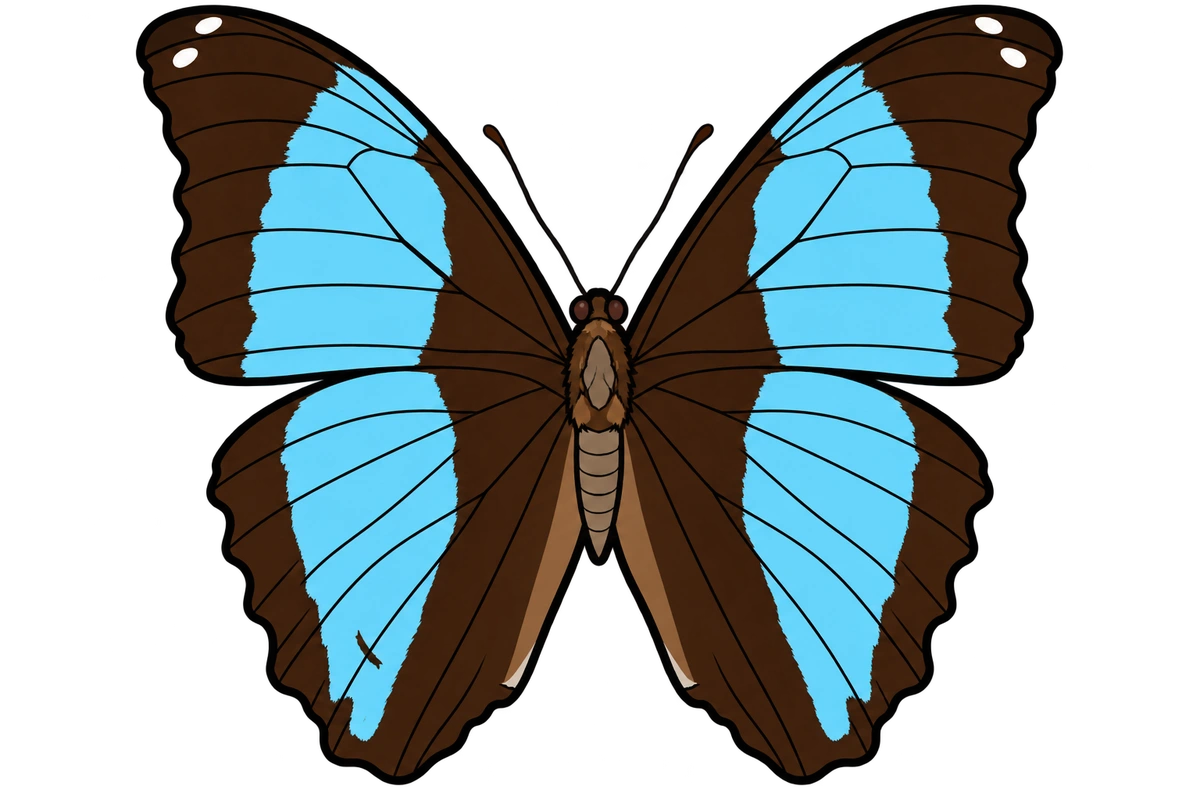
Morpho deidamia has blue-banded upper wings and a complex brown underside. Amazonian research compares it with similarly patterned Morpho species through field experiments and genomic analyses.
Morpho deidamia belongs to Nymphalidae. The broad Butterflies of America treatment includes Central American forms such as polybaptus and South American populations. English names include deidamia morpho and scarce morpho. [1][2]
02
Dorsal band and ventral pattern
The upper wings carry a blue band against dark fields. The brown reverse has a complex arrangement of bands and eyespots; the Amazonian field guide illustrates regional variation in the underside pattern. [1][2]
03
Forest-understorey distribution
The Amazonian account places the species in forest understory and lists records from Nicaragua and Costa Rica south through Panama, Colombia, Ecuador, Peru, Bolivia, Brazil, Suriname and Venezuela. [2]
04
Larval plants and fermented fruit
Compiled host records include Inga laurina, Zygia latifolia, Machaerium seemannii and Iriartea deltoidea. Adults of both sexes visit fermented or rotten fruit, and the field guide records captures in fruit-baited traps. [2]
05
Daily activity at an Amazonian site
At a Peruvian Amazon study site, the daily activity period of Morpho deidamia overlapped with that of M. achilles. M. helenor was active at a different period, reducing temporal overlap with the other species. [3]
06
Similar patterns and reproductive interference
Moving-model experiments elicited interspecific territorial and courtship responses among similarly patterned Morpho butterflies at a Peruvian Amazon site. Genomic analyses supported genetic isolation among the species involved. [3]
07
Comparative genomes and chromosome structure
Comparative genome assemblies revealed Z-chromosome rearrangements among Morpho deidamia, M. achilles and M. helenor. The authors proposed that these rearrangements could contribute to reproductive isolation between the sympatric species. [4]
08
Regional names and museum history
The catalogue retains nominate deidamia and regional polybaptus and granadensis treatments. The museum guide also records Leonte deidamia as a historical combination. Museums Victoria specimen LEP 59155 documents Tingo Maria, Peru, on 20 May 1971 in the David Holmes collection, with Jose Schunke recorded as collector. [1][2][5]
09
Comparing dorsal and ventral pattern
The blue dorsal band contrasts with the brown ventral bands and eyespots. The field guide documents variation in the ventral pattern among regional forms. [2]
10
Blue bands within the composition
The illustration preserves the blue band within the dark upper-wing fields and the separate brown ventral pattern. Bold contours define the complete wing silhouette. [1][2]
Morpho deidamia · Ventral view.
11
Preventive specimen care
Keep a physical specimen away from direct sunlight, heat and damp conditions. Avoid touching the scaled wing surfaces and maintain a closed, pest-free enclosure. [6]
12
Fruit feeding and daily activity
What do adults feed on? Both sexes visit fermented or rotten fruit, including fruit baits used in field surveys. [2]
What distinguished the daily activity periods in the Peruvian study? Morpho deidamia overlapped with M. achilles; M. helenor was active at a different period. [3]
13
Taxonomy, field experiments and genomes
The specialist catalogue and Amazonian field guide establish the taxonomic treatment, pattern variation and feeding records. Field experiments and comparative genomes examine interactions among sympatric Morpho species. [1][2][3][4]