

The Dark Willow Etching
Black Willow
Salix nigra
Loading this page…
Return homePlease wait while the next page arrives.
A vigorous native willow with fine green leaves and darkening bark. Begin with rooting care, then plan for its thirst, spreading roots and outdoor dormancy.
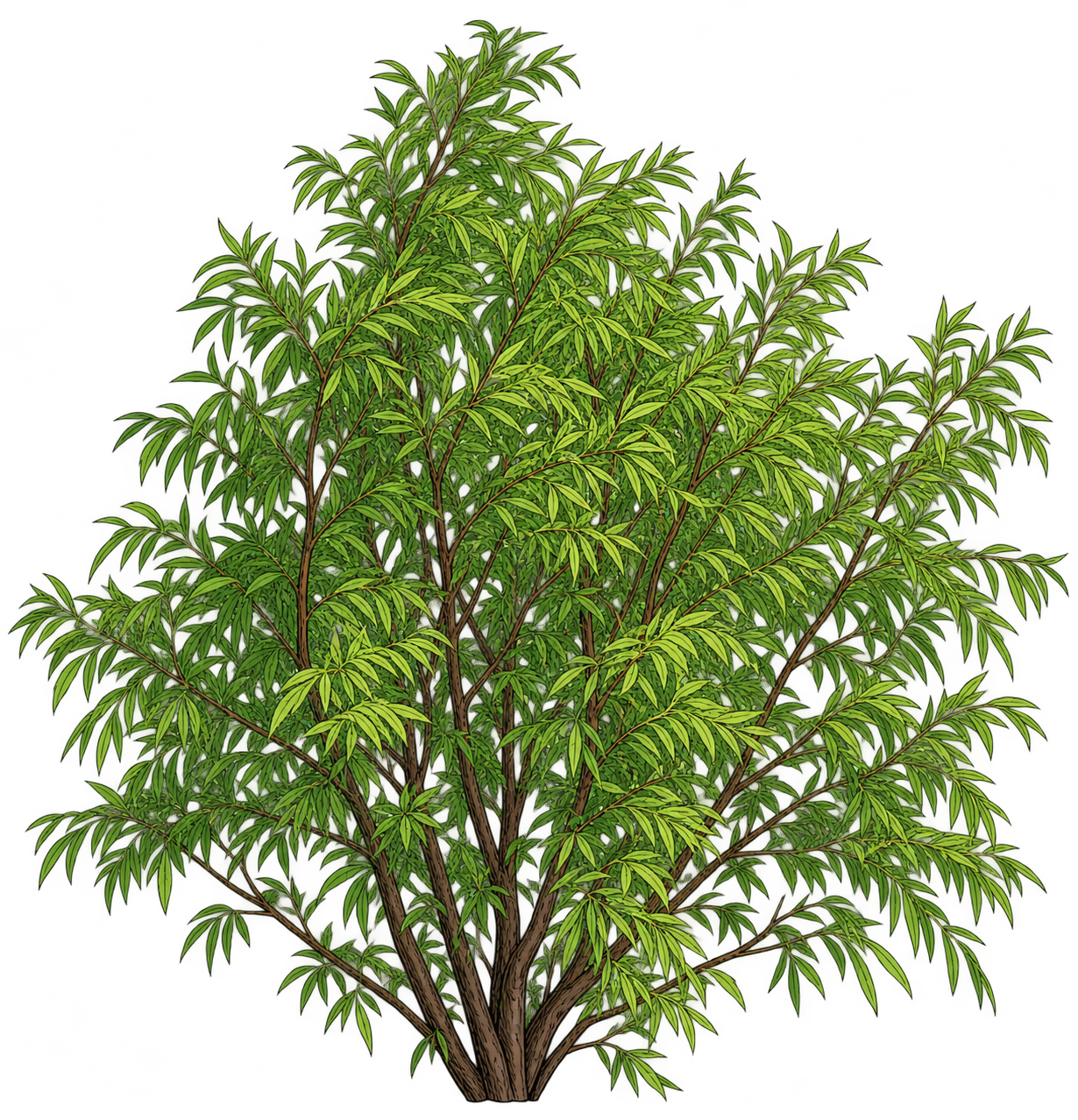
Source photograph · Bruce Marlin; Morton Arboretum accession 180-88-3, author reports arborist-vetted identity
Reference photograph Salix_nigra_Morton_180-88-3.jpg: CC BY-SA 2.5 (https://creativecommons.org/licenses/by-sa/2.5/). Adaptation: plant isolated and graphically stylized. Attribution retained; ShareAlike requires adapted material to use the same license.
Black willow is a deciduous North American tree in the Salicaceae family. Narrow leaves and dark, fissured mature bark accompany a broad crown. Its mature size and spreading root system call for generous landscape space. [1]
Established black willow prefers full sun and tolerates some partial shade. Avoid a deeply shaded corner, and choose its permanent site for water access as well as light. [1]
Protect leafy cuttings from direct sun and drying wind while they root; gradually remove their humidity cover after roots develop. [5]
Black willow needs consistently moist to wet soil. Check a small rooted pot frequently in hot weather and water before the root ball dries; established landscape trees also need a suitably moist site. [1]
Feel below the surface and water slowly across the mix. Brief rain may miss sheltered pots; stop once water reaches the drainage holes. [6]
Use a draining pot that fits the roots and a moisture-retentive, loam-based container mix. Choose a stable base; progressively enlarge the pot as roots fill it. [2]
Keep this deciduous tree outdoors through its growing season. For overwintering, protect the pot: roots above ground face more severe cold than roots insulated by garden soil. [7]
Do not fertilize an unrooted cutting or use feed to treat wilt. Newly planted landscape trees usually need careful watering rather than fertilizer; use a soil test before correcting a suspected deficiency. [8]
For established container growth, follow a complete container-feed label and account for fertilizer already in fresh mix. Pause routine feeding during dormancy. [9]
For dormant live stakes, use healthy wood with several buds and preserve its original top-to-bottom orientation. Keep cut material cool and moist, then insert its basal end into a suitable moist rooting site. Never reverse a stem simply because one end is angled: cutting conventions differ. [11]
Keep dormant cuttings from drying during establishment. Allow a root system to develop before lifting and potting on; early leaves alone are not a reason to disturb the stem. [12]
For fresh leafy tips, remove lower leaves and place the stem base in moist cutting mix. Maintain humid air with a ventilated cover; remove decaying material promptly. [5]
Begin with dead, damaged or rubbing twigs. Use sharp tools, preserve the branch collar and shape gradually. Large limbs and work overhead belong with a qualified arborist. [13]
Prune black willow in late winter to early spring. Plan for mature canopy size; repeated severe reduction is not a substitute. [1]
Wilt with dry mix: rewet the root ball and reduce drying wind while it recovers. Wilt with sodden mix: check blocked drainage and compacted medium before adding more water. [9]
Sticky growth or distorted young leaves: inspect stems for aphids. Rust-colored spots or galls need closer identification; photograph affected and healthy leaves before seeking local extension advice. [14]
Increase moisture checks as spring foliage expands, and inspect containers frequently during summer heat. In autumn, let leaves fall naturally as the tree rests. [14][6]
After dormancy, heel the pot into suitable garden soil or use a protected cold space suited to your climate. Check thawed mix for dryness; avoid moving it into a warm living room. [7]
Other willows also bear the name black willow. Compare botanical names before choosing a landscape site. [1]
NC State Extension
Accessed October 5, 2026
Royal Horticultural Society
Accessed October 5, 2026
Children’s Hospital of Philadelphia
Accessed October 5, 2026 · Publisher date: 2019-07-08
Pet Poison Helpline
Accessed October 5, 2026
Royal Horticultural Society
Accessed October 5, 2026
Royal Horticultural Society
Accessed October 5, 2026
Iowa State University Extension
Accessed October 5, 2026 · Updated: Reviewed February 2025
University of Maryland Extension
Accessed October 5, 2026 · Updated: 2023-02-17
Royal Horticultural Society
Accessed October 5, 2026
Royal Horticultural Society
Accessed October 5, 2026
Penn State Extension
Accessed October 5, 2026
Royal Horticultural Society
Accessed October 5, 2026
Royal Horticultural Society
Accessed October 5, 2026
NC State Extension
Accessed October 5, 2026
National Capital Poison Center
Accessed October 5, 2026
ASPCA Poison Control
Accessed October 5, 2026
