Luminary Oddities · Natural history & art
Delias ninus
Delias ninus
Lepidoptera / Pieridae
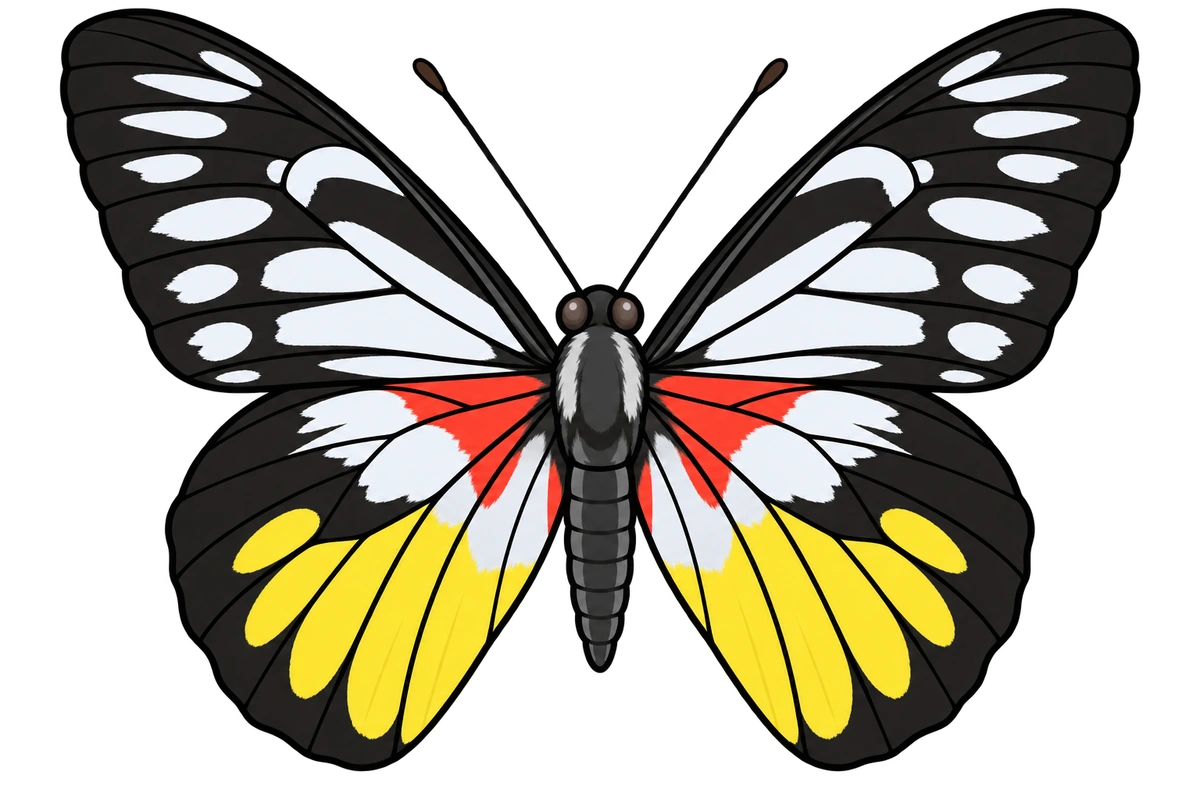
A Southeast Asian jezebel whose male hindwings combine a red basal mark, a bluish-grey band and an ochre-yellow inner corner.
Read the species account
Loading this page…
Return homePlease wait while the next page arrives.


Luminary Oddities · Natural history & art
Delias ninus
Lepidoptera / Pieridae
A Southeast Asian jezebel whose male hindwings combine a red basal mark, a bluish-grey band and an ochre-yellow inner corner.
Read the species accountWallace’s male description records dark forewings with blue basal patches. The upper hindwing has a small red basal mark, a broad bluish-grey transverse band and a large ochre-yellow patch at the inner hind corner, divided by veins. [4]
Below, a red curved band contrasts with clearly defined ochre-yellow markings around the hindwing’s outer region. [4]
Records extend across the Malay Peninsula, northern Borneo and western Sumatra, with additional named populations in West Kalimantan and Tenasserim. A Fraser Hill, Malaysia, record is dated 11 August 2012 at approximately 1,200 metres. [2]
The illustrations retain the forewing apical markings and the boundaries of the hindwing colour fields. These characters are compared within the depicted geographic form.
Keep the enclosure away from direct sunlight, dampness and large changes in temperature or humidity. Handle the frame, clean only its exterior, and inspect for loose fragments, moisture and pests. Retain the specimen’s original labels and follow the enclosure maker’s care instructions. [3]
University of Florida Lepiverse; Catalogue of Life 2026-08-26 XR · Accessed 2026-10-09
Delias of the World; international Delias specialists · Accessed 2026-10-09
Canadian Conservation Institute; Fiona Graham · Accessed 2026-10-09
Alfred Russel Wallace; Transactions of the Entomological Society of London, third series 4: 301–416 (1867); Western Kentucky University transcription · Accessed 2026-10-11
Sources checked 2026-10-11. Illustrations · Luminary Oddities.
Return to the Entomological Atlas ↑