

The Golden Cushion
Tokyo Sun Sedum
Sedum ‘Tokyo Sun’
Loading this page…
Return homePlease wait while the next page arrives.
A low cushion of fine golden foliage. Give Tokyo Sun a bright position, a draining shallow pot and a moisture check beneath the dense mat.
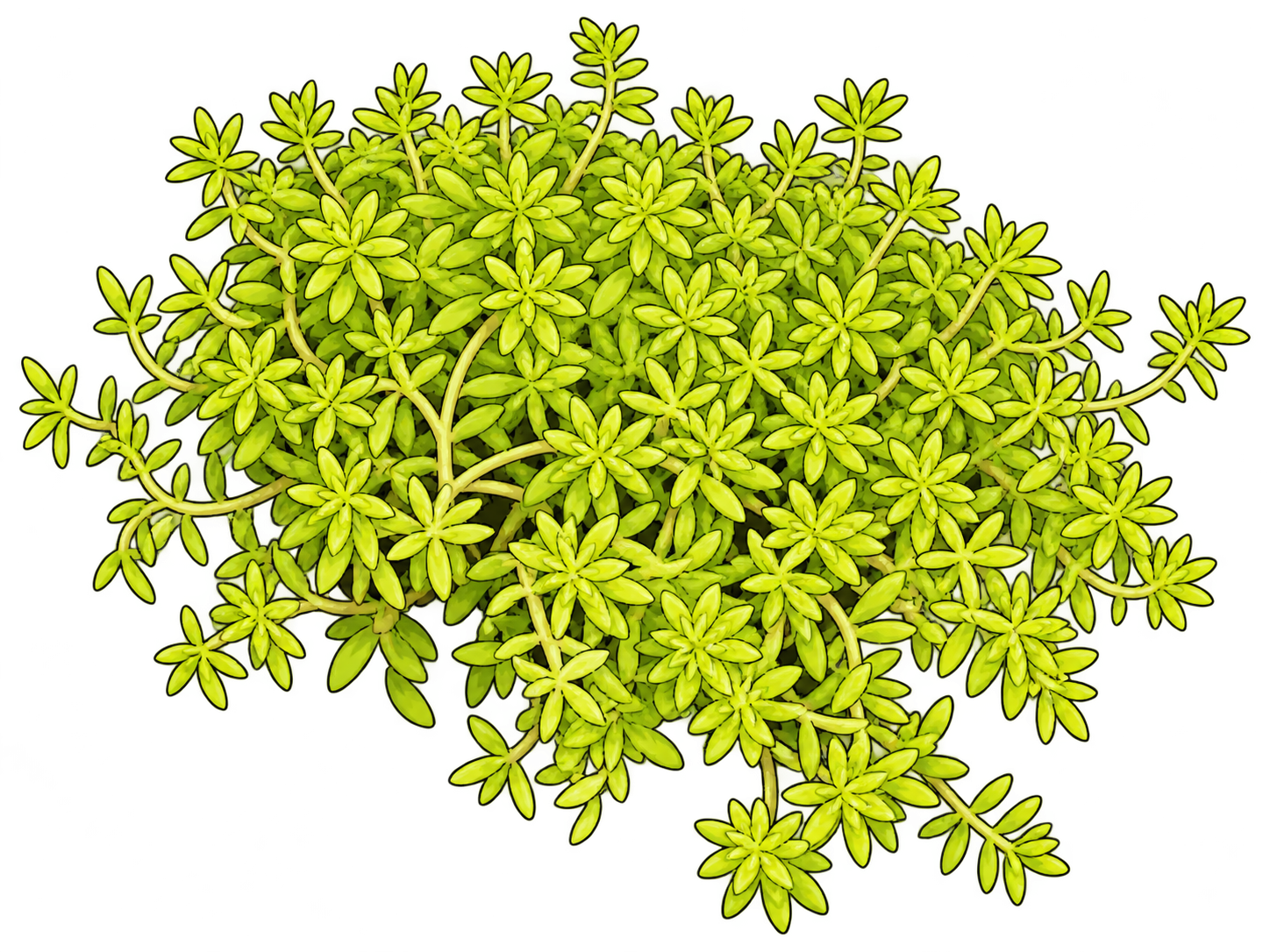
Source photograph · Mila’s Exotic Plants and Curiosities / Luminary Oddities; photographer not separately credited
Reference photograph from the owner’s shop listing; no public open license is stated.
Tokyo Sun is a fine-leaved, spreading Sedum selection. Its close-growing golden foliage creates a low cushion that can soften the rim of a container. [1]
Sedums belong to the stonecrop family, Crassulaceae. Their water-storing leaves and stems call for open drainage beneath that delicate-looking foliage. [2]
Gently part the mat and check the mix beneath it. Let the upper half of a small pot dry, then water through and drain. This follows container-Sedum guidance. [7]
Dense foliage can hide damp compost. Check the root zone itself before repeating a watering; a dry-looking surface alone can be misleading. [9]
Keep container-grown Tokyo Sun in a bright, frost-protected place through cold weather. The original grower did not establish an ultimate cold limit for this selection. [1]
Ordinary indoor air is suitable for this succulent approach. Give the mat breathing space instead of keeping it in a sealed, humid display. [5]
Take a healthy short stem cutting, remove foliage from its lower portion, and let the cut surface dry before inserting the base into airy rooting mix. [4]
Use a small pot, bright indirect light and restrained moisture. Keep the cutting stable while roots develop; do not repeatedly lift it to check. [3]
Waterlogged roots may lose function. [14]
Long drought can damage roots as well as foliage. [16]
Low light can elongate growth.
As days shorten, move the pot toward the best available light and allow longer drying intervals. Resume more frequent checks when new shoots return. [8]
Keep leaves and cuttings out of mouths. Use this plant for display rather than food or household remedies. [10]
Keep plant material away from chewing pets. An ornamental label is not a guarantee of harmless ingestion. [13]
Human poisoning (U.S.): 1-800-222-1222. Medical emergencies: 911. [11]
Pet poisoning: veterinarian; ASPCA 888-426-4435 (consultation fee). [12]
Tokyo Sun forms a tiny, fine-textured mat. Taller border stonecrops make upright flowering stems and need different space and seasonal planning. [2]
References checked October 5, 2026. Botanical identity, cultivation and handling guidance are linked to the sources below; general growing advice is adapted to container conditions.
Nurseries Caroliniana
Accessed October 5, 2026
NC State Extension
Accessed October 5, 2026
Royal Horticultural Society
Accessed October 5, 2026
Iowa State University Extension
Accessed October 5, 2026
University of Minnesota Extension
Accessed October 5, 2026 · Updated: Reviewed 2026
Mealybugs produce wax and feed on sap. [17]
West Virginia University Extension
Accessed October 5, 2026
University of New Hampshire Extension
Accessed October 5, 2026 · Publisher date: 2019-01-17
University of Illinois Extension
Accessed October 5, 2026 · Publisher date: 2024-01-08
University of Illinois Extension
Accessed October 5, 2026
National Capital Poison Center
Accessed October 5, 2026
National Capital Poison Center
Accessed October 5, 2026
ASPCA Poison Control
Accessed October 5, 2026
ASPCA Poison Control
Accessed October 5, 2026
University of Maryland Extension
Accessed October 5, 2026 · Updated: 2023-03-13
University of Maryland Extension
Accessed October 5, 2026 · Updated: 2023-03-13
University of Maryland Extension
Accessed October 5, 2026 · Updated: 2023-03-13
University of Maryland Extension
Accessed October 5, 2026 · Updated: 2024-10-17
Penn State Extension
Accessed October 5, 2026 · Updated: 2026-02-23
University of Georgia Cooperative Extension
Accessed October 5, 2026 · Updated: 2022-07-21
Oklahoma State University Extension
Accessed October 5, 2026 · Publisher date: February 2017