

The Orbital Roundleaf
Chinese Money Plant
Pilea peperomioides
Loading this page…
Return homePlease wait while the next page arrives.
Indoor care for Chinese Money Plant: placement, watering, potting, propagation and practical problem checks.
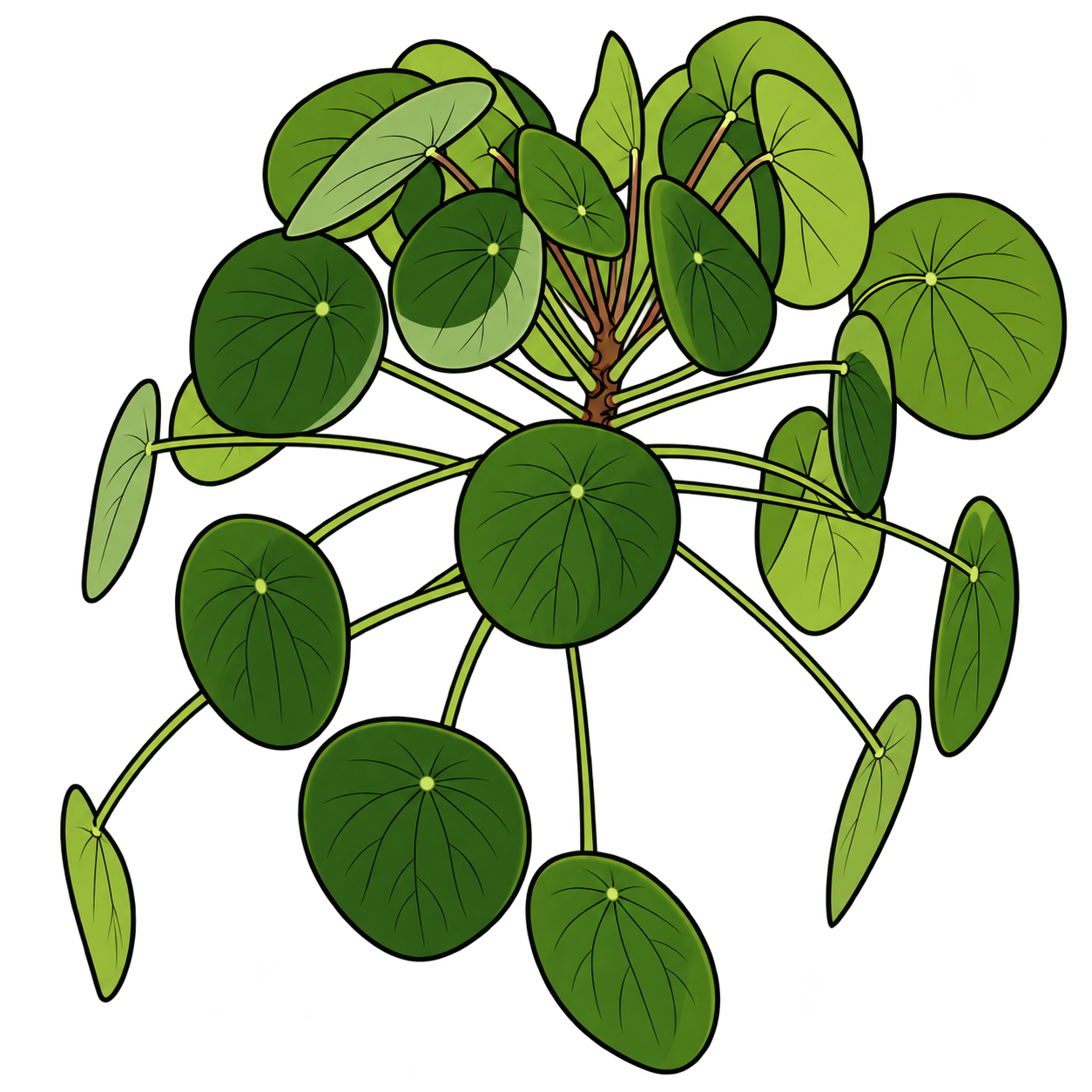
Source photograph · Husky (Hay Kranen)
Reference photograph Pilea_peperomioides_Chinese_money_plant.jpg: CC0 1.0 (https://creativecommons.org/publicdomain/zero/1.0/). Adaptation: plant isolated and graphically stylized.
Chinese Money Plant has nearly round, fleshy leaves held on slender stalks that attach near each leaf’s centre. Pilea peperomioides belongs to the nettle family, Urticaceae. [1]
Choose bright indirect light. Rotate the pot regularly so the disc-leaved crown develops evenly rather than bending toward the window. [4]
Ordinary household humidity is usually suitable. Protect the leaves from heating vents and cold drafts rather than placing the pot beside a radiator to warm it. [1]
Feed during active growth at the product label rate; pause when growth slows. [7]
Choose a developed offset growing beside the mother plant. Check that it has its own roots before separating it. [9]
Ease the plant from its pot. Separate the rooted offset gently, cutting its connection with a clean tool if needed, and pot it individually in fresh moist mix. [9]
Keep the young plant in bright indirect light and monitor moisture while it establishes. [1]
Remove damaged foliage for a tidy outline. If a tall stem becomes bare, it can be shortened during active growth to encourage new growth from the base. [2]
Use these checks before choosing a treatment. [1]
Use these checks before choosing a treatment. [1]
NC State describes Pilea peperomioides as safe for children and pets. Treat it as an ornamental: keep leaves and potting materials out of mouths. [1]
Even non-toxic plants can cause stomach upset in a pet that eats them. [11]
Human poisoning (U.S.): 1-800-222-1222. Medical emergencies: 911. [12]
Pet poisoning: veterinarian; ASPCA 888-426-4435 (consultation fee). [13]
Pilea peperomioides has smooth, round leaves on long central stalks. Pilea cadierei has pointed leaves with silver markings, while Pilea involucrata has a deeply crinkled surface. [2]
NC State Extension
Accessed October 5, 2026
Royal Horticultural Society
Accessed October 5, 2026
National Capital Poison Center
Accessed October 5, 2026
Colorado State University Extension
Accessed October 5, 2026 · Publisher date: February 2023
University of Maryland Extension
Accessed October 5, 2026 · Updated: 2023-03-10
Iowa State University Extension and Outreach
Accessed October 5, 2026 · Updated: Last reviewed October 2023
Use these checks before choosing a treatment. [1]
University of Illinois Extension
Accessed October 5, 2026
University of Illinois Extension
Accessed October 5, 2026
Iowa State University Extension and Outreach - Aaron Steil
Accessed October 5, 2026 · Updated: Last reviewed January 2025
University of Illinois Extension - Chris Enroth
Accessed October 5, 2026 · Publisher date: 2018-05-31
ASPCA Poison Control
Accessed October 5, 2026
National Capital Poison Center
Accessed October 5, 2026
ASPCA Poison Control
Accessed October 5, 2026
